
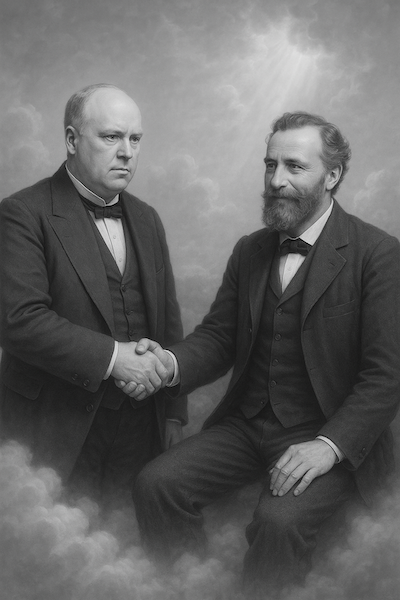
An oft-repeated warning from afterlife communicators is that those who doggedly reject the possibility of life after death sometimes become what we might consider to be ghosts. Not the open-minded atheists and agnostics who withhold judgment, but those who, despite centuries of evidence, use skepticism or dogmatic beliefs to “just say no” and deny any possibility. Similar to Pascal, it’s a kind of Skeptic’s Wager: he’s betting there’s no such thing as ghosts—a curious gamble, given the possibility that yesterday’s skeptics are today’s haunters. As the Alanis Morissette song goes, “Isn’t it ironic?”
If a ghost is defined as the spirit of someone who has died, then we are all potentially ghosts in the making. Yet throughout history, across many cultures, a ghost has meant something more: a soul still entangled with the physical world, drifting through the earth planes, often unaware it has died—a shadowy figure lingering among the living, replaying old memories, sometimes for centuries as we measure time.
In Chinese culture ghosts are called guǐ—a spirit who cannot, or will not, move on. It may be that they have strong earthly attachments, unresolved issues, or are distressed or confused, and rather than joining the honored ancestors, they linger, addicted to their earthly existence. In Japan they are yūrei—spirits still tethered to the physical world; in India it’s preta, the “restless ones”; in ancient Greece it’s eidola.
In Tibetan Buddhism, preta are hungry ghosts—dissatisfied spirits driven by material cravings, suffering because they still cling to worldly desires and identities. How not to be a hungry ghost—be aware of the dreamlike state after death that is the bardo. Recognize the dream; recognize the bardo in order to become liberated from it. That’s the theory.
In A Doorway to the Light, authors Carmen De Sayve, a medium, and Jocelyn Arellano write: “If you believe there is nothing after death, then nothingness is what you will find: a thick mist of sorts that isolates you from both the spiritual and physical worlds. It’s important to open our minds now to the idea of the soul’s survival in order to be better prepared to enter the astral plane.”
One deceased communicator told them:
“I’m surrounded by a cold fog. I don’t understand what’s happening to me. I didn’t know what death was. I thought everything ended with the disintegration of the physical body, so I was afraid of it. At the same time, I didn’t care about what I was leaving behind since I didn’t know what would happen after my death. I was very selfish, always thinking only of myself and my desires. Now, in this loneliness, I’ve had time to think, and I feel so sad when I realize how much harm I caused. I’d been told there would be a punishment, but I don’t see that either. I see only this cold fog.”
During a sitting in Rothesay, Scotland, on April 26, 1912—just two weeks after the Titanic struck an iceberg and sank in the Atlantic Ocean—taking more than fifteen hundred passengers with it—a communicator came through identifying himself as William Stead, (above right) the prominent journalist and peace activist who was on his way to a peace conference in New York at President Taft’s invitation, and went down with the ship. Stead had written and spoken widely on his “knowing” that life continues, and when his time came, he said he was prepared.
He explained to a sitter:
“When I became conscious, I saw her [the ship] … She was surrounded by a bright band of risen spirits, singing the hymn [‘Nearer, My God, to Thee’] and illuminating the surroundings by the radiance of their presence. I saw ministering spirits, glorified spirits, helping the feeble ones whose bodies went down with the vessel or perished in the numbing waters. They were arousing those, brave or terror-stricken, who had faced the reality. Many soon realized the great change had come, but the majority are as blind as bats [my italics]. They cannot help themselves. Pray for them. …”
In No One’s Dead: The Jesus Messages, I discuss James E. Padgett, a U.S. attorney who claimed to have received thousands of messages from hundreds of deceased communicators during the early twentieth century. Padgett’s wife, Helen, died on February 12, 1914, and within months was communicating with him using automatic writing and providing personal evidence that he couldn’t explain by normal means.
In December that year Helen told him that after death she had been met by his mother who assured her that she had nothing to fear. “She was so beautiful that I hardly realized that it was she,” she wrote. She was then joined by Padgett’s grandmother whom she described as so “beautiful and bright that I scarcely could look at her.”
“So you see,” she continued, “I was so very fortunate in having your dear parents and grandmother welcome me when I passed over. If they had not received me I do not know to what condition of fear and distraction I might have been subjected. …”
Helen had been brought up in the Methodist tradition. Her father Rev. George W. Heyde, was a minister for more than fifty-five years. He died on January 20, 1913. Her mother, Olivia Whitehill Heyde, died on June 16, 1905, so by the time Helen passed, her father had been dead for a little over a year, and her mother, nine years. When Padgett asked if she’d met them she replied:
“I first saw my parents, after I commenced to believe that I was in the spirit world; and when I saw them they did not know me, but thought that I was still in the body and that they were still on earth, as they had not yet awakened to the fact that they were in the spirit world. They were very unhappy, and it took considerable talking to make them believe that they were spirits and not mortals.”
We can only speculate as to why Helen’s parents hadn’t understood that they were dead, particularly since her father was a Christian minister and presumably believed in an afterlife. But if after death he had expected to find himself with God in some kind of heavenly setting, he might have believed he was still at home with his wife, who had been in that “dream state” for nine years and, according to Helen, was still wondering why her friends were ignoring her.
A number of messages recorded by Padgett allegedly came from Robert G. Ingersoll, (above left) a prominent US lawyer, politician, orator, and campaigner for agnosticism who died in 1899. Known as “the Great Agnostic,” Ingersoll railed against the church and its rigid dogma. He delivered hundreds of lectures and wrote numerous books and pamphlets. In 1881, in an unpublished lecture titled The Great Infidels, he attacked the Christian doctrine of eternal Hell saying:
“All the meanness, all the revenge, all the selfishness, all the cruelty, all the hatred, all the infamy of which the heart of man is capable, grew, blossomed, and bore fruit in this one word — Hell.”
On August 5, 1915, Ingersoll told Padgett that he was enjoying life in the fourth sphere and was still agnostic with regard to the teachings of Jesus and his existence as a historic figure:
“I did not deny that there would be a future life,” he said. “I merely didn’t know anything about it, and hence, all my teachings were directed to making men live on earth in a way that would bring to them happiness while mortals. And my foundation stone, as it were, was love, one towards another. And with this went love, kindness and forgiveness, and good feeling, and fair dealing. Especially did I emphasize the necessity for love at home. …”
Ingersoll appears to have had a relatively easy time after death. He was no ghost. He went on to say, “I was not compelled to undergo such suffering when I came into the spirit world or to endure much darkness; but I suppose there were some deeds which I had to pay the penalties for, and hence I had to suffer some. But as my love for all mankind was my principle and feeling when on earth, this love gives me a position which I now enjoy.”
Although he had his religious detractors, Ingersoll was by most accounts a well-loved and respected figure—he appears to have been one of the “good guys.” Nevertheless, in the worlds beyond this one, while motive seems very important, we are told that “truth” ultimately trumps “motivation.” In Ingersoll’s case, his widely followed skepticism meant he had to (or felt he had to) undo the untruths he had previously advocated. In a later message to Padgett he said, “I fully realize the meaning of ‘What a man sows that shall he also reap.’ But this is my work, and you must know that it is self-imposed, for I see that until I have removed the evils by me taught and engendered, I cannot be so happy and progress as rapidly as I desire.”
So, how not to be a ghost? Keeping an open mind to the possibility of life beyond death seems to be key. Avoid being “blind as bats”—avoid being convinced of nothingness—avoid dogmatic expectations based on religious imagery. Or as the Buddhist’s say, “Recognize the dream; recognize the bardo.”
Jonathan Beecher is the author of No One’s Dead: The Jesus Messages, published by White Crow Books. This article can also be found on Substack.

Emanuel Swedenborg, the brilliant 18th Century scientist who learned to leave his body and explore the afterlife realms, may have been the first to mention the “earthbound” phenomenon. He said that he had met newly departed souls in something of a stupor, unaware they were “dead.” This seemed especially true of people who had “denied the Divine” when alive in the flesh. When they finally came to realize that they had left the physical body behind and were existing in a different state, they were, he said, “acutely embarrassed.”
Jon,
I search databases for obscure mediums giving insights in to the afterlife. This is from Library of Congress in a book called Letters from Spirit by Carlyle Petersilea. He was “a most remarkable medium, and his writings have always met with the cordial approval of Spiritualists generally.
There is a peculiar fascination in all his works, that interests and instructs, and
leads one to a higher plane of thought”. These “Letters From the Spirit World” include a figure you mentioned.
“My dear Carlyle, Robert G. Ingersoll, when in the body, wanted proof of a future life. So did I. His thoughts and mine were very much alike, as you are well aware, and now that he is here in the celestial life with me, we are very much attracted to each other. ‘There is a great correspondence between his life line and my own, although I preceded him to this life some twenty years or more.
As I have already said, my surprise was very great on finding that I still lived after the death of the body. I had not heard as much of Spiritualism at the time of my departure as had Robert. I think if I had I should have given it much thought; but it is positive evidence that the earthly world now needs more than anything else. The great universal cry is “Proof! Give us proof;” and the proof will soon be forthcoming. Every member of every church in your land wants proof.”
page 18 https://tile.loc.gov/storage-services/public/gdcmassbookdig/lettersfromspiri00pete/lettersfromspiri00pete.pdf
I know that we all should arrive in a better shape (Belief in the afterlife) as ghosts seem to not understand how to progress.
Thanks
Bruce
Bruce,
Thanks for sharing. One might try and argue that the “evils” Ingersoll mentioned to Padgett were just due to ignorance, but as “old Bob” says in the Carlyle communication, after death, all memories are with us and ignorance/incorrect belief has consequences:
“Now, my friend Robert, who stands by my side waiting his turn, laughs long and heartily as he says: “Let me speak a word here, if you please. I have not forgotten that I was called by many, Bob; or old Bob Ingersoll, the Infidel. … ”
“Yes,” says Robert, “you will find a hell here, sure as fate. I was mistaken about that hell.
‘The fires of some of these hells are pretty hot I can tell you. I have my hand on the head of a poor wretch this moment, who has crawled to me for relief from his burning, for a drop of water—cannot quench his thirst or cool his parched tongue. ‘This spirit, here crouched beneath my hand, was a libertine and a drunkard, and he is burning—burning within the flames of his desires that water cannot cool, and to indulge them is but to feed the flames into raging fury.
“Poor wretch! His hell is so hot he has crawled to me for relief.
“‘Bob,’ he says, ‘you told us there was no hell and so I said to myself, ‘There is no hell. I can do as I like. Death ends it all, and I shall soon be dead. Life has nothing for me, and I don’t want to live. So I poured the liquor down and debauched myself as much as possible, and here I am Robert, and I swear you are somewhat to blame for my condition.’
“My friends, if weeping tears of blood could do me any good, I would try to shed them. Not only do I remember all, but this man remembers as well and now reproaches me. Am I guilty or not guilty? Answer me, my soul, and my soul replies: “Robert, thou art guilty! Behold the consequences of error—in other words—ignorance.”
Mike & Bruce,
Thinking about Ingersoll and Swedenborg, I’m reminded of a Padgett message attributed to Ingersoll in which he said:
“I have talked with Swedenborg and have learned from him the sources of his wonderful declarations and doctrines as set forth in his works. He is now in full knowledge of the truth, and also of his errors of his own learned disquisitions, as his followers believe and pronounce them to be. …
But I, Ingersoll, who was truly and honestly an agnostic, can and do say that in this spirit world I had less darkness and less erroneous beliefs to get rid of than had Swedenborg; and while he had more of this Divine Love in his soul than had I—for I had none—yet his mind was so warped by his intellectual conceptions of the truth that it was easier for me to find the true way and progress in it towards the Father’s Love and the Celestial heavens than it was for him. This he has told me, and I have listened to him with much interest, and have learned that the way of the narrow and bigoted orthodox believer is a harder road to travel than that of the agnostic who has not in his soul been too much defiled by sin and evil.”
Jon
I read all of these blog entries and comments ardently. Thank you to everyone for all of these writings.
Just a thought- lately I have been contemplating that perhaps we ( in the physical world) are the ultimate “ghosts” in a kind of Bardo and so asleep to Reality that we do not even comprehend how spiritual out existence can and, perhaps, needs to be.
Reading and contemplating this research helps to “wake me up”
Annie,
I agree that we probably are all earthbound spirits to one degree or another, and thus ghostly specters wandering the earth seeking to satisfy from this great accretion of cosmic dust some pieces of it to satisfy body and mind. Perhaps though, the chains and fetters that bind us ghosts to this sphere are necessary to keep us at the plow working the furrow of life.
Annie,
We sometimes hear from “afterlife communicators” that their observations of many of us are that we think this is all there is — in other words, we’re not aware of our true reality. It could even be argued that this unawareness is a definition of a ghost. 🙂
Dear all,
Do all spirits make it to the other side or are some trapped? I get asked this as I am a medium who gets told if a spirit that I know arrives safely. It is not a given that we all transition smoothly. I was prompted by a great question How Long does it take for the soul to cross over? Some spirits never cross over.
This story below is typical of the stories of the spirit saying goodbye. It was from a collection of similar stories in 1907. Departure is noted by relatives but safe arrival is not guaranteed.
A man who was at work in 1906 in his place of business at the hour of ten o’clock in the morning, with the bright sun shining in the room, saw the form of his wife entering at the door. She came directly to him, but said nothing. He supposed that she had come for money with which to do some shopping, and he pulled forth two bills to give to her. But she had gone. ‘Three others in the room saw him take out the money, and noted the look of alarm on his face when he was about to hand it to her. “That was my wife,” he said. They told him that no one had been there. But he ran to the door and called loudly to her. In distress he put “on his hat and coat to go to his home, when a messenger brought the news that his wife had been killed by an automobile as she was about to pass in at the gate to her home. The car had left the road in making a sudden turn at a speed of a steam locomotive, and, dashing on the sidewalk, had crushed out the life of the woman. She had been dead not more than two minutes when the vision entered the husband’s office. This kind of an occurrence is common.
Page 65 Book of the Psychic Society: A Study of the Unseen powers that surround human life. 1907.
This is a problem for those crossing over and for those trying to improve the figures arriving to the other side. Arriving in a better shape is the key. My after life communicators are always trying to assist with a smooth transition.
Thanks,
Bruce
R. G. Ingersoll came through Cora Richmond on several occasions in Summer camp meetings exactly two years apart. In his first appearance, he describes his death experience with close correspondence to elements frequently found in NDEs. Though not a Spiritualist nor believer in the hereafter, Ingersoll was popular with many Spiritualists and spoke at their gatherings. He said via Cora:
“The Great Agnostic” speaks from the spirit world
I’d like to expand a bit on Annie’s comment that we are “‘ghosts’ in a kind of Bardo and so asleep to Reality that we do not even comprehend how spiritual our existence can and, perhaps, needs to be.”
According to the Online Etymology Dictionary :
Earth-bound spirits are ghosts who don’t know that they have always been ghosts (spirits) and are unaware that they have departed the flesh. We could say that there are two fundamental orders of ghosts; wholesome ghosts and unwholesome ghosts, or to use religious terminology, holy and unholy ghosts. I hesitate to use the religious terms, as they are freighted with misconceptions in many minds. An unwholesome ghost can be healed and made whole again, and by this light an unholy ghost can be redeemed.
Embracing our essential ghost nature, and thus being open to the dimensions of life beyond the plane of spacetime, has the benefit of lightening our burden while in this world in addition to preparing us for the next.
The saying “Keep your eyes on the stars and your feet on the ground” is attributed to Teddy Roosevelt. It is good advice for wholesome ghosts, as to be “whole” involves grappling with the paradox of being a ghost planted on earth and arrayed in a shroud of dust, while also reaching upwards to the starry heavens.