
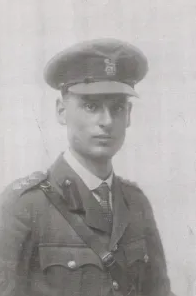
On March 12, 1917, while walking by the sea in Bournemouth, England, Wellesley Tudor-Pole, (above) a major in the British Army with mediumistic abilities, had an unusual thought. In his 1917 book Private Dowding: The Personal Story of a Soldier Killed in Battle, he wrote: ‘I felt the presence of someone. I looked round, no one was in sight. All that day I felt as if someone were following me, trying to reach my thoughts. Suddenly I said to myself, “It is a soldier. He has been killed in battle and wants to communicate.”’
He let the thought pass and forgot about it, but later that evening he visited a woman who had clairvoyant abilities. She told him that a deceased man dressed in military khakis was sitting in a chair staring at him. She said he was ‘mature, wore a small moustache, and seemed somewhat sad’.
Later that evening, back at home, Tudor-Pole sat at his desk, pen in hand, and immediately it moved. ‘Did I move it?’ he wrote. ‘Yes, in an involuntary sort of way. The thoughts were not my own, the language was a little unusual. Ideas were mainly conveyed in short simple phrases. It would really seem as if some intelligence outside myself were speaking through my mind and my pen.’
The communicator identified himself as Thomas Dowding, a name he was unfamiliar with. He said he had been a schoolmaster – a reclusive man who had lived an uneventful life.
‘I cannot remember doing anything really worthwhile,’ he told Tudor-Pole. ‘I never looked outside myself. My school? Well, teaching bored me. I simply did it to earn my bread and cheese. People will say I was unique, a crabby, selfish old bachelor. Selfish yes, but alas! far from being unique. I was thirty-seven when I came over here – that is, my body was. Now I feel so ignorant and humble that I don’t feel I’ve begun to have any age at all. …
‘I am grateful for this opportunity. You may not realise how much some of us long to speak to those we have left behind. It is not easy to get messages through with certainty. They are so often lost in transit or misinterpreted. Sometimes the imagination of the receiver weaves a curious fabric round the thoughts we try to pass down, then the ideas we want to communicate are either lost or disfigured. …
‘I do not find it easy to express myself,’ he wrote. ‘If the ideas are not clear, that is not your fault. You are setting down just what I impress upon you. How do I know this? I cannot see your pen, but I see my ideas as they are caught up and whirled into form within your mind. By ‘form’ perhaps I mean words.’
By 1916, the war in Europe had reached a fever pitch and although Dowding was reportedly not an obvious candidate for soldiering, the boredom of life and ‘war fever’, as he described it, gripped him and he signed up. He didn’t last long. ‘My soldiering lasted just nine months,’ he told Tudor-Pole. ‘Eight of which were spent training in Northumberland. I went out with my battalion to France in July 1916 and we went into the trenches almost at once. I was killed by a shell splinter one evening in August, and I believe that my body was buried the following day. As you see, I hasten over these unimportant events, important to me once, but now of no real consequence. How we overestimate the significance of earthly happenings. One only realises this when freed from earthly ties.’
‘Think of it! One moment I was alive, in the earthly sense, looking over a trench parapet, unalarmed, normal. Five seconds later I was standing outside my body, helping two of my pals to carry my body down the trench labyrinth towards a dressing station. They thought I was senseless but alive. I did not know whether I had jumped out of my body through shell shock, temporarily or for ever. You see what a small thing is death, even the violent death of war!
‘I seemed in a dream. I had dreamt that someone or something had knocked me down. Now I was dreaming that I was outside my body. Soon I should wake up and find myself in the traverse waiting to go on guard … It all happened so simply. Death for me was a simple experience – no horror, no long-drawn suffering, no conflict.’
It appears that Dowding had been in the misty, foggy, dreamlike state others report since his death eight months prior, but the act of communicating with Tudor-Pole seems to have ‘awakened him’.
In the following days he wrote, ‘I am no longer alone – I have met my dear brother. He came out here three years ago and has come down to welcome me. The tie between us is strong. William could not get near me for a long time, he says. The atmosphere was so thick. He hoped to reach me in time to avert the ‘shock’ to which I have referred but found it impossible.
‘I am beginning to meet people and to exchange ideas. Strange that the only person I came across for a long time was my brother. He tells me that I have never been really alone. The mist around me, shutting me off, has emanated from myself, he says. This fact rather humiliates me. I suppose my loneliness of life and character whilst on earth has followed me here. I always lived in books; they were my real world. And even then, my reading was technical rather than general.
‘I begin to see now that my type of mind would find itself isolated, or rather would emanate isolation, when loosed from earthly trammels. I shall remain near earth conditions whilst learning lessons I refused to learn before.’
Tudor-Pole didn’t expect to hear from the soldier again. Aware of how difficult it sometimes is for names to come through during spirit communication, he wondered if he had got the name ‘Thomas Dowding’ right. Neither had he ruled out the possibility that the soldier might have been a figment of his imagination, although, as he wrote in Private Dowding, ‘It is not easy to believe that I have imagined the whole of this experience.’
But Dowding did return and shared his experiences of the borderland: the hells he was taken to by his brother, who was on a rescue mission, the ‘angel of light’ who protected them, and the purgatorial state in which he found himself.
‘The darkness of the deep forests appals,’ he told Tudor-Pole. ‘The loneliness is intense. At last, light is seen ahead. It is not the light of heaven; it is the lure of hell. These poor souls hasten onwards, though not towards destruction; there is no such thing. They hasten down into conditions that are the counterpart of their own interior condition. The Law is at work. This hell is a hell of the illusions and is itself an illusion. I find this hard to credit. Those who enter it are led to believe that the only realities are the sense passions and the beliefs of the human ‘I’. This hell consists in believing the unreal to be real. It consists in the lure of the senses without the possibility of gratifying them. I was told a great deal more about this awful region, but I must not pass it on. The angel said that the ‘condition’ would ultimately dissolve into nothingness. Hell – or, apparently, that part of it we are speaking about – depends for its existence on human thoughts and feelings. The race will never rise to greatness until the passions are controlled. This refers to nations and to individuals. On earth I was never interested in such matters. I did not realise the existence of the sexual canker at the heart of human life. What a terrible thing this is! Do not wait until you come over here. Set to work at once. There is no time to lose. Gain control of self. Then retain control by emptying yourself of self. All the thoughts of lust and passion, greed, hatred, envy, and, above all, selfishness, passing through the minds of men and women, generate the ‘condition’ called hell. Purgatory and hell are different states. We all must needs pass through a purging, purifying process after leaving earth life. I am still in purgatory. Someday I shall rise above it.’
Tudor-Pole may have been uncertain of the true identity of his ‘Private Dowding,’ but the Commonwealth War Graves Commission website lists a Private Thomas Dowding (2nd Battalion, South Wales Borderers) who died on 1 July 1916 and is commemorated on the Thiepval Memorial in France. The date coincides with the opening day of the Battle of the Somme, which resulted in thousands of deaths on the first day and continued to inflict heavy casualties over the following weeks. Because soldiers with no known grave were often assigned the date on which major operations began, the July, 1, 1916 date may not be the actual day he was killed, and his commemoration on a ‘memorial to the missing’ suggests that his body was not recovered — a common occurrence for casualties of that period. Dowding said that he went into battle in July 1916 and thought he had been killed a few weeks later in August. But as he said, ‘I hasten over these unimportant events’.
Private Dowding: The Personal Story of a Soldier Killed in Battle is published by White Crow Books and is now available as an audiobook on Amazon/Audible.
This article is also available on Substack.

Dowding’s experience rings true. His and many other similar descriptions gave me the courage and inspiration to write The Hell Dwellers.
Stafford,
Aside from the content of Dowding’s messages, I found it interesting that Tudor-Pole appeared to have no prior knowledge of him and even considered the possibility that Dowding was a figment of his imagination. In March 1917, the War Graves Commission had not yet been established. Yet we now know that Private Thomas Dowding did exist, and that his death aligns with the timeline provided by Tudor-Pole.
Really interesting. Thanks.
Jon,
Excellent article. When mediums receive messages they often have no background to the person. Their messages are the key. Private Dowding had such a message.
In THE SILENT ROAD W. Tudor Pole page 51.
“My name is of no importance; apparently names over here are not needed. I became a soldier in the autumn of 1915, and left my narrow village life behind. I joined as a private and died as a private. My soldiering lasted just nine months, eight of which were spent training in Northumberland. I went out with my battalion to France in July 1916, and we went into the trenches almost at once. I was killed by a shell splinter one evening in August, and I believe that my body was buried the following day. As you see, I hasten over these unimportant events, important to me once, but now of no real consequence. How we over- estimate the significance of earthly happenings. One only realises this when freed from earthly ties.
Well, my body soon became cannon fodder, and there were few to mourn me. It was not for me to play anything but an insignificant part in this world — tragedy, which is still unfolding.
I am still myself, a person of no importance; but I feel I should like to say a few things before passing along. I feared death, but then that was natural. I was timid, and even feared life and its pitfalls. So I was afraid of being killed and was sure it would mean extinction. There are still many who believe this. It is because extinction has not come to me that I want to speak to you. May I describe my
experiences ? Perhaps they may prove useful to you. How necessary that some of us should speak back across the border ! The barriers must be broken down. This is one of the ways of doing it. Listen therefore to what I have to say.
Physical death is nothing. There really is no cause for fear.”
I could continue the message.
Thanks
Bruce
Jon,
There are other cases which feature the drop in spirit has the later verification of their details. These are usually found in spiritualist literature. I rely on the book “What is this Spiritualism?” By Horace Leaf 1919 page 96 August 1874 Rev Staunton Moses was staying with Dr Stanhope Speer on Isle of Wrightsville England. The drop in was Abraham Florentine. He said he had been concerned in the war of 1812 and that he died at Brooklyn USA on August 5 1874 and was 83 years 1 month and 17 days. The contents of this visit was placed in the Spiritualist magazine Banner of Light December 12 1874. A reply came from the person who checked soldiers claim in State of New York who said that the name was that of a soldier from 1812. The Editor wrote to the Adjutant-General SNY without any background but to obtain details of service. Full details were provided. At the same time a Dr Cromwell on his own visited the address shown for this man. He was met by the widow. Abraham had passed on 5 August 1874 aged 83. His birthday was 8 June.
The drop ins are always fun,
Thanks
Bruce
They are, Bruce, particularly when the identity can be verified later.