
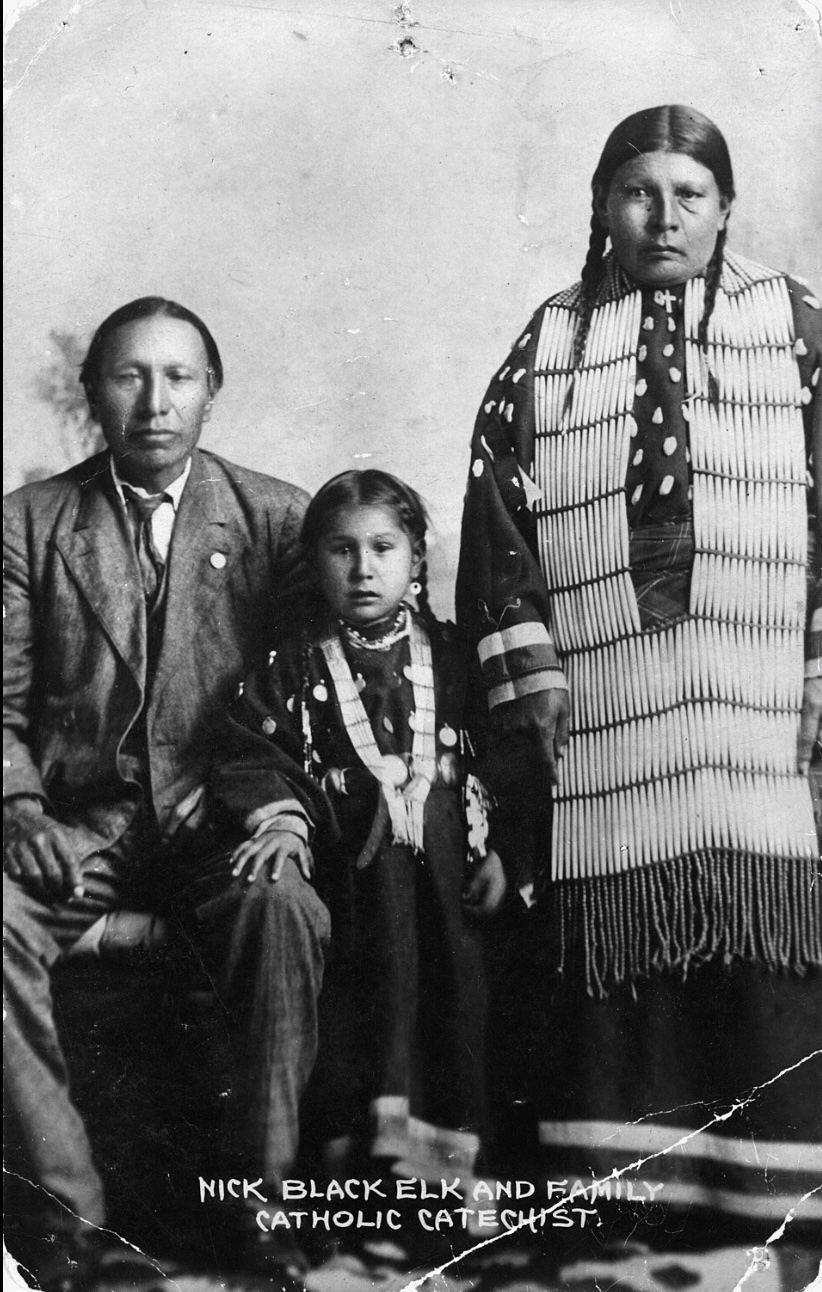
What does the afterlife of an American Indian look like? Is it different from what you and I can expect?
Black Elk (1863-1950) was a shaman and visionary who twice visited the land of his ancestors.
His second trip was induced by an exhausting, ecstatic “ghost dance” ritual in the Lakota homelands of what is today South Dakota. He was 24 at the time and in good health.
Copilot summarizes the vision: “Black Elk is taken by spirit guides (into the spirit world). He travels upward, away from the earth. The world below becomes small and distant. A soft, glowing light surrounds him. This marks the boundary between the living world and the world of spirits.
“He enters a beautiful, green, sunlit land.
The land itself is alive. The grass is tall and shining. Flowers bloom everywhere. The people live in tipis that glow with light. There is no hunger, no fear, no sorrow.
“The air feels alive, gentle, and peaceful. (It is not a land of) punishment. He sees many people who had died, including relatives. They are healthy, joyful, and young again. No one is sick, wounded, or suffering. They greet him with warmth, as if welcoming him home. The dead are not lost; they are alive in a better world.”
Here are Black Elk’s exact words: “I saw a beautiful land where many, many people were camping in a great circle. I could see that they were happy and had plenty. Everywhere there were drying racks full of meat. The air was clear and beautiful with a living light that was everywhere. All around the circle, feeding on the green, green grass, were fat and happy horses; and animals of all kinds were scattered all over the green hills, and singing hunters were returning with their meat.”
Tipis, drying racks full of meat, singing hunters, fat and happy horses—these are details we don’t meet in the descriptions of “Summerland” by people like me, and most of you, who come from a different culture.
Yet much is the same. The living light, happy residents, beauty of nature, and meeting with dead relatives are familiar features found in descriptions we’re more familiar with.
In a later passage Black Elk describes the land of unhappy spirits: “Then I looked down and saw many men and women who were trying to cross the dark and fearful river, but they could not. Weeping, they looked up to me and cried, ‘Help us!’” This is consistent with the findings we are familiar with: Many souls are unprepared to enter the lands of light and harmony and roam the earth as earthbound ghosts—the subject of my recent novel The Hell Dwellers.
What is the importance for us of Black Elk’s visions? They remind us that in the afterworld there are many sectors, a multitude of varying neighborhoods, all influenced by the cultures that shaped us on earth. We naturally gravitate to what we are comfortable with, the climate and scenery we enjoyed, the habits and manners we cultivated, the nonphysical games we played for entertainment (ball sports are impossible since mind controls matter), the religions we practiced or worldviews we clung to, the people who loved us and will welcome us when we come over.
Stafford Betty, Professor of Religious Studies, CSUB, (ret) is the author of When Did You Ever Become Less by Dying?, Heaven and Hell Unveiled and his novels which include,The Afterlife Therapist and Guardians of the Afterworld. His latest book, The Hell Dwellers: A Novel about the Dark Side of the Afterlife is coming in 2026. Stafford can be found at staffordbetty.com.

Hi Stafford. Just finished reading your latest book and loved every chapter. I very much enjoyed how you described the dark astral worlds from very different angles. I strongly recommend it.
Thanks, Hans. I appreciate your support. This was a difficult book to write.
Hi, Stafford… Thanks. I look forward to reading your book. Meanwhile, I’m wondering whether this is the same “Black Elk” as in “Black Elk Speaks.” If I’m not mistaken, according to the Zammits’ source the latter “Black Elk” was a sort of nom de plume for another soul, who chose a Native American identity as a vehicle of expression. Does this sound familiar? Thanks for any insights. Sincerely, Dan Drasin (Wendy Zammit’s Global Gathering co-host)
My apologies: I was confusing Black Elk with Silver Birch. Thanks to Gary Langley for catching this!
– Dan Drasin
My apologies: I was confusing Black Elk with Silver Birch. Thanks to Gary Langley for catching this!
– Dan Drasin
Such an interesting case! Black Elk also had two actual spontaneous NDEs — one when he was just 9 years old. The other was when he was in his 30s, in Paris in 1889. He ascended on a cloud, traveled home to see his family, then awoke in a doctor’s office where he’d been pronounced dead. His mother later corroborated his OBE visit, claiming that she had seen him returning home on a cloud in a dream. Black Elk referred to all his experiences as “visions,” and didn’t seem to place greater value on how they came about. But he did emphasize that they were not dreams, but that they “actually happened.”
Tipis, drying racks full of meat, singing hunters, fat and happy horses—these are details we don’t meet in the descriptions of “Summerland….
Yes, dear Strafford, indeed what you say is true. Thank you.
However, in many entirely credible descriptions of advanced ITC, starting with the Harsch-Fischbach couple and reported by Dr. Theo Locher and Maggy Harsch herself (1989), as well as by Professor Ernst Senkowski (1995, 2000), by Adolf Holmes’ computer texts (Senkowski, 1999) up to my own communications (Cardoso, 2017, 2023), the concurrence is complete.
Although the “meat” carried by the hunters doesn’t fit the ITC descriptions, since no humans eat other animals there, and synthetic materials that mimic meat exist for those who appreciate it, we shouldn’t forget that in Sir Oliver Lodge’s Raymond, the same analogy and example are present. After all, it all comes down to a world of thought, doesn’t it? Just like the one we live in…
Cardoso, A. (2017). Electronic Contact with the Dead, What Do the Voices Tell Us? Hove, UK: White Crow Books.
Cardoso, A. (2023). https://www.academia.edu/111933618/ITC_A_Transpersonal_Connection
Locher T. & Harsch M. (1989, German original). Jenseitskontakte mit Technischen Mitteln Gibt es! Biel: SVPP.
Senkowski, E. (1995, 2000). Instrumentelle Transkommunikation (first ed. 1989), Frankfurt: R. G. Fischer.
Senkowski, E. (1999). Die Transkontakte des Adolf Homes – Ein rückblick. Teil 1: übersicht und transpartner (The transcontacts of Adolf Homes – A review. Part 1: Synopsis and Transpartners). TransKommunikation. Vol. IV, No.1, pp. 12-31.