
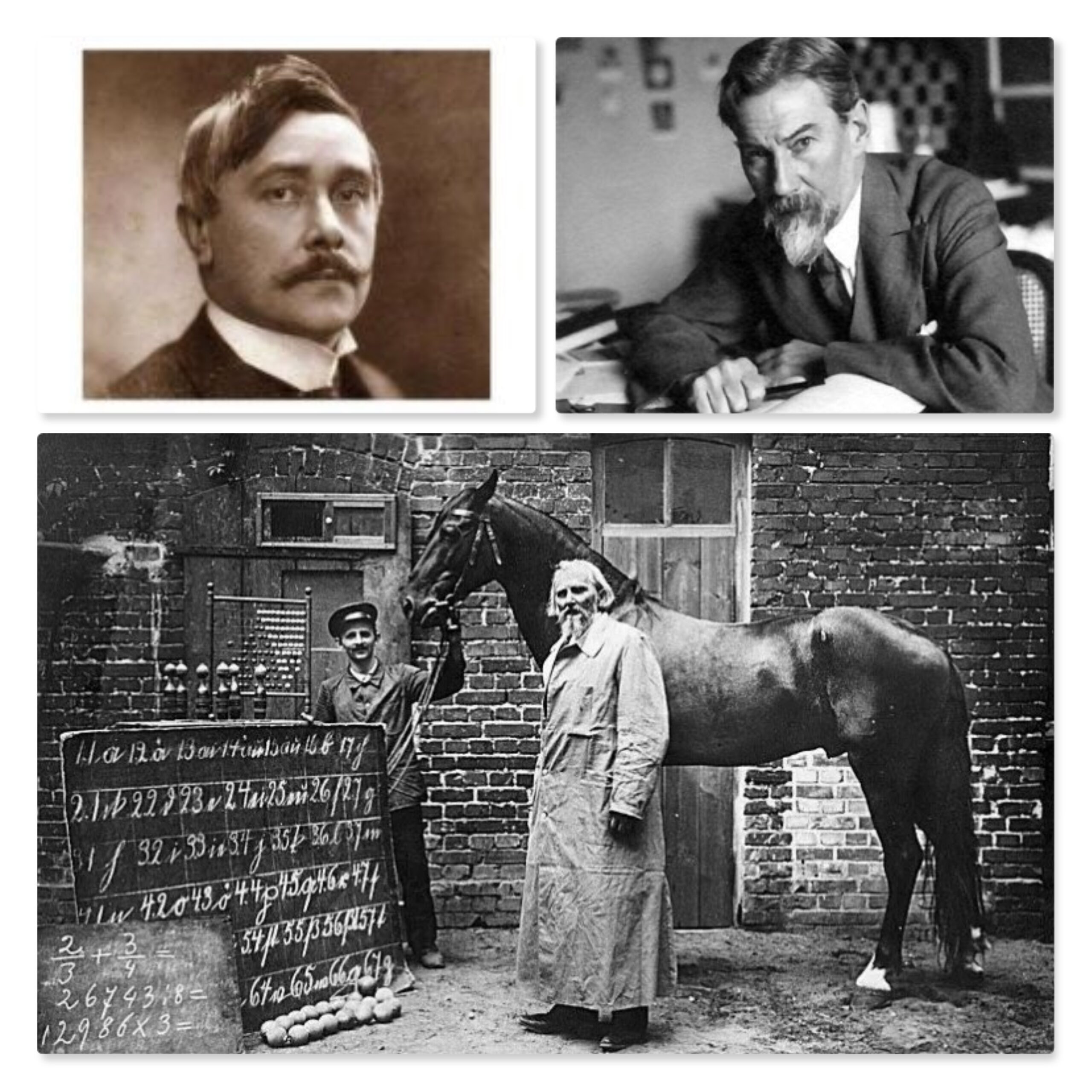
Professor Edouard Claparéde, a distinguished Swiss psychologist of the University of Geneva (top right photo), called the phenomenon “the most sensational event that has happened in the psychological world.” Maurice Maeterlinck, a world-famous Belgian author, playwright, and Nobel prizewinner for literature (top left photo), was astounded. “You rub your eyes, question yourself, ask yourself in the presence of what humanized phenomenon, of what unknown force, of what new creature you stand,” Maeterlinck reacted in his 1914 book, The Unknown Guest, of which the story of the Elberfeld horses is one of several mysteries. “…You look around you for some sort of trace, obvious or subtle, of the mystery. You feel yourself attacked in your innermost citadel, where you held yourself most certain and most impregnable. You have felt a breath from the abyss upon your face. You would not be more astonished if you suddenly heard the voice of the dead.”
Maeterlinck was clearly flabbergasted and continued: “I assure you that the first shock is rather disturbing, however much one expected it. I am quite aware that, when one describes these things, one is taken for a dupe too readily dazzled by the doubtless childish illusion of an ingeniously-contrived scene. But what contrivances, what illusions have we here?”
The story of the Elberfeld horses was summarized in my blog of August 5, 2019, but I was curious as to what AI (Chat GPT) had to say about them. However, before offering AI’s conclusions, I’ll provide another summary here. As the well-documented story goes, in 1900, Wilhelm von Osten of Elberfeld, Germany (then Central Prussia) taught his horse, Hans, a Russian stallion (later called Kluger Hans, or Clever Hans, bottom photo), mathematics, including addition, subtraction, multiplication, and division. Von Osten first made Hans familiar with directions, such as right, left, top, and bottom. Then he would place skittles, or bowling pins, in front of Hans and count. He would then ask Hans to strike as many blows with his hoof as there were skittles in front of him. After a short time, the skittles were replaced by figures on a blackboard. “The results were astonishing,” Dr. Claparède reported. “The horse was capable not only of counting, but also of himself making real calculations, of solving little problems….But Hans could do more than mere sums: he knew how to read; he was a musician, distinguishing between harmonious and dissonant chords. He also had an extraordinary memory; he could tell the date of each day of the current week. Claparède asked Muhamed to give him the fourth power root of 614,656, to which the horse correctly replied 28 after a few seconds.
After word spread of Claparède’s independent investigation, a scientific committee was appointed in 1904. The committee found nothing suspicious but offered no explanation. A second committee was then appointed, including Oskar Pfungst of the Berlin psychological laboratory. Pfungst reported that the horse merely obeyed visual clues, whether conscious or unconscious, given by von Osten. This became known as the “Clever Hans effect,” a term still used by animal trainers today. It was later revealed that of the 24 professors on the committee, only two of them actually observed Hans. The committee also stated that to accept such intelligence in horses would be subversive of the theory of evolution. In effect, it was unscientific and deserved no further investigation.
As a result of the committee’s report, von Osten became something of a laughing-stock in the community. When he died in 1909, he left Hans to Karl Krall, a friend who had taken much interest in the horse in spite of the committee’s report. Krall, a wealthy merchant, also bought two Arabian stallions, Muhamed and Zarif, as well as Hȁnschen, a small Shetland pony, and began to train them in the same manner von Osten had taught Hans. Within two weeks, Muhamed was doing addition and subtraction. He would distinguish tens from units by striking the latter with his right foot and the former with his left foot. By the end of the third week, he was doing multiplication and division and by the time four months had passed he knew how to extract square and cubic roots. Krall then devised a table with letters and numbers and Muhamed was soon spelling and reading.
No Voice
Krall and a Dr. Scholler decided to make an attempt to teach Muhamed to express himself in speech. The horse made several feeble efforts before stopping and striking out the message, translated from the German to read, “I have not a good voice.” They then asked Muhamed what was necessary for him to speak. He replied, again in German, “Open mouth.” They asked him why he didn’t attempt to open his mouth, and the reply came, “Because I can’t.”
Maeterlinck did not conduct his investigation until September 1913. At that time, the horses were seen as a curious novelty, but it was all too much for science to accept beyond the Clever Hans effect reported by the 1904 committee. As science saw it, Krall must have picked up where von Osten left off, giving little clues to the horses. After Maeterlinck was introduced to Muhamed, Krall asked the horse to spell his name. Muhamed began by rapping out an “H.” Krall then reprimanded the horse, but Muhamed continued with a an “E” and an “R” before the two men realized that he was spelling Herr, the German equivalent of Mister. But Muhamed then struggled with the surname, first spelling M-A-Z-R-L-K. When told by Krall that it was incorrect, Muhamed groped a little before rapping M-A-R-Z-L-E-G-K. Krall then repeated Maeterlinck’s last name, and after two more attempts the horse spelled the name with one small error. The two men concluded that it was close enough. Maeterlinck further noted a number of other spelling errors and the fact that the horses had their good days and their bad days, as was the case with human mediums.
Maeterlinck was left alone with the horse as Krall tended to chores. Since the horses performed in the absence of Krall and gave some answers to questions that Maeterlinck himself did not know the answers to, he discounted the Clever Hans effect. Another theory advanced was that of telepathy, as fantastic as the idea of a mind-reading horse seems. To test this theory, Maeterlinck took some large cards with Arabic numerals on them, shuffled them and placed them in front of the horse without looking at them himself. “Without hesitation and unasked, Muhamed rapped out correctly the number formed by the cards,” Maeterlinck wrote. “The experiment succeeded, as often as I cared to try it, with Hänschen, Muhamed, and Zarif alike.” Since Maeterlinck was the only person present and did not know the numbers, there was no mind to be read for the answers.
In one test, Maeterlinck wrote a surd – a number which had no square root – on the blackboard, not realizing that it was a surd. Maeterlinck looked to Muhamed for a square root. The horse lifted his hoof, paused, looked back at Maeterlinck and shook his head. This little test also opposed both the Clever Hans effect and the telepathy theory. One day, Zarif stopped in the middle of a lesson by Krall. The horse was asked why and replied, “Because I am tired.” On another occasion he stopped again and explained, “Pain in my leg.”
By 1913, much phenomena had been observed since the 1904 Pfungst committee supposedly proved that it all resulted from the Clever Hans effect. According to Maerterlinck, that intimidated the greater part of the official German scientific world and no further official investigation was deemed necessary, even though different horses and a different trainer were involved. The fact that experiments were made in the absence of the trainer with answers not known to the experimenters was ignored by mainstream science. Yes, mistakes were made by the horses and there were times when they didn’t respond, but there were more than enough correct responses for the researchers to recognize that it was all beyond the Clever Hans effect, telepathy, coincidence, lucky guesses, or known trickery.
No Scientific or AI Explanation
According to Maeterlinck, learned men of every country, including Dr. Edinger, the eminent Frankfort neurologist, Professors Dr. H. Kraemer and H.E. Ziegler, of Stuttgart; Dr. Paul Sarasin, of Bale; Professor Ostwald, of Berlin, Professor A. Beredka, of the Pasteur Institute; Professor Schoeller and professor Gehrke, the natural philosopher, of Berline, Professor Goldstein of Darmstadt, professor von Buttel-Reepen, of Oldenburg, Professor William Mackenzie of Genoa, Professor R. Assagioli, of Florence; Dr. Hartkopf, of Cologne, Dr. Freudenberg of Brussels; and Dr. Ferrari, of Bologna, all agreed that the 1904 Pfungst committee report did not explain the phenomena they had observed; however, they could not agree as to how to explain them.
Maeterlinck, himself, considered the spiritualistic theory – that spirits of the dead were lifting the hooves of the horses in the same way they supposedly made table legs lift off the floor and spell out messages, but he struggled with the fact that they didn’t admit to being spirits of the dead and wondered why they would play such games. Why wouldn’t spirits admit to being spirits? Even if playful spirits, wouldn’t they at some point laugh and say, “Gotcha!”?
I then asked AI for its view of the Elberfeld horses. It provided much of the history as summarized above and said that “Most modern treatments regard the horses as remarkable examples of animal sensitivity and training, not as evidence of abstract mathematical thought or language. They’re frequently cited in psychology textbooks as classic cautionary tales about experimenter expectancy and the difficulty of eliminating unintentional signaling. At the same time, even skeptical writers often acknowledge that the animals’ perceptual acuity and responsiveness were extraordinary; detecting cues humans themselves could barely notice is an impressive skill in its own right.”
AI goes on to say that once Oskar Pfungst explained it all with the Clever Hans theory, later researchers made sure the horse could not see the person and that no one present knew the answer. When those controls were established, “performance typically declined sharply” and “success rates usually fell.” AI’s statement is not consistent with the Maeterlinck’s observations and report, which came nearly 10 years after Pfungst’s explanation. While Maeterlinck does not provide any statistics comparing pre-Pfungst with post-Pfungst research, it is clear from his report that numerous phenomena were beyond scientific controls and analysis. Moreover, Maeterlinck points out that Pfungst’s committee observed only Hans and von Osten, not Krall and the horses he acquired and trained. Assuming Maeterlinck an honest and accurate reporter, we might conclude that AI has not provided a comprehensive report and has its limitations. Its justification seems to be that the post-Pfungst research was not subject to peer-review.
Perhaps Maeterlinck sums it up best in writing: “ Even in the presence of those astounding horses and while they are working before our eyes, we do not yet sincerely believe that which fills and subdues our gaze. We accept the facts, because there is no means of escaping them; but we accept them only provisionally and with all reserve, putting off till later the comfortable explanation which will give us back our familiar, shallow certainties. But the explanation does not come; there is none in the homely and not very lofty regions wherein we hoped to find one; there is neither fault nor flaw in the mighty evidence; and nothing delivers us from the mystery.”
Michael Tymn is the author of The Afterlife Revealed: What Happens After We Die, Resurrecting Leonora Piper: How Science Discovered the Afterlife, Dead Men Talking: Afterlife Communication from World War I. and No One Really Dies: 25 Reasons to Believe in an Afterlife. His latest book Consciousness Beyond Death: New and Old Light on Near-Death Experiences is published by White Crow books.

Michael…
Fascinating–I had never read the full story before. One would think that such an anomaly would generate at least a few attempts at replication. Do you know of any (beyond Krall) and were they at all successful?
Thanks…
Don, I know there have been a few other horses since then who have shown special psychic abilities, but I don’t recall their names. I gather that there were at least a dozen other scientists and scholars who to some extent studied the Elberfeld horses, but apparently some of them were reluctant to report and others didn’t know how to explain it and their reports were not published.
Typical. Thanks Mike…
That phenomenon was not limited to horses. I remember having read a book dealing with a small dog that was trained by its owner, a lady—not a scientist. Interesting to read yet inconclusive due to the full absence of control measures.
Thanks, Peter, I know that there have been other animals and even other horses displaying some abilities, and I had a file on them at one point. I can’t seem to find it. I’m hoping a little further digging will result in success and, if so, I’ll attempt another blog on the subject.
Michael was AI referencing Wikipedia? If so did you ask it to answer without referencing Wikipedia?
Mickey, I did not mention Wikipedia and wasn’t aware that you could ask AI to exclude Wikipedia. Thanks for the information.
It avoids a possible garbage in garbage out scenario 🙂
In “The psychic power of animals” by Bill Shul in 1977, there are amazing stories who surpase the feats of all horses. For example, the story of ‘Missie’, a Boston terrier, who could subtract or add numbers by barking, which the dog learned by itself. She was interviewed by KTLN a Denver radio station. After barking the correct number of letters in ‘Happy New Year’, she was asked when the NY transit strike would end, she barked out Jan 13, which was correct. The next day, she was on another radio station on Jan 1st 1966 and predicted nine months in advance the outcome of the World Series, the day the series would end, and the correct score. In many instances Missie pedicted the date, sex and weight of an unborn child. When asked what time it was, she would bark out the correct hour closest at hand, without looking at a clock. The owner, miss Probert, obtained many notarised affidavids and signed letters . One of these was from Dennis Gallagher, a state senator of Colorado. He wrote that the dog barked out his social security number (!), his phone number, address and the number of letters of the street where the senator lived. The dog predicted many events, including the day, month and year of Miss Probert’s husband death, who had cancer, but he died of an accidental gun shot wound on the predicted day! Then Missie made her last prediction, of her own death, a few days before her 11th birthdate. Missie attracted Miss Proberts’s attention, by seven times that day barking eight times. She died at eight o’clock that day, by choking on a piece of food. Later, miss Probert discoverd Missie’s toy clock in the corner of the room, the hands turned on eight o’clock… It seems that some animals not only can reason, but even predict future events correct, even indicating the correct time, thus doing better than some remote vieuwers and psychics… Mmm, makes me wonder why the CIA FORBADE anyone to experiment with Dolphins ? Is it not that high time we study the enormous possibilities of gifted animals, for human and animal kind ?
Thanks for that info, Theo. I know that Dr. Rupert Sheldrake wrote a book on the subject about 25 years ago, although I don’t think he studied animals able to do square and cubic roots, etc. Hope to get back to this subject in the near future, if I live that long.
Now that you mentioned Rupert Sheldrake, about 20 years ago he filmed N’Kisi, an African Grey parrot, raised by a NY woman, who could speak out what his female boss saw on a PC screen and comment on it. For example, when a phone was shown, N’Kisi (from another room) would say ‘ring ring, telephone’, or when she looked at men in swiming trunks on the beach, he said ‘nice men on the beach’ etc. So again, animals reasoning, recognizing, and speaking on telepathic info…