
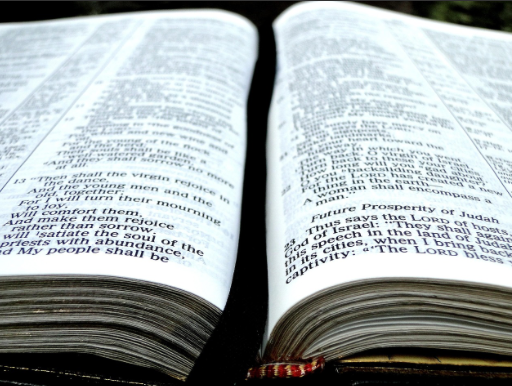
When my fundamentalist, evangelical,“born-again” friends – whatever name be attached to them – become aware of my interest in mediumship, they express concern that I am being influenced by Satan himself. They cite Deuteronomy 18:12-13, which they interpret to say that we should not consult the dead and Ecclesiastes 9:5, which says that the “dead know not anything.”
But how are we to reconcile those Old Testament injunctions with passages in the New Testament, such as 1 John 4:1, which says we should “test the spirits as to whether they are of God”? How are we to test them if we shouldn’t be talking with them and if they know nothing? And what about 1 Corinthians 12:10 that says some are given the gift of “discerning” what the spirits have to say? Why discern if they know nothing? Then, there’s 1 Thessalonians 5:21, which says to “test them all and hold on to what is good,” while 1 Peter 1:5, tells us that we should add “knowledge” to our faith.
How are we to interpret Joel 2:28-29, which says, “It shall come to pass afterwards that I will pour out my spirit upon all flesh; and your sons and your daughters shall prophesy, your old men shall dream dreams, your young men shall see visions, and also upon the servants and upon the handmaids in those days I will pour out my spirit.”?
If the Bible is to be interpreted literally, then why do Christian leaders ignore all of those Old Testament teachings, such as putting to death both persons in an adulterous relationship (Deut. 22:22), stoning to death stubborn and rebellious children (Deut. 21:18-21), accepting polygamy (Deut. 21:15), sanctioning slavery (Lev. 25:44), not eating shellfish (Lev. 11:10), or not having one’s hair trimmed (Lev. 19:27)?
Clearly, much of the Bible has been distorted over the centuries in the various translations. According to Dr. Robert A. Morey, a professor of Apologetics and Hermeneutics at Perry Bible Institute, the word nephesh is used 754 times in the Hebrew Bible, but it takes on 30 different meanings, ranging from “soul” and “the dead” to “fish” and “dogs,” while the Greek word aion is found in the New Testament 108 times and is given 10 different meanings, including “forever,” “ages,” “occasionally,” and “never.” What we read in the English Bible as “everlasting punishment” meant “age-long pruning” in the original Greek.
Although I have not been able to confirm this with a Bible scholar familiar with Hebrew, I recall reading somewhere that the Hebrew word from which “dead” is derived meant “spiritually dead” and referred to earthbound spirits. Thus, those passages cited above likely referred to earthbound (low-level) spirits. That is, earthbound spirits know nothing and we should not speak with earthbound spirits.
Much of orthodoxy clearly interprets Scripture in a self-serving, self-stultifying way and does not grasp the fact that the foundation of the Bible is similar spirit communication coming through mediums of one kind or another. “If we were to expunge all accounts of the apparently paranormal from the pages of the Bible, we would be left with an intolerably emasculated volume,” Canon (Dr.) Michael Perry of the Church of England wrote.
The more modern revelation has come to us in the same way that the ancient revelation did – through mediums of one kind or another, even though those ancient mediums, whether clairvoyants, trance types, direct voice types, automatic writers, or even near-death experiencers, might have been called prophets, seers, saints, or even saviors (or were translated as such). What the ancients called an “angel of the Lord” might now be referred to as a “spirit guide.” Where it is written that “his eyes were opened and he saw a vision,” might be translated today as saying the person was a clairvoyant. The method by which Moses received the Ten Commandments might today be called “direct writing” or “automatic writing.” In Isaiah 8:1, we read: “Then the Lord said to me, ‘Take a large tablet and write…’…’ seemingly a reference to automatic writing.
If the evangelicals accept that argument, which most don’t, they point to Revelation 22:18, in which John supposedly says that God will punish anyone who adds or takes away anything from the Bible. And, yet, in John 16:12-14, we are told that there is much more to learn. “I have much more to say to you, more than you can now bear. But when he, the Spirit of truth, comes, he will guide you into all the truth. He will not speak on his own; he will speak only what he hears, and he will tell you what is yet to come.” But the world, at least then, was not yet ready for it. Are we to assume that the world is still not ready for it and will never be ready for it?
If, as fundamentalists believe, Scripture is the inerrant word of God (vis-à-vis the inspired word of the spirit world manipulated by man), we must conclude that God lacked in communicative skills or in the ability to foresee the confusion concerning the conflicting interpretations given to the Bible after numerous translations. “They [the ancient words of Scripture] have frequently blinded us from seeing and entering the experience they seek to describe because these words are always limited by their time, their culture, and their apprehension of reality,” John Shelby Spong, a bishop of the Episcopal Church, recently wrote.
If Christian leaders were to closely examine the newer messages, they would realize that the basic teachings of Jesus – Love thy neighbor…, Do unto others…, and You reap what you sow – are also the teachings emerging from the modern revelation. Moreover, many of the current messages pay homage to Jesus and suggest that he pretty much functions in what might be called “Chairman of the Board” on the Other Side. With proper testing and discernment, numerous new teachings edify and clarify Scripture, offering us language that is not muddled and befuddled by human hands and brains.
Perhaps the best guide in this respect is Matthew 7:16: “By their fruits ye shall know them.” Also, the 23rd chapter of Proverbs, seventh verse, which reads, “For as he thinketh in his heart, so is he..” It is difficult to read the wisdom that has come through so many credible mediums in recent centuries and believe that the spirits communicating this information are attempting to mislead us, as they offer a much more sensible and more appealing afterlife environment – one that can be reconciled with a loving and just God rather than a cruel, capricious, vindictive, and wrathful one or one who would offer a humdrum heaven or horrific hell. From this new revelation we discover a Divine plan – one of attainment and attunement, of gradual spiritual growth, of evolution of spirit through progressively higher (in vibration) planes. In a nutshell, it puts “life” into the afterlife.
Michael Tymn is the author of The Afterlife Revealed: What Happens After We Die, Resurrecting Leonora Piper: How Science Discovered the Afterlife, Dead Men Talking: Afterlife Communication from World War I. and No One Really Dies: 25 Reasons to Believe in an Afterlife. His latest book Consciousness Beyond Death: New and Old Light on Near-Death Experiences is published by White Crow books.
