
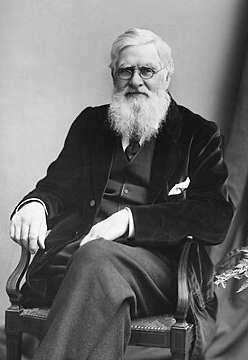
While recently accompanying a granddaughter around the Smithsonian Museum of Natural History, so much of which sets forth biological evolution as fact, I wondered if fundamentalist Christians – at least those fundamentalists rejecting Darwinism – were among the visitors and how they reacted to it all. I wondered how there can be such absolute certainty when there is still that “missing link.” I thought about the comment by Alfred Russel Wallace, (above) co-originator with Darwin of the natural selection theory of evolution, that the evidence for a spirit world is as good as the evidence for evolution and wondered if the evidence is still as good as it was back then, concluding that it was much greater in both areas.
I further wondered about the quantum aspect; that is, if there is no such thing as “time,” then how do things “evolve”? Of course, that question doesn’t help religion, either, since even Creationism involves time, if only seven days. As with reincarnation, I have come to the conclusion that biological evolution is much more complicated than we realize and for the most part beyond human comprehension, and so I don’t concern myself too much with our origins.
I concern myself more with where we are headed than from where we came and wonder why others are not so concerned. I recalled that when Professor James Hyslop (below) was teaching philosophy and logic at Columbia University, a fellow professor sneered at his interest in psychical research. When Hyslop published articles that strongly supported non-mechanistic theories, the fellow professor tried to have him fired. In his defense, Hyslop, noting scientific efforts to find a species of useless fish to support Darwin’s theory, asked “why it is so noble and respectable to find whence man came, and so suspicious and dishonorable to ask and ascertain whither he goes?” Pondering on that, I wondered why paleontologists are so much more respected than psychical researchers and parapsychologists.

As I further toured the Smithsonian and came upon the displays dealing with space exploration, I wondered why people are so interested in exploring “outer” space and so little interested in exploring “inner” space. I wondered about the benefits of space exploration if life is nothing but a march into an abyss of nothingness, as fundamentalist science would have us believe. Who benefits and in what way? Will our descendants find greater meaning in life if we find something out there? What is the point of it all? I wondered how Smithsonian officials would react if someone proposed they set aside a building devoted to discoveries in psychical research and parapsychology. No doubt, they would scoff at the idea.
The July 28 issue of the Washington Post carried an interview with Harvard geneticist Jack Szostak, who won a share of the 2009 Nobel Prize for physiology or medicine, about his attempts to create life in a test tube. “What I hope this will show people is that there is a perfectly natural progression from chemistry to life and that the origin of life is not something magical,” Szostak was quoted, going on to say that a supernatural explanation is not needed. I wondered about his definition of “supernatural” and further wondered how the world might be better off if he were to succeed in completely ruling out a supernatural explanation. Would everyone be happier knowing that life is meaningless, nothing but a march into that abyss? Is life just about making life better for future generations? I wondered what happens when Utopia is achieved – when some future generation experiences only happiness. Will it be all eat, drink, and be merry? What will life be like without challenges and adversity? To what end the progeny, to which generation full fruition? Will that future generation go the way of Nero and Rome, and then will the pursuit of happiness start all over again? Then again, I wondered if creating life in a test tube proves anything relative to the existence of the soul. Might not a soul attach itself to that life in the same way it attaches itself to a fetus or a newborn?
I visited a 99-year-old friend at the Old Soldier’s Home in Washington, D.C. and after seeing the pain and misery he seemed to be in I wondered why anyone would want to live to be that old. As near as I could determine, when he wasn’t sleeping he was in pain, and so he preferred to spend most of his time sleeping. I wondered if his fundamentalist religious beliefs helped him deal with it all. He was not in condition to talk about it this visit, but when I visited him two years ago he talked about seeing his family in heaven at some far off date, though he did not seem anxious to join them, seemingly looking forward to making it to 100 and beyond. Most of the other old soldiers I observed at the retirement home appeared depressed and despondent and I wondered what their beliefs are.
Going south, we visited Universal Studios in Orlando. As we toured the new Harry Potter theme parks, I wondered how so many people can get so excited about a fantasy world involving some elements of spirituality while taking no interest at all in a real spiritual world. I wondered why fiction appeals to so many when there is enough non-fiction concerning a spiritual world to delve into.
On my 11-hour flight home to Hawaii on American Airlines, I sat in the coach section, the seats moved even closer to each other than on previous flights, and wondered why they don’t call it what it really is – “steerage,” and if that is what it feels like to be buried alive.
Michael Tymn is the author of The Afterlife Revealed: What Happens After We Die, Resurrecting Leonora Piper: How Science Discovered the Afterlife, Dead Men Talking: Afterlife Communication from World War I. and No One Really Dies: 25 Reasons to Believe in an Afterlife. His latest book Consciousness Beyond Death: New and Old Light on Near-Death Experiences is published by White Crow books.
