
In my essay for the Bigelow contest of 2021, I presented a simulated present-day court trial in which The Survival School contends that consciousness survives death in a greater reality, while arguing that the evidence for such survival was overwhelming before 1920. I offered the testimony of 11 pre-1920 scholars and scientists, including three chemists, two physicists, a biologist, a judge, a lawyer a theologian, a philosopher, and a physician.
Because the trial judge (contest rules, 25,000 words) placed a limit on the trial, the attorney for The Survival School was unable to call a number of other witnesses to the stand. In prior blogs here, I’ve summarized the testimony of the 12th through 17th witnesses – Professor James Hyslop, Dr. Gustave Geley, Vice-Admiral William Usborne Moore, Professor Cesare Lombroso, Dr. John King, and Dr. Bernard Laubscher. All of their depositions were taken before the trial and summarized in prior blogs here. .
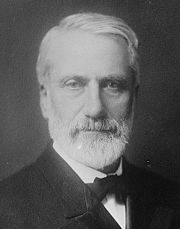
The 18th witness, had the trail judge permitted it, would have been Isaac K. Funk, D.D., LL.D. (above.) He is most remembered as the co-founder of Funk & Wagnalls Company, publishers of The Standard Dictionary of the English Language. He began his professional career as a Lutheran minister and later in life took an interest in psychical research. He authored two books dealing with psychical phenomena, The Widow’s Mite and Other Psychic Phenomena (1904) and The Psychic Riddle (1907). The intriguing case of the Widow’s Mite was summarized in my blog of February 14, 2022. While the Widow’s Mite might have been his most intriguing case, he had many more to tell. Three of them involved the Brooklyn, New York medium May S. Pepper. According to Nandor Fodor’s Encyclopedia of Psychic Science, Mrs. Pepper was pastor of the First Spiritualist Church of Brooklyn and her remarkable powers of clairvoyance were a lively discussion in the American press for a considerable time. Professors William James and James Hyslop were, according to Fodor, convinced of her supernormal faculties. As might be expected, however, Wikipedia, while otherwise praising Funk, suggests that he was duped by mediums, including May S. Pepper.
Mrs. Pepper was most known for her ability to psychometrize letters. Members in attendance at her church would place letters in a sealed envelope in a box. Pepper would randomly pick one and tell of its contents as well as deliver messages coming from the spirit world.
In the January 1907 issue of the Annals of Psychical Science, Funk tells of enclosing a letter to his mother — no names other than “Mother” on the envelope or in the letter. His mother had died 40 years earlier and he doubted that any person in Brooklyn knew her name or what caused her death. Funk’s letter was one of many in the pile of letters in front of Pepper. “There was only one chance in some hundreds that she would happen to seize upon my letter,” he reported. “Picking it up, she immediately spoke my mother’s first name, described her by a number of trifling, but none the less important, details of appearance, she said that, curiously she seemed to walk as if she was using one foot.” Funk then asked Pepper why she walked in this way. Mrs. Pepper replied that his mother asked if he did not remember “that needle.” Funk did remember it. “The fact was, when I was a young man, my mother stepped off a chair and ran a needle into her foot,” he explained, adding that the needle punctured her slipper and ran deep into her foot. He removed it with a pair of pincers. Paralysis of the foot followed and she died a week later. In his sealed letter, Funk had asked; “Will mother tell me what caused her death?”
Mrs. Pepper then told Funk that his mother was not alone, that she had by her side a boy child named Chester and that it was her grandchild. Funk knew of no such grandchild, either dead or alive, but in later making inquiries of family members, he was told of a grandchild named Chester who had died in infancy about 20 years earlier. Funk considered the possibility of telepathy with the needle, but the Chester information seemed to go beyond telepathy.
A Lost Pearl
On another occasion, as reported in his 1907 book, an acquaintance who was an editor, clergyman and teacher at the University of Chicago wrote such a letter, and gave it to Funk, as did other acquaintances. For test purposes, he randomly picked the letter from the editor/clergyman/teacher, the envelope of which game no indication as to who had sent it to him or what was in it. However, Funk placed a special seal on the envelope so that he would recognize it if Pepper picked it from about 20 in front of her. When Pepper took hold of it, she said, “I hear the name Horacum or Horaca.” (Funk explained that for privacy purposes he was not using the actual name in his book, but the one he used was very close to it.) The medium then said that she heard the word “Pearl.” Funk told Pepper that he recognized the envelope as the one he brought by the seal, but he did not know who Pearl was. After some hesitation, Pepper said, “It is not the name of a person. Mother Horacum says, ‘Tell Eton that the pearl breast-pin was not stolen; it was lost.’ You do not know what is in this letter. The man who sent it to you is named Eton, and he lives in the West. This letter is addressed to a spirit named Horacum or Horaca, and was sent to you by a man named Wilton.” After some pause, Pepper then gave the full name as Eton Wilton, which Funk said was correct, although when he took the letter from his home he made no attempt to identify the sender. It was one of several letters he had requested for test purposes.
Funk then corresponded with Eton Wilton in Chicago. Wilton told him that Mrs. Horacus was an old classmate of his and had died some 14-15 years earlier. Mrs. Horacus’s daughter had visited some friends of Wilton’s and during the visit lost a pearl pin. Hearing of the loss and knowing of Funk’s research with Mrs. Pepper, Hilton then sent a sealed letter to Funk. The letter, intended for Mrs. Horacus, read: “Your daughter has lost a beautiful pearl pin recently given her by her aunt. Can you tell me where it is?”
While getting the name of the mother and the question concerning the pearl pin, none of which was known to Funk, Pepper did not say where the pearl pin could be found, which apparently made Wilton continue to be skeptical about her abilities. He seems to have assumed that spirits of the dead, if they exist, are all-knowing. Typical skeptic!
Stainton Moses Speaks
Funk also tells of an interesting sitting with Mrs. Pepper early in 1906. Judge Abram H. Dailey, of Brooklyn, accompanied him in an otherwise private sitting. “As soon as Mrs. Pepper went into the apparent trance condition it was announced by her [spirit control] that there was a group of spirits present who were strangers to her,” Funk recorded. One gave the name “Imperator” and another they called “French Doctor,” and a third gave the name of “Oxion.” With the three of them, Pepper saw a “fine-looking man who seems not to have been long on this side, as he appears ‘very weak’.” Pepper then appeared to go into a deeper trance and with pencil in hand wrote “Stainton,” then again “Stainton Moses.” She then began speaking in a strange voice, as follows:
“I come not to speak for myself this evening through this medium who is strange to me, and it is a strange thing for me to attempt to speak through a medium. Imperator who is here, helps me. We have come to bring one who as given a long time to psychic matters, and he desires to let it be known that he is present and that spirit communication is a fact. The spirit is Dr. Hodgson. (Hodgson died at the age of 50 on December 20, 1905.) He is not strong enough to use the medium himself. He wishes me to say that he finds that he conducted experiments altogether too much on the physical plane, and hence developed insufficiently the higher spiritual powers, which enable one to control the spirit forces in the spirit world and to understand quickly that laws that govern here. When the Doctor came over to our side, many of us gathered together to help him, but we found that he was attuned to earth vibrations and it was difficult to wake him. I found in order to communicate, that it was necessary for me to reach a medium who was keyed to the vibrations. Valuable as scientific facts of the material world are, they are not necessarily so valuable as those that have to do with the spiritual man and with the unfolding of the spiritual powers of man. I myself left a legacy for the uplifting of mankind, and I found when I reached this side a place among an exalted company of spirits.”
Moses, or “Oxion,” continued: “This thought we all wish to impress upon you and upon the friends on earth, that there is a difference between the entrance into the spirit world of those who seek for spiritual unfolding and those who simply seek for scientific knowledge. Dr. Hodgson says that I shall tell you that it was a great error that he kept himself so largely attuned to material life and material things. You will understand he means that he did not move in the realm of the higher or spiritual. He did not view these psychic matters from the standpoint that I did. He sought to base everything mainly on material facts and did not seek to interpret anything wholly as spiritual. One that comes over as he came over, is transplanted from one sphere of life into another like a babe just born. He has been besieged since he is here with messages started from your side. All manner of questions are being carried to him by messengers. This is all in vain; he cannot answer. He repeats that I shall tell you he realizes now that he saw only one side of this great question, and that the lesser important.”
Moses went on to say that when Hodgson was alive in the physical world he thought Funk was dwelling too much on the spiritual and not enough on the scientific. However, he now recognized that Funk was approaching it correctly. Funk asked who Hodgson thought should be his successor at the American Society for Psychical Research. Moses replied that Hodgson said it should be a man who puts less stress on the scientific side of investigation, and more on the spiritual side than he did. Moses then said he could not hold on to the medium any longer and departed.
Next blog post: June 8
Michael Tymn is the author of The Afterlife Revealed: What Happens After We Die, Resurrecting Leonora Piper: How Science Discovered the Afterlife, Dead Men Talking: Afterlife Communication from World War I. and No One Really Dies: 25 Reasons to Believe in an Afterlife. His latest book Consciousness Beyond Death: New and Old Light on Near-Death Experiences is published by White Crow books.

Michael.
I have been looking at Stantion Moses (who wrote under the name M.A. Oxon) the Oxion mentioned above by Mrs Pepper. Stantion seems to be the link between the UK and the US with being the editor of Light. There were Spiritualists who reported the state of affairs. When Alfred Deakin visited the USA before becoming Prime Minister, he carried letters of introduction to various high-ranking Spiritualists. These groups were very common in all walks of life with my ancestors when they come to Australia from England presented their membership to various lodges. This allowed ease of work placement as they were boilermakers. (The acceptance lasted over time and when his boilermaker friend became the Premier on NSW (one of our states) he stayed close.)
The Spiritualists operated in a similar manner. Professors William James and James Hyslop were in correspondence with Station, who was a Cambridge lecturer, hence the pseudonym when working with the Spiritualists.
Thanks,
Bruce
Bruce, I agree. To really appreciate it one has to be aware of the entire Imperator story and that of Stainton Moses. As I mentioned to Newton, I doubt that a fraudulent medium would have had the creativity to make all that interaction up. However, I am surprised that they are saying Hodgson was “too earthy.” I got the impression that friends were concerned because he was spending too much time in his room communicating with Imperator and others during his last year or so. It’s difficult to understand what exactly Moses had in mind relative to how Hodgson was handling his research. If he had been too spiritual, he would have been “too unscientific.” Hard to know where the balance is in all that.
An after-thought on this. Hodgson, as I recall, was very anti-Palladino and other physical mediumship, so that might have been his problem.
I read this stuff the opposite way, Michael. To me, what Hodgson’s shortcoming was, was that he was too much dialed into the supernormal phenomena, the mind-blowing aspects of mediumship, and not enough dialed into the very unglamorous, down-to-earth ethical messages the angels or spirits were trying to communicate. “Spirit Teachings” repeatedly warns us not to focus on extraordinary phenomena like physical mediumship but rather to attend to more subtle, less exciting forms of spiritual guidance that come via intuition and intimation. Is not this the guidance that leads to a life lived in pursuit of love and wisdom, rather than one spent in fascination with, and constantly chasing after, things psi?
Newton, as I see it, the physical mediumship was at a time when many had become nihilists and there was a need to simply let them know that consciousness did survive. Once faith in survival was restored, then the Imperator teachings were to be considered. According to Imperator, the spirit world overestimated the ability of humans to grasp it all and therefore they had to pull back on the physical side, i.e., too many legitimate mediums were being labeled frauds.
Very interesting, Michael, thank you. I wonder if you will arrive in the Imperator group in due course too, after your considerable contribution to afterlife evidence ?
In the mean time, keep well !
Keith, I’ve been told I’m part of the Conan Doyle group, but hopefully they interact with the Imperator group. 🙂
The strongest evidence, for me, that it was indeed Stainton Moses, in the company of Imperator, speaking through Mrs. Pepper, is the consistency of the content of Stainton’s communication with the gist and thrust of “Spirit Teachings.” In both, the point is made that spiritual growth in this world, the deepening of one’s love and wisdom, is the means by which we put ourselves in the best position in the next life. This is reminiscent–is it not?–of Jesus’s teaching about the importance of storing up treasure in heaven rather than on earth, about living the values of the kingdom to come in the difficult and challenging circumstances of the here and now.
Again let me make the point that, as in Christianity, divided between Catholic/Orthodox and Protestant, there is a similar division of Spiritualism between a Christian-influenced orientation, on one hand, and a New Age-influenced orientation, on the other. One might argue that Near Death Experiences also fall roughly into these two rather different camps, but that’s a subject for another time.
Am I alone in thinking that Michael’s Bigelow Contest essay was not only the most unusual and original, but also, by far, the most persuasive? Of course, in its focus on the past, it was swimming upstream against the current of “presentism” that the internet has brought us, in which the ever-new sweeps away all living memory of the past, even of the past week. Continual and instantaneous connection with each other may work beautifully in the spirit world, but it causes some serious problems, yet to be solved, on this side. As I like to say in my internet commentary, it’s not so much that the internet has dumbed us down as “younged” us down.
Newton, I agree concerning the consistency, especially the interaction between Moses and Imperator and the reasons for their presence with Hodgson. It doesn’t sound like something a fraudulent medium would make up. Thanks for the comment about my essay. Much appreciated.
Newton,
Nice comment. The worth of Stainton Moses’ automatic writings is high among mediums. You might like this quote
“These are but a very few of messages which fill up twenty-four books each of some 85 pages of typed work. Spirit Teachings is a small selection from these, and is to my mind, the very climax of mediumship yet attained. The opposition between the mind of the automatist and that of the communicating spirits is most marked. The writer says:—
I cultivated the power of occupying my mind with other things at the time that the writing was going on, and was able to read an abstruse book, and follow out a line of close reasoning while the messages were written with unbroken regularity. Messages so written extended over many pages, and in their course there is no correction, no fault in composition, and often a sustained vigour and beauty of style.” Clarity of transmission is the key.
The Spiritual Churches were split over Christain values. Many who joined did not want any religion, having fled other churches. There were splits and high tempers. It was decided not to adopt another principle and left Fatherhood of God as the first principle. Having said that, it is a CoE service with readings.
Bruce
I appreciate your sharing that quote, Bruce. I’ll never forget the first time I read “Spirit Teachings” and found anticipated, in the late 19th Century, so much of the later liberal Christian understanding of scripture, religious history, Christology, theology, etc. that I had come to embrace and internalize. What continues to draw me to this book in particular, among the many spiritualist texts (and I now read it daily, devotionally), is what you allude to, that it was delivered by a very high spiritual being to Stainton Moses, a man of considerable courage, kindness, and integrity, via automatic writing. And although there were sequels, it purports to be a kind of self-contained, standalone communication, specifically addressing Stainton’s spiritual struggles as he moved from a more traditional Christianity to a Christian-influenced form of Spiritualism. Those of us who have made or are making a similar journey would be hard-pressed to find a more helpful guidebook. Thanks again, Bruce, for this response to me and for all the edifying comments you make on this wonderful blog.
Newton,
Thank you for your comments. You have a generosity of spirit, which is a rare gift. Recognition of Michael’s writing is one example.
I have some articles on Stainton which reveal the depths of the conversations from the high spirits. Another quote “There was a branch of the Christian Church which was unknown to you ; and to it we directed you. A book which casually—as you thought—reached you, fired your mind with desire to know more of that Eastern Church whose history Stanley wrote, and you had just read. . . . You saw what were the teachings, the beliefs of those who were the Fathers of the Christian Church. You saw and you turned aside. The mind had outgrown the theology of the first Christian ages. The spirit had soared to a higher plane than that which was satisfied with a stereotyped theology and could rejoice in the curses of an Athanasian creed. The shock at first was rude, and the recoil sent you to study the speculations of German thought and the writings of your own teachers, Maurice and Robertson, and afterwards of Seeley and Stanley, men heaven-directed and angel-guarded. . .”
This shows that Stainton was prepared as a medium to understand the layers of meaning that spirit communication has in its careful transmission. The Controls directed him. This is often overlooked how they do this. It is preparing the ground.
The notebooks of these communications were given to Frederick Myers to examine in the early days of the SPR.
I fully agree that it is an excellent guidebook.
Thanks
Bruce
Newton,
I would like to thank you with a direct answer which will help with understanding the process.
I am an evidential medium using automatic writing. Different types but mine is dictation. There are some extras that come with this territory. These are direct and indirect directions to various resources. The direct has been finding a book that was not cataloged in a university library. These directions were instructions to locate a certain shelf in the many racks of books. This was by spirit voice. Nowadays, it is being told to find a certain article in the ASPR Proceedings online, again by spirit voice. Subject matter is told but not the exact issue. Only around certain dates. This is similar to the book tests where a book and a page are given. It is like fireworks going off when you locate it.
The indirect is finding a coincidence that happens, which makes sense later on.
I believe that Stainton Moses used both techniques, which I found out after this became my normal. The reason is that it is more economical to use the article information than to dictate it
Each medium gets a surprise when it happens, as you find yourself at a point organized by others. I am unsure that Stainton would try to explain these strange feelings as it would be best to just write the words down.
Thanks,
Bruce
Mike,
Very informative as always.
So many important people, more than we know, have studied the paranormal.
Many people have all kinds of experiences with spirit whether they realize it or not.
Once one is convinced of the reality of spirit, the afterlife, etc. concentrating on the moral aspects of the spirit teachings and trying to put them into practice is the most important thing.
Take care!
Yvonne
Bruce, interesting quote. did it come from a book? I’m interested in reading the rest of it.
I asked ai about the names mentioned:
“Frederick Denison Maurice — a leading Anglican theologian, Christian socialist, and critic of eternal damnation. Maurice emphasized God’s universal love and was influential among liberal Christians.
“Frederick William Robertson — usually known simply as “Robertson of Brighton.” His sermons were widely read and stressed moral and spiritual insight rather than rigid dogma.
“John Robert Seeley — often cited as J. R. Seeley. He wrote on religion as well as history, including Ecce Homo, a highly influential study of Jesus that approached Christianity in a non-traditional way.
“Arthur Penrhyn Stanley — usually called Dean Stanley. He wrote important works on church history, including books on the Eastern Church. The passage’s reference to “that Eastern Church whose history Stanley wrote” almost certainly points to his lectures and writings on the history of the Eastern (Orthodox) Church.
“The phrase about “the teachings, the beliefs of those who were the Fathers of the Christian Church” suggests the recipient had been reading the early Church Fathers through Stanley’s historical works and discovered that early Christianity was often more diverse and less systematized than later doctrinal formulations.
“The line about “the curses of an Athanasian creed” is a criticism of the traditional Athanasian Creed, which contains a series of warning clauses stating that those who do not hold the catholic faith “faithfully and firmly” cannot be saved. Liberal Victorian theologians such as Maurice and Stanley were often uncomfortable with those condemnatory statements.”
I particularly like the phrase “heaven-directed and angel-guarded.”
Jon,
I like the quote “heaven-directed and angel-guarded.” I should have it on my business card. The link to the article has been sent.
Thanks,
Bruce
Michael and Jon,
I opened up my copy of The Psychic Riddle by Issac Funk and admired his turn of phrase.
“Psychic research at its present stage is a wanderer in a vast wilderness that has in it wild beasts and fiery serpents in plenty. It is still in its experimental stages. Let us not err on either side, that of extreme credulity and recklessness, nor that of extreme cautious skepticism.”
I can see why such a witness would be persuasive. Another quote “The reader throughout the perusal of these strange stories should bear in mind that it is not superstition, that it is not ignorance that is now pressing this psychic question upon the public mind; instead it is the experiences and observations and reasonings of trained scientists as Lombroso of Italy; Richet and Flammarion and Maxwell of France; Crookes, Lodge, and Wallace of England; Hyslop, James, and
(until his recent death) Hodgson of America.
For a witness to convince any court of public opinion, there must be solid evidence. Funk presents this evidence well.
Thanks
Bruce
Bruce, I agree. Thanks for the comments.