
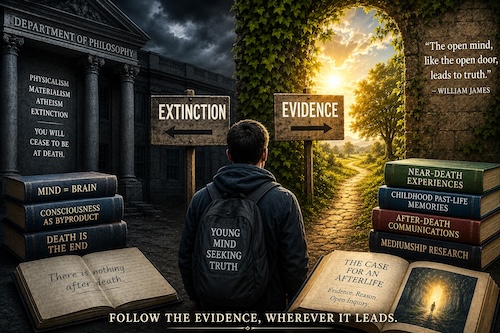
University of Texas philosopher Paul Woodruff recently wrote in an oped, “My death is close. But I do not think of myself as dying.” This is typical of what comes out of philosophy departments these days: You will cease to be at death, so make the most of the present. These are not consoling words, but are they true? (A 2009 survey of philosophers and philosophy grad students showed that 73% leaned toward physicalism and atheism.)
Many evidence-based studies that present evidence of an afterlife are now available to anyone who can read. Most academic philosophers shun this evidence. Why is this? Typically male, they might have had a bad experience in church as a teenager or come under the spell of a senior philosopher like Woodruff in college. In short, they have become convinced that belief in an afterlife is religious, and that smart, informed, scientific people have too much self-respect to get seduced by such superstition. They pass on this message to a new crop of vulnerable students in their philosophy classes. The students’ world becomes darker and perhaps frightening. Life’s enchantment dims. Death “grins in at the banquet,” as William James so memorably put it.
The basic mistake our philosophers make is that life after death is a consolation for needy, unscientific, religious people who refuse to confront the evidence that death is the end. It might turn out that philosophers like Woodruff are the needy ones. It seems to me they are so dug into their materialist worldview that they refuse to investigate research that contradicts it. Are they afraid of getting entangled in a worldview that belongs to a past they “outgrew”?
They are correct, however, to link belief in an afterlife to religion—all religions affirm it—but they fail to distinguish between a religious belief founded on evidence and one growing out of a theological or wish-fulfilling imagination. In other words, they reject good evidence because it’s associated in their minds with religion.
This good evidence is based on contemporary scientific research. Thousands of highly credentialed scientists—physicists, psychologists, doctors, poets, Christians and non-Christians, agnostics, even a few exceptional philosophers, the list goes on and on—are unafraid to look at it.
True scientists read accounts and analyses of the near-death experience and come away with minds opened. They survey the numerous accounts of deathbed visions and rightly conclude they can’t all be explained away as hallucination. They study the vast literature on ghostly apparitions from all over the world and marvel at how materialists intellectualize them out of existence, as if they were all due to a temporary disease of the mind.
They marvel that some advanced Alzheimer’s patients with ravaged brains perk up and momentarily become their old selves just before death—impossible to explain by materialists who regard the brain as the sole source of consciousness. They look at poltergeist phenomena, much of it utterly unexplainable by conventional material science. They even force themselves to study what perhaps they don’t like: the memories by little children, thousands of them, of a past life that matches the life of a real person.
Taken together, this evidence, its various strands, all point independently to the same conclusion: Like it or not, fear it or look forward to it, we survive death.
There are many books and articles that tell this story. Most researchers focus on only one of the six types of evidence mentioned here. I am deeply indebted to them for the in-depth research they do, each in their own specialty. They make possible the wide-ranging, derivative studies I write. Raymond Moody’s classic Life after Life would be a good book for a newcomer interested in the near-death experience. Ian Stevenson’s Children Who Remember Previous Lives is my favorite study on reincarnation. My own When Did You Ever Become Less by Dying? synthesizes the various types of evidence.Michael Tymn’s supersmart blogs (found at White Crow Books) are an especially good source of information and insight on the afterlife.
Paul Woodruff says that he and his philosopher friends worry about death obsessively (“every third thought”). I would too if I had nothing more to look forward to but extinction. I sympathize with him as he lives his remaining days. But I see him as a flawed guide, not someone who imparts wisdom, which should be the mission of a philosopher.
Stafford Betty, Professor of Religious Studies, CSUB, (ret) is the author of When Did You Ever Become Less by Dying? and Heaven and Hell Unveiled. His novels include The Imprisoned Splendor, The Afterlife Therapist and Guardians of the Afterworld. His latest book, The Hell Dwellers: A Novel about the Dark Side of the Afterlife is published by White Crow Books. Stafford can be found at staffordbetty.com.

Hi, Stafford… Love the AI image at the top of your excellent article.
A thought: shouldn’t the left-pointing sign say “assumption” or “presupposition?” That, I think, would be the opposite of “evidence.”
In my view, much of philosophy comes down to semantic games. (How often does anyone even define their terms, for pity’s sake, before charging ahead…?)
In any case, when it comes to these matters or life and death, I think language tends to fail us. I suppose that’s partly because language arises from culture and our culture is either spiritually impoverished or, as you rightly point out, hobbled (and often scared out of its wits) by religious tradition. So the evolution of our language would seem to be a high priority.
Keep up the good work!
Dan Drasin
Author, A New Science of the Afterlife; Space, Time, and the Consciousness Code
Producer, Calling Earth (www.bit.ly/callearth) and Scole, the Afterlife Experiment. (www.bit.ly/scolemovie)
So sad, but so true. I’ve had many educated friends and acquaintances who won’t even take a look at the evidence because they associate it with religion. Many of them grew up in religious homes and assume it is a return to the mistaken ways of their parents. They were able to liberate themselves from their parents’ mindset and want nothing more to do with it. They just don’t get the difference between religious belief and what has come to us from psychical research. As Jung, one of the giants of psychology put it, “Only if we know that the thing which truly matters is the infinite can we avoid fixing our interest upon all kinds of goals which are not of real importance.”
Thank you, Stafford, beautifully explained. Because so many people believe that their life ends after death they become organ donors. Although their intention seems to be generous, this is not without danger, as recently proven by the government investigations on the US Organ Transplant System (see New York Times). Some time ago I made a short video on this: https://youtu.be/UAcOvvnJkr0?si=-xDxaa-zbUpXgT7_
Very good. Well stated.
I don’t understand why some people are afraid to truly investigate the evidence with an open mind. I mean, I DO understand the psychological mechanisms involved (cognitive dissonance, self-justification, the anxiety triggered by threats to worldview, etc.). But the information itself, once you take it in, is so liberating and comforting. Why wouldn’t you want to learn about it?
And why would you want to be stuck with a flat, depressing philosophy like materialism? Why would you want to cling to a picture of the world that tells you that you are nothing but random chemicals in motion for 80 years or so, and that when your body dies, that’s it, you’re done. And same goes for everyone you love and everything on Earth. Why would you want to hold on to that worldview, if there was something better? Talk about missing out…
Dear Stafford,
I think your central concern is right: academic philosophy often treats extinction as the sober and rational default while showing little serious acquaintance with the best evidence for survival. But I would frame the difficulty somewhat differently. The problem is not primarily, or at least not only, the personal psychology of individual philosophers. It is a broader matter of paradigm entrapment and paradigm threat.
By paradigm entrapment, I mean the way a governing intellectual framework teaches its members in advance what counts as a serious question, a respectable source, and an admissible datum. The survival literature is often not examined and then rejected. It is classified out of court before examination—as religion, consolation, folklore, occultism, grief response, hallucination, or anecdote. Kuhn’s account of paradigms and anomalies is relevant here, as is Charles Taylor’s account of the closed immanent frame. Evidence for survival is not merely judged weak; it is encountered as the kind of thing that cannot be allowed to count without destabilizing the reigning picture of reality. In short, a paradigm threat.
This also helps explain what happens pedagogically. Philosophers need not consciously set out to indoctrinate their students. But by the time one has passed through graduate training, hiring, publication, tenure, and professional recognition, one has usually learned the tacit boundaries of serious thought. Those boundaries are then passed on to students, not only through formal arguments, but through tone, gesture, omission, ridicule, and the unspoken sense of what an intellectually mature person is permitted to take seriously.
The broader history of parapsychology illustrates the same pressure. It is true that Rhine’s ESP work, ganzfeld telepathy studies, remote-viewing research, and PEAR’s micro-PK experiments do not directly establish survival. Much of this research concerns the capacities of living agents rather than the continued existence of the dead. But its significance should not be understated. Survival-adjacent psi research does not have to prove survival in order to threaten the framework that excludes survival. If telepathy, clairvoyance, anomalous cognition, remote perception, or mind–matter interaction are even provisionally admitted as evidence, then the closed model of mind on which the easy dismissal of survival depends is already weakened.
That is why the response is often not careful adjudication but paradigm defense. Conventional explanations are accepted if they are merely possible, while anomalous interpretations are rejected unless every conceivable normal alternative has been eliminated. The paradigm is thereby protected not by refutation, but by rules of admissibility.
There is a particular irony here. Psychical research began with the survival question close to its center. The early Society for Psychical Research arose in a cultural setting in which Darwinism, materialism, and the Victorian crisis of faith had made inherited religious certainties newly vulnerable. Its inquiry into apparitions, mediumship, crisis cases, telepathy, automatic writing, and related phenomena was already, in one sense, a partial secularization of the religious question: not “What has revelation taught about immortality?” but “What evidence bears on whether personality survives bodily death?”
The later Rhinean pivot narrowed the question still further. It moved psychical research toward what could be tested under better laboratory light: Zener cards, ESP scoring, forced-choice experiments, and, later, more refined work on telepathy, remote viewing, and psychokinesis. That move made the field more experimentally tractable, but at a tremendous cost. It displaced the existentially decisive question—do we survive death?—toward the secondary question of whether living agents possess anomalous capacities. In Mullah Nasruddin’s terms, the search moved under the street lamp because the light was better there.
But survival is the lost key. Whether a living person can score above chance in an ESP experiment is important. Whether I (or you, for yourself) personally survive death is foundational. And once one says, “Yes, the dead survive,” the inquiry is not finished. It begins again at another level. The next question is not merely whether consciousness continues, but what survives, how it continues, where it finds itself, and toward what end it is ordered.
At that point the survival literature becomes inescapably teleological. It is not merely about persistence after death. It is about development, purification, affinity, consequence, service, love, ascent, and the soul’s orientation toward ultimate Reality. Survival reopens the religious question because it raises the question of destiny: if we survive, whither do we go, toward what do we tend, and in relation to what ultimate Reality does that journey have meaning?
Nor does the survival case rest on one fragile strand. It is a cumulative field: deathbed visions, crisis apparitions, spontaneous and induced after-death communications, near-death and out-of-body experiences, mental mediumship, proxy and drop-in cases, automatic writing, cross-correspondences, physical mediumship, technological attempts at communication, and reincarnation studies. These lines are not all of equal evidential weight, but they are also not reducible to one another. The significant point is not uniform strength, but cumulative convergence.
This is why survival is so threatening to the modern intellectual settlement. It cannot remain a small anomalous claim. If admitted as even seriously possible, it changes the philosophy of mind, the meaning of death, the nature of personhood, the status of religious testimony, and the moral structure of life. Modernity can tolerate religion as culture, spirituality as psychology, and death as existential poetry. What it cannot easily tolerate is survival as fact.
This does not mean that ordinary people have ceased to believe in some form of survival. In America especially, belief in life after death remains widespread. The exclusion is concentrated most strongly in authority-bearing institutions: universities, professional philosophy, prestige media, and the disciplines that certify what counts as knowledge. Survival is not absent from the culture; it is denied epistemic status.
The scandal, then, is not that philosophers disagree about survival. Disagreement would be healthy. The scandal is that a question of such existential magnitude, supported by such varied lines of evidence, is so often excluded before it is studied. Philosophy should be the discipline most willing to ask what death is, what consciousness is, and what kind of evidence could bear on these questions. Instead, too often, it has allowed the modern paradigm to decide in advance what may count as evidence.
The dead are not refuted; they are ruled out of court. And once they are ruled out of court, the larger questions they would force upon us—what the soul is, where it tends, and how it stands before ultimate Reality—are ruled out with them.
Best,
Paul
Paul, we are of like mind. Thanks you for your thorough analysis.
Thanks for bringing attention to Professor Woodruff’s Washington Post piece. I found a copy of his 2023 article outside the WaPo paywall and enjoyed the quick read. I didn’t interpret the meaning of his post as “You will cease to be at death, so make the most of the present.” His view on death was not that of Marcus Aurelius, “to live each day as if it were your last”, but rather to “live every day as if it were the first for something.” Like George Burns, who always made bookings in the future as a kind of life insurance, Woodruff seemed keen to stay active with a reason to get out of bed every day. Paul’s body died, but he was intent on living through the experience. Perhaps Professor Woodruff’s tenacity to live was his answer to your book When Did You Ever Become Less by Dying?
From this one article his view on the afterlife isn’t clear, but his lecture on Renewing Reverence gives evidence of a man of deep faith and moral character. No doubt there are many philosophers that adhere to a firm materialist/physicalist philosophy, but as a professor of ethics (well grounded in Platonic and Socratic philosophy) I expect that Woodruff was as keen to live a good death as he was to encourage his students to live good and meaningful lives.
Not for a moment do I question Woodruff’s moral character. The world is full of good materialists. I think his view on an afterlife is clear beyond debate if we take him at his word. As an ethicist he may be an inspiration to his students. Asa a metaphysician he is incomplete. Do you see it differently?
I won’t presume to know Woodruff’s views on the afterlife based on this single essay. In any event, whatever errors he may have held with respect to the hereafter have been cleared up since his passing 😉. A central tenet of spirit communications is that our current living dictates the quality and character of life hereafter. Woodruff rejected the notion that though his diagnosis was terminal he was not dying. I don’t think that he was in error from a metaphysical standpoint by taking this stance. If, as we presume, there is no death, then neither is there any dying.
I get your point, David. I interpreted his comment differently. I thought he refused to think of himself as dying, not because he looked forward to the prospect of an afterlife, but because he preferred to think of himself as living, even in the face of imminent death, which of course he was. In any case, the long acquaintance I’ve had with academic philosophers as a whole has left me with the impression that they are usually not our allies. The figures I quoted point to that. So did my forty+ years as a member of a philosophy department.
I recall a remark you made once how, even as a professor of religion, your interest in the afterlife was looked down upon by your academic colleagues. This is most curious, as examining the source of religious beliefs in an afterlife would seem to be very much pertinent to your field. Presumably, you ran afoul of your colleagues by taking your subject matter seriously. I’m glad that you did, and your books have enriched my life and prompted me to seek out the source material. Keep up the good work.
That’s essentially correct, David.I was supposed to teach ABOUT religion, not TEACH religion, as it seemed to them I was doing. Of course, I was actually teaching a new kind of science–one they could not imagine since they never deigned to read anything I wrote. So I was outed–which was one of the most important things that ever happened to me, painful though it was. .