
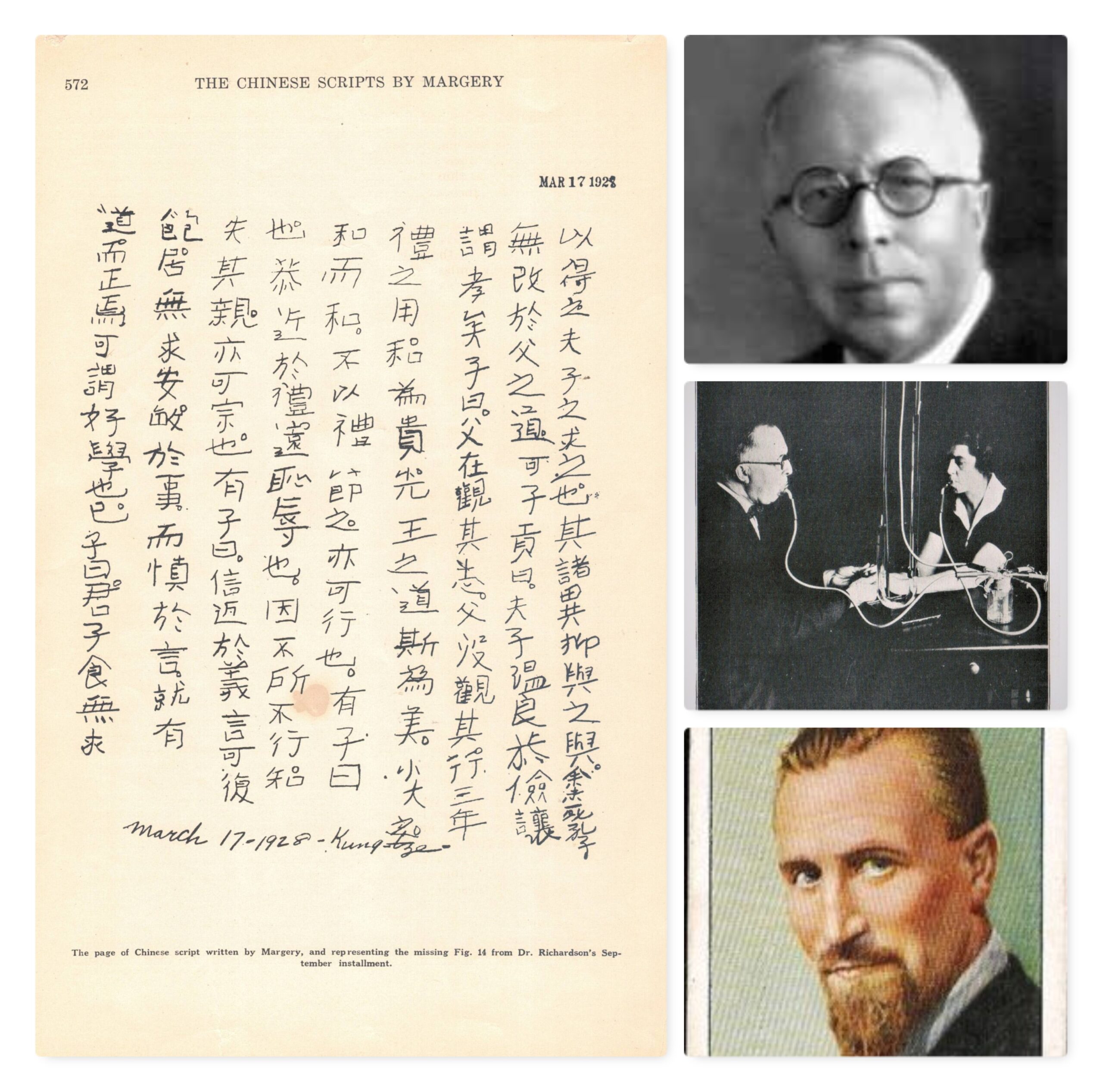
The most mind-boggling mediumistic phenomena ever reported, at least in my opinion, took place in New York City in late 1926 – 100 years ago — at the Park Avenue home of Judge and Mrs. William Cannon. It was reported by Dr. Neville Whymant, a professor of linguistics at Oxford, London, Tokyo, and Peking Universities who was in the United States to study the languages of Native Americans (bottom photo). He is said to have been conversant in 30 languages. During 12 sittings with direct-voice medium George Valiantine at the Cannon home, Whymant claimed to have carried on conversations with “departed spirits” in 14 different languages, including Chinese, Hindi, Persian, Basque, Sanskrit, Arabic, Portuguese, Italian, Yiddish, and Greek. He also conversed with his deceased father-in-law, who spoke in his characteristic drawl, reminiscent of the West County of England. The most noteworthy communicator gave his name as K’ung-fu-tzu, which Whymant recognized as that by which Confucius was known. At first, Confucius spoke in an ancient Chinese dialect, which Whymant recognized but in which he was not fluent. He asked the “voice” to speak in a more modern dialect (Mandarin), and the two then carried on a conversation.
Initially, Whymant thought it some kind of joke, although he couldn’t imagine a trickster knowing such classic and fluent Chinese, especially an ancient dialect with all the proper tongue twists. To test the “voice,” Whymant recited the first line of one of Confucius’s poems and asked the voice for the next line. The “voice” responded with the remaining 14 lines of the poem in the modern Chinese dialect. Whymant then asked the “voice” about another poem, one that had stymied scholars. The “voice” responded and explained that copyists had mistranslated one word, thereby giving rise to the confusion. The “voice” then gave the proper translation, and the poem then made sense to Whymant. (See blog of October 24, 2022) Moreover, the “voice” referred to a book Whymant had recently authored but still not published about the Mongolian language. Whymant was fairly certain that nobody present knew of this book. Whymant added that his report was conservative and did not do justice to the experience. Had he given “full rein” to the story, it would “have astonished people.”
Jump ahead to March 1928 and the home of Dr. Leroi Crandon, a Boston, Massachusetts physician and Harvard University medical school instructor. Crandon’s wife, Mina, also known as “Margery,” (middle photo) was, like Valiantine, a direct-voice medium. Present at many of the sittings with Margery was Dr. Mark Whymant Richardson (top and middle photos), like Crandon, a lecturer at Harvard and remembered today mostly for his contributions to his research of typhoid fever. (See blog of June 29, 2026 for more about Richardson). In the September 1928 issue of “Psychic Research,” published by the American Society for Psychical Research, Richardson reported on a number of his sittings with Margery in which Confucius, Lao-Tse and other Chinese philosophers communicated. The case is further discussed in the October 1928 (Whymant), and August 1929 (Malcolm Bird), issues of the ASPR journal, as well as the SPR Journal of March-April 1928 (Whymant).
In all of Margery’s sittings, her deceased brother, Walter Stinson, was first to speak and was the “control” for all other voices heard, i.e., he was the medium on the Other Side. Richardson had heard of Professor Whymant’s experiences and asked Walter if it were possible to get “Confucius” to communicate through Margery. Walter replied that he didn’t know the Chinese language and didn’t see what that would accomplish. Richardson replied that Walter might get something in ancient Chinese which could be identified and be evidential. Walter explained that he could not reach Confucius directly, but only “in an impersonal way.” He further explained that when and if Confucius manifests, he is not necessarily personally present, although he was present when he communicated with Professor Whymant.
Automatic Writing
On March 10, 1928, Walter reported that he had made arrangements for some Chinese communication to take place after that night’s sitting. Then, after the sitting was concluded and Margery was no longer in the trance state and sitting in bright white light she took up a pencil and wrote an introductory communication, in English signed by “Tao.” The signature was duplicated in Chinese, all of it in the presence of Richardson and 11 other witnesses.
Historians are uncertain as to whether there was actually a person named “Tao” or whether it was strictly a philosophy taught by Lao-Tse. Likewise, there is confusion as to whether Lao-Tse existed and, if he did, whether he was a founder of Confucianism or a contemporary of Confucius. He is credited with being the chief proponent of Taoism. There is further confusion as whether both Confucius and Lao-Tse were referred to as “the master,” or just one of them had been given that honor.
Walter communicated said that Lao-Tse was among the Chinese who would communicate. It was on March 15, after a sitting of some 32 minutes, that Margery came out of her trance, picked up a pencil and began automatic writing, the words flowing from her pencil in English, but in a columnar manner from top to bottom, rather than across the page, the manner of Chinese writing. With punctuation added for clarity, Margery’s hand wrote:
“Myself, Lao-Tse I come to you most honored of peoples, myself I come, Lao-Tse. I kept in my charge many Books. I also wrote of My life, My philosophy, My ways and thinking. I would not change. They are as I would have them, correct. I had not so convincing a spirit as Kung-Futze but our philosophy compares favorably. Myself Lao-Tse you need today. First to learn the how (tao) of Universe and also would learn the why (teh) I have learned both. Much Ethics is Needed for the courage of man more ethics – Much occupation and study – Kung-futze will come before many (word illegible) sitting. He travels much and has great spirit. I depart. I, Lao-Tse.” A figure was drawn, which resembled an ancient Chinese altar.
At the next sitting, on March 17, Walter opened and said that he was providing the energy for the night’s entertainment but that he was in no way responsible for what the Chinese guests might do or say. He then called for a pad and pencil, asked that the red light be turned on, and that Margery be allowed to write. Richardson reported: “Where upon Margery took up the pencil and wrote on the uppermost page of the pad in nine vertical columns in a Chinese dialect, but with such speed that those nearest her could only assume that her hand was merely trembling.” According to Richardson, the longest time consumed in the writing of any one column was seventeen seconds and the shortest was twelve seconds. Upon examination under full lighting in another room, Richardson and others present observed what they took to be Chinese script (see accompanying figure). Margery’s script is said to have been extracts from the first book of Lun Yu, one of the four canonical books of the Confucian classics.
Because of the confusion noted above, it is not clear as to the identity of the “spirit” using Margery’s hand – whether Lao-Tse, Confucius, or a group-soul subscribing to the philosophies of Lao-Tsu and/or Confucius. The script was presented to two Chinese scholars living in Boston, a Dr. Hsieh and Dr. Tse-fang F. Huang, the latter the Chief of the Department of Epidemiology in Peking who was attending the Harvard graduate school of public health. The two scholars referred to the writing as “original” text, rather than “ancient” text and said that a rapid and accurate reading was not possible, but Huang provided a rough translation, as follows: (It is uncertain as to which “Master” they were referring to.)
“The Master said: ‘The primary object in life of a man of virtue is not to be always well-fed, nor to be always comfortably housed. He is diligent in his work and careful in his speech.’
“Yu-tse said: ‘Truth is akin to faithfulness, as it enables one to abide by one’s words; humbleness is akin to politeness, as it keeps one away from disgrace and shame.’
“Yu-tse said: ‘serenity is the most valuable fruit of politeness. This is the most valuable teaching of our ancient sages.’
“He is a filial son who is able to do a small as well as a big type of work.’
“Kung-fu-tze said: ‘He is a filial son who studies his father’s ambitions during his lifetime and observes his life history after his death, and who does not forego his father’s ways within three years of his death.’
“Tse-king said: ‘The Master’s ways were characterized by kindness and gentleness, humbleness and politeness Neither should our ways differ from his ways.’”
A second sheet, written through Margery’s hand, later, yielded the following translation:
“The Master said: ‘Isn’t it a happy thing to have the opportunity to study and to review your studies? Isn’t it a pleasant matter to receive a call from a friend afar? Isn’t it like a true gentleman to possess knowledge and yet not to be disheartened when his knowledge is not known to others.?’
“Yu-tze said: “It is improbable to have a man who is good to his parents and brothers, and who could be disobedient to his superiors. It is impossible to have a man who is not disobedient to his superiors and who could be a disturber of the public peace.’”
Skeptical View
Since the book of Lun Yu could, theoretically, have been made available to Margery, skeptics argued that she might have memorized it all beforehand and that she knew the Chinese language or that her Japanese houseboy coached her in the Chinese language. They further pointed to the fact that the calligraphy was crude and below the quality of the great Chinese scholars. However, the counter-argument was that Margery knew nothing of the Chinese language and that the crudeness was a result of Margery’s hand lacking the dexterity for such usage.
The scripts were submitted to Professor Whymant for examination and comment. He concluded that (a) The characters are veritably Chinese script, in normal form. (b) That there is a lack of firmness about some of the strokes, and an absence of symmetry and balance, strongly suggesting that the hand holding the pen was that of a foreigner. (c) That the words are not mere extracts learned by heart from the Chinese classics. He agreed with Dr. Huang’s translation and otherwise concluded that – given the witnesses to the writing – that it was not recorded by a native Chinese person familiar with the Crandons and part of some hoax by Dr. and Mrs. Crandon. However, being a respected academician, Whymant was reluctant to insist upon the spiritistic interpretation, although he said he had considerable sympathy for those who lean in that direction.
Richardson concluded his report with this: “Under the circumstances all must agree, I think, the simplest explanation is the spiritistic one – that Walter is what he claims to be, the still-existent brother of Margery; that through years of patient experimentation, assisted by the persistent cooperation of the Lime Street circle, he has mastered many of the conditions incident to mediumship in general, and that of Margery in particular; that the control thus gained is not restricted to physical conditions, but is now becoming extended so as to include mental phenomena; that this mental control can under proper supervision be delegated to other entities, such as the Chinese who exist apparently under conditions similar to his own; that this control is independent of space conditions and has come in relation to the physics of wireless, in which domain Walter promises enormous progress during the next few years. An interesting point in this connection is Walter’s statement that, in order for him to get into communication with any individual, mediumistic or otherwise, on our plane, he must first have had personal touch with him – possibly in order to get his wave-length. Because the spiritistic explanation is simple does not, of course, assure its truth. Neither should its simplicity require its rejection.”
Unfortunately, few people have dug deeply into the subject matter and their boggle threshold remains low. They accept the supposed debunking evidence of both Valiantine and Margery and assume that they were both charlatans. Therefore, both Professor Neville Whymant and Dr. Mark Richardson must have been duped or they were part of the conspiracy to dupe others. It’s also unfortunate that all the other witnesses to the Confucius voice and the Margery writing were never interviewed, or, if they were, I have not come across them. It is known that Judge William Cannon existed and served on the board of the American Society for Psychical Research and there was some indication that Whymant was upset with Mrs. Cannon for having made his participation public. One might assume that Judge Cannon would have objected to Whymant’s story if it hadn’t happened at his home.
The “know-nothings” are apparently unaware of the research indicating that what was taken to be “tricks” by the medium were, in fact, synchronistic spirit activities. The problem is that one can’t claim spirits to prove spirits. And so it goes a hundred years after Professor Whymant and Dr. Richardson were eyewitnesses to some very intriguing and convincing supernormal phenomena.
Next blog post: September 21
Michael Tymn is the author of The Afterlife Revealed: What Happens After We Die, Resurrecting Leonora Piper: How Science Discovered the Afterlife, Dead Men Talking: Afterlife Communication from World War I. and No One Really Dies: 25 Reasons to Believe in an Afterlife. His latest book Consciousness Beyond Death: New and Old Light on Near-Death Experiences is published by White Crow books.

Michael,
Thanks for this excellent piece. It reminds me of my interest in Confucius six years ago which resulted in a Youtube video entitled ‘Is Confucius Dead?’ (2,300 views). It is different in its approach with a large amount of extra material. But it still covers Whymant, Margery, and Dr Henry Hardwicke a medium of Niagara Falls. Also, Reginald Johnson, a Mandarin speaking British diplomat and tutor to the last Emperor of China. In his view, Margery’s scripts were in a modern script, with poor penmanship and that no Chinese person would claim it as his own apart from possibly an ignorant domestic servant or foreign student of Chinese.
All in all, though, I agree with Michael that the evidential nature of this material is remarkable and it is a great shame Whymant felt unable to back the spirit hypothesis given his direct contact with his own father and the startling historic revelations regarding the Analects. Interestingly, Walter reported that three Chinese disciples of Confucius were guarding the table while Margery wrote her script, although he also stated : “Make no mistake, Confucius was not here but worked from a distance”.
Here is the link:
https://www.youtube.com/watch?v=rSWk7sAXMJQ&list=PLLB-82YMhiPFPKSm2Ke69aK0DKTftpvo0&index=33
Keith, thanks for the providing the link to your excellent video on the subject. There was so much more to say here on the subject, especially on the cross-correspondences, but I was already over my word limit. I should point out that Margery’s houseboy was Japanese, not Chinese, and that Japanese and Chinese are about as much alike as English and Spanish. It’s possible he knew the Chinese language and taught it to Margery, and that she happened to read the works of Confucius and had a photographic memory and that her written Chinese was so fast that she could write each column of the script in 12-17 seconds. There seem to be no limits as to what is ‘possible’ and that absolute certainty is clearly not possible.
Mike,
Extremely interesting and evidentiary spirit communications!
People who are unable to and/or who do not want to believe, will come up with any excuse not to.
Take care,
Yvonne Limoges
Michael, you are likely already familiar with this book, but may I commend a title to you? “Great Moments of Modern Mediumship, Volumes 1 and 2,” by Maxine Meilleur (ALM, Harvard), 2014.
I so appreciate your hard work on sharing so many profound details of mediumship with us. I read everything you send with fascination.
Thanks, Brian, for the kind words. I don’t recall the book you mentioned, but I’ll look for it.
I’m currently reading White Crow’s latest release, “Silver Birch’s Medium,” by Nick Richbell, whose doctoral research was on the medium, Maurice Barbanell. Since Barbanell became a spiritualist, the assumption might be that he was heavily biased and not a credible witness. However, he was also a journalist and apparently exposed a number of frauds among the hundreds of mediums he sat with and tested. It was estimated he attended more than 3,000 seances. It was interesting to note that in 1937, he spent several days with Margery. Of course, she was well past her prime at that time and had been written off by many as a fraud. However, Barbanell called Margery the “eighth wonder of the world,” commenting that she was a simple, honest woman who was not capable of cheating. He also referred to her as “the greatest medium Spiritualism every produced.”
Michael and Newton,
First, a thank you to Newton for his last comment. Second, there are funny stories about Margery and the mediumship, which happens to many mediums. From page 52 of J. Malcolm Bird’s book on Margery, the Medium: “An Italian script was given to a linguist (Whymant?), who was not able to translate it completely. The first sentence means, “Although the truth is clear to rne, he is not able to believe”; but the word ending in a consonant stumped him. This must be either an imported slang expression, or sheer nonsense. The linguist did not recognize it as slang; but F. H.’s (Friend Husband) bootblack did, and supplied the translation: “He is saturated to the point of disgust with the belief that he knows everything.”
Liberty has been taken here; the figure of speech which the original employs to represent the notion of saturation to repletion is not one that can be presented to a respectable English-speaking audience! The unprintability of the text in English does not argue against its having been printed in Italy, so it may still be a quotation—I do not know.
Roback got another note in Italian on the twenty-second, after the sittings of the fifteenth and twenty-first had brought out trances which need not be further reported. As originally written it stood, “Mi prolai in una selva oscura the la diritta via era smaritta.” At once the word “prolai” was crossed out, and “volai” written in above; and the last word was revised to read “smarrita.” Next night, the word “trorai” was written alone, with no explanation. Students of Italian will recognize the passage as one from the Divine Comedy, “It came to me in a dark forest that the direct way was lost.” But the critical point remains to be told. The words “prolai,” “volai” and “trorai” are three variant readings for this line, between which, I am informed that classicists have been unable to choose!
On July 23 1923 Walter talked long and freely in trance, but said nothing I need quote here. On the twenty-fourth, there came to Cross two bits of writing in Anglicized Chinese. One read, “Kein Yuen hang li chilig”—the great General Kein Yuen is here. Aleck said that this name was one to conjure up horror with, and that his only explanation for its delivery to him was that some deceased Chinese friend was spoofing him. (Aleck was connected to the Chinese). It will be seen that Aleck had gone the whole distance in acceptance. The second of these scripts read, “Chu hi,” and means “Chinese man.” While a boy at Canterbury School, Aleck had a face so broad and eyes so peculiar that the boys, as boys will, hung a name on him, just as an American youngster might get nicknamed “Chinese” if his facial contours suggested the Chinese type. ”
I use the term layers of meaning. You receive a message which makes sense to the sender (in spirit) but requires work to understand the meaning. I once received a strange word and the spirits repeated this technical word three times to make sure that I had that particular word. (The spirits said that the recipient would understand). I passed it on (not much of a reaction) and found out years later what it meant to the person. She had discussed its meaning in a lecture one week before the message arrived. The spirits knew what the intent was but I didn’t.
Thanks,
Bruce
Bruce, yes, there is so much confusion. I just finished reading “Silver Birch’s Medium,” and there was even much confusion and conflict among Spiritualists as to whether Maurice Barbanell communicated, as set forth in “The Barbanell Report.” Some verbiage used by the alleged Barbanell was supposedly foreign to him when alive and thus some Spiritualists claimed it was not Barbanell. However, so much research says that the spirits communicate ideas while the medium puts his or her own vocabulary to them. There is no mention of this in the debate between Spiritualists.
Thanks again for an excellent article Michael and please thank Keith Parsons for the link he disclosed. It was most revealing and also enjoyed Keith’s lovely garden. Wonderful background to his work .Must inspire his studies. Cheers. Andrew .
Thank you, Andrew. I’ve informed Keith of your comment. I have also envied his garden and home while being stuck in “paradise” awaiting hurricanes.
Dear Michael,
Your account of Whymant and the ostensible Confucius strikes me as belonging to a particularly interesting category of survival evidence – cases in which what is demonstrated through a medium is not merely information, however obscure, but a highly developed ability. In the Whymant sittings, the remarkable feature is not simply the production of Chinese unknown to the medium, but the apparently dynamic exercise of linguistic and literary competence: the use of an ancient form of Chinese, the shift to Mandarin at Whymant’s request, responsive conversation, completion of classical material, and discussion of a textual difficulty. What gives this special evidential weight is that the performance occurred before an interlocutor unusually well qualified to judge whether the competence being displayed was genuine. Whymant was not merely witnessing the phenomenon; his expertise became, in effect, part of the measuring apparatus.
A close analogue seems to me the famous Maróczy–Korchnoi chess match. There again, the ostensible deceased personality did not merely provide veridical information about chess, but appeared to play chess at a very high level over an extended series of moves against one of the strongest players in the world. At one stage Korchnoi was reportedly uncertain that he would win, while Bobby Fischer later reportedly regarded the play as being of grandmaster quality. What links the two cases is therefore not simply exceptional skill but expert-validated performance: the ostensible communicator is confronted in real time by a living expert capable of recognizing whether the performance is authentic or superficial.
Such cases seem to strain a super-psi explanation in a rather different way from, say, the cross-correspondences. In the latter, the explanatory burden concerns the paranormal acquisition, distribution and coordination of complex information.
In the Whymant and Maróczy cases, however, super-psi must apparently do something more: it must obtain whatever information is required and then organize and deploy it as a sustained expert performance responsive to changing circumstances. Knowing a great deal about chess is not the same thing as playing grandmaster chess, just as paranormal access to Chinese texts is not the same thing as conducting a responsive linguistic and philological exchange. One begins to ask not merely, “Where did the information come from?” but “What, exactly, is doing the thinking?” Super-psi is not thereby logically excluded, but the more capacities assigned to it, the less obvious becomes its advantage in explanatory economy over the hypothesis of an actual communicating intelligence.
There is another aspect of your Chinese cases that has long struck me. The body of ostensible discarnate communication with which most of us are familiar is overwhelmingly Western in origin, and very often more narrowly British or American and English-speaking. That is rather curious when death itself is hardly an Anglophone phenomenon. Non-Western communicators certainly occur, but they seem comparatively uncommon within the literature that has come down to us.
I recently came across a book edited by Jack Hunter and David Luke, “Talking With the Spirits: Ethnographies from Between the Worlds”, which suggests that we should be careful about what conclusion we draw from this. Its contributors examine spirit-mediumship, ancestor relations, possession and related phenomena in settings ranging from China and Hong Kong to Cuba, Brazil and shamanic contexts. The wider human phenomenon of relations with spirits and the dead therefore appears far less culturally restricted than the classic Spiritualist and psychical-research literature might suggest. Perhaps what is peculiarly Western is not communication across the boundary itself, but the particular literary and institutional form in which it was documented – the séance, the investigated medium, the transcript, the evidential case, and eventually the published book.
All this made something I encountered very recently especially striking. In Mildred H. Collyer and E. Patrick Dampier’s rather obscure 1937 book “When We Wake: How Souls of Many Grades See Their Own After-Life”, Collyer describes an ostensibly Chinese influence that began around the end of 1930 and purported to derive from a group associated with Chuang Tzu, of whom she says she was at the time completely ignorant. The communicators included Chang Li and Chang Lin, described as “current aspects” of the Chuang Tzu group; collectively they called themselves “leaves falling from Chuang’s Tree.”
What makes this particularly relevant to your article is their very curious account of their own identity. Chang Li tells Collyer that the separate personality adopted for purposes of communication is of little importance compared with the larger group from which it derives. He compares such personalities to temporary leaves or petals and says that, when his particular work is finished, he will “absorb again to the greater personality” and lose that separate identity. Collyer herself concludes that these group-guides appeared to be emanations from very ancient spirits whose personality had either become merged or was no longer individual in anything like the ordinary human sense.
This immediately reminded me of Walter Stinson’s peculiar qualification in the Margery sittings – that Confucius could be reached “in an impersonal way,” and that a manifestation of Confucius did not necessarily mean that Confucius was personally present – as well as your own suggestion that the Chinese material might somehow involve a group-soul associated with Confucius or Lao-Tse. The parallel with the Chuang Tzu material is quite remarkable.
I would not call it independent corroboration, since the Whymant and Margery sittings preceded Collyer’s experiences and I have no way of establishing that she was wholly unaware of them. But it raises a fascinating question which your article touches upon: what would it actually mean for a personality such as Confucius, Lao-Tse or Chuang Tzu to communicate after more than two millennia of postmortem existence and development? Perhaps our ordinary assumption – that the name of a historical personality must signify the continuing presence of precisely the same sharply bounded individuality familiar from earthly life – is too simple. The literature itself occasionally seems to suggest something more complex: enlargement, affiliation, group-consciousness, and perhaps the capacity to manifest through temporary or derivative personae.
Thus your Chinese cases seem remarkable to me in two quite different respects. Evidentially, they belong to that unusual class in which exceptional competence appears to be dynamically demonstrated before someone capable of judging it. But they also open a much stranger question about the nature of the communicator itself – particularly when the ostensible communicator belongs not merely to another culture, but to remote antiquity.
Best,
Paul
Thanks, Paul, for your thoughts on this intriguing phenomenon. It certainly sounds like a group soul. Kardec and Hugo seem to have had a number of them, calling themselves, ‘Death,” “Angel of Light,” “Shadow of the Sepulcher,” etc. Stainton Moses’s Imperator seems to have been a group soul.
As Frederic Myers explained it through Geraldine Cummins, a soul belonging to the group of which he was part lived a previous life and built for him a framework for his own earthly life. The spirit – the bond of the group soul – manifests, he said, many times on earth. “We are all of us distinct,” he continued, “though we are influenced by others of our community on the various planes of being.” He further communicated that a group soul might contain twenty souls, a hundred souls, or a thousand souls and that the Buddhist’s idea of reincarnation is but a half-truth. “And often a half-truth is more inaccurate than an entire misstatement. I shall not live again on earth, but a new soul, one who will join our group, will shortly enter into the pattern of karma I have woven for him on earth.”
As Kardec came to understand, the distinctive character of a spirit’s personality is in some sort obliterated in the uniformity of perfection, and yet it preserves its individuality. “This is the case with the superior and pure spirits,” Kardec related. “In this condition, the name they had on earth, in one of their thousand ephemeral corporeal existences, is quite an insignificant thing. Let us remark again that spirits are attracted to each other by the similarity of their qualities, and that they thus form sympathetic groups or families…but as names are necessary to us to fix our ideas, they can take that of any known personage whose nature is best identified with their own…It thus follows that if a person’s guardian angel gives his name as St. Peter, for instance, there is no actual proof that it is the apostle of that name; it may be he, or it may be an entirely unknown spirit belonging to the family of spirits of which St. Peter makes a part; it also follows that under whatever name the guardian angel is invoked, he comes to the call that is made, because he is attracted by the thought, and the name is indifferent to him.”
But why so much of it during the nineteenth century and so little of it in recent years? Imperator told Stainton Moses that they (the superior spirits) overestimated their ability to communicate. “It is true that Benjamin Franklin did discover means of communication by raps, and that he was greatly aided by Swedenborg in awakening interest among spirits in the subject,” Imperator communicated. “At the time of the discovery it was believed that all denizens of both worlds would be brought into ready communion. But, both on account of the obstinate ignorance of man, and of the extent to which the privilege was abused by spirits who assumed well-known names and personated them and so deceived men, that privilege has been greatly narrowed.”
If I’m not wrong (and, Michael, please correct me if I am), various mediums, including even the inestimable Leonora Piper, were induced, on occasion, to speak in the voices of totally fictional characters. If so, small wonder that Imperator cited false impersonation by earthbound spirits as one reason that mediumship declined in the early 20th Century. One also wonders whether such phenomena may have helped, among other considerations such as professional reputation, to keep the great William James from fully accepting, at least publicly, the reality of spirit communication.
Paul,
An excellent analysis. I particularly loved “leaves falling from Chuang’s Tree.” I have found that the various personalities are from groups with aligned thinking. I once asked about this alignment and was told that a certain individual was “the nominal boss”. Each spirit retains their personality but represents their group – leaves falling from the tree.
Your observation “the particular literary and institutional form in which it was documented – the séance, the investigated medium, the transcript, the evidential case, and eventually the published book” is very interesting. I suspect that is follows the legal process. Again, excellent analysis.
Thanks,
Bruce