
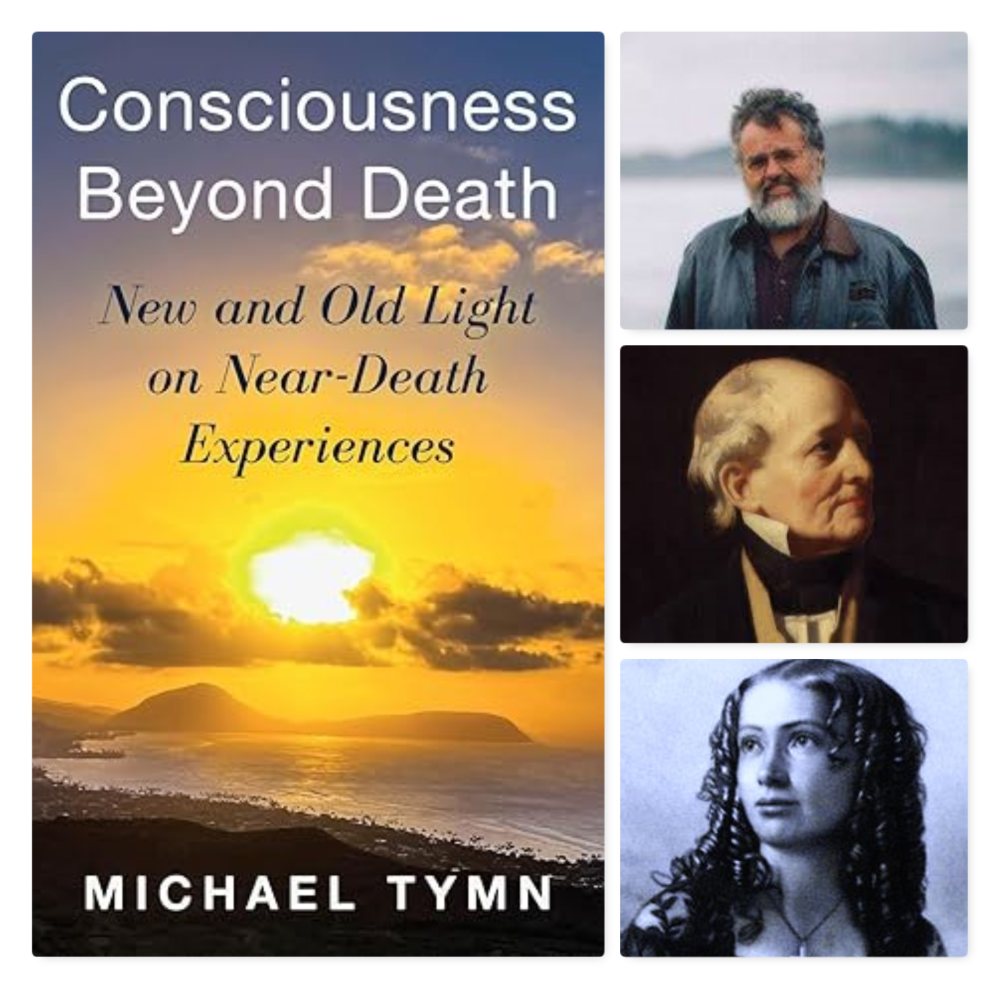
“The possibility of the spirit leaving the body for a time and then returning to its usual activity has been demonstrated many times,” wrote Cora L. V. Richmond in her 1923 book entitled My Experiences While Out of My Body. She further pointed out that the separation of the two bodies can be caused by accident or illness but sometimes by “voluntary absence,” referred to as simply an out-of-body experience (OBE).
While all the near-death experience (NDE) research carried out since Dr. Raymond Moody’s 1975 seminal book, Life After Life, has offered overwhelming evidence of mind-body dualism – a physical body and a spirit body, or soul – the pre-Moody stories, such as Richmond’s, are usually forgotten or overlooked. Some of them offer even more detail than the recent NDEs and are to some extent more veridical since it seems far less likely that the experiencers had heard of similar stories and had subconsciously drawn from those stories, thereby coloring their own experiences. To put it another way, the older stories are often more credible.
The debunkers often argue that a person can experience some of the phenomena reported by NDErs without being near death. They don’t seem to realize that the person does not have to be “near-death” in order to experience the unusual phenomena reported by the experiencers. As I understand it, even drug-induced experiences and those of pilots reporting similar phenomena while undergoing anti-gravity training in a centrifugal-force machine, still support a duality of body explanation. I have never had an NDE, but I had what seemed to be an OBE during a four-mile race in Hawaii during 1979. I was 42 at the time and had been running and racing for some 25 years, never having had the same experience before, nor did I have another one in the years after that. It was one-time only experience during more than 200 races. Moreover, it was not the so-called “runner’s high” that I experienced a number of times over those years.
I was sharing the lead with a much younger runner as we passed by the two-mile mark in 9 minutes, 38 seconds, Upon hearing an official call out our time, I recall thinking how effortless it felt when I should have been experiencing much more stress and strain at that pace. I felt like I was floating. As I momentarily pondered on that, I sensed myself about 12-15 feet above my body, looking down at myself and my fellow runner as we were striding by side by side. I still have a vivid snapshot in my mind of that moment. It lasted for about two seconds and then I went from “floating” to the stress and strain that I should have been experiencing. The remainder of the race required effort. There was no more floating, just striding. My fellow competitor outkicked me over the final 200 yards, but those two seconds of looking down at myself have remained in my conscious mind ever since.
There may be other explanations offered by the skeptics, but the dualistic mind-body makes the most sense to me. Here are a few quotes from early NDErs. the more complete stories told in my 2025 book, Consciousness Beyond Death, although part of the ending quote from Dr. C. G. Jung has been added from his book, Memories, Dreams, Reflections.
Admiral Sir Francis Beaufort (middle photo), most remembered today for devising the Beaufort Wind Scales, recalled almost drowning in his early days of British navy life, about 1795: “From the moment that all exertion had ceased – which I imagine was the immediate consequence of complete suffocation – a calm feeling of the most perfect tranquillity succeeded the most tumultuous sensation. It might be called apathy, certainly not resignation; for drowning no longer appeared an evil; I no longer thought of being rescued, nor was I in any bodily pain. On the contrary, my sensations were now of rather a pleasurable cast, partaking of that dull but contented sort of feeling which precedes the sleep produced by fatigue. Though the senses were thus deadened, not so the mind; its activity seemed to be invigorated in a ratio which defies all description; for thought rose after thought with a rapidity of succession that is not only indescribably, but probably inconceivable, by anyone who has been himself in a similar situation.”
A..S. Wiltse, a physician of Skiddy, Kansas, was, in 1889, suffering from typhoid fever, and thought to be dead by another physician: “I realized my condition and reasoned calmly thus. I have died, as men term death, and yet I am as much a man as ever. I am about to get out of the body. I watched the interesting process of the separation of soul and body…As I emerged from the head, I floated up and down and laterally like a soap bubble attached to the bowl of a pipe until I at last broke loose from the body and fell lightly to the floor, where I slowly arose and expanded into the full stature of a man.” After continuing to observe the separation, with “astonishment and disappointment,” he then found himself back in his physical body, the “silver cord” connecting the two bodies not breaking..
Fanny Ruthven Paget, a resident of Houston, Texas, was suffering from severe pneumonia in 1911. “All about and above me I could see nothing, but fancy my astonishment if you can, when looking down, I saw my body resting peacefully on the bed, representing what is commonly called a ‘dead person.’…There were loved ones and many others welcoming me and rejoicing that I was with them…” She saw a “movie” of her entire life to that point and was told that it was not yet her time, that she must return and build upon what she had seen.
Cora L. V. (Scott) Richmond (bottom photo), a resident of Cuba, New York, began having psychic and out-of-body experiences in 1851, at age 11, giving lengthy discourses during her teens on various philosophical, metaphysical, social, political, and reform matters, sometimes in foreign languages, to standing-room only audiences in New York, San Francisco, London, and afar. She died in 1923, at age 82. She explained one NDE a few years before her actual death: “There was a perception of great light, a consciousness of illumination, an awakening to the vastness, the unlimitation of this Realm of Spirits. All else was swallowed up – eclipsed by the wonderful experiences that came—the Beloved Presences – the vistas of luminous Spirits! This was a state of Super-Consciousness, the awakening of faculties and perceptions before unknown, or being aware, almost without limitation, of KNOWING! Whatever is the nature and state of the real Ego this seemed as near to the Absolute as one could well conceive! There was so much of me! There was so little of me! There were so many and such surpassing spirits! How one shrinks in the presence of the mighty ones! How one expands in the Knowledge of the Infinite: His Image!”
Sir Auckland Geddes, a British surgeon and statesman, addressed an audience at the Royal Medical Society annual meeting of 1937, telling of the experience of a man whose credibility he did not doubt, with implications that he was telling of his own experience: “…at no time did my consciousness appear to me to be in any way dimmed, but I suddenly realized that my consciousness was separating from another consciousness, which was also me. These, for purposes of description, we could call the A and B consciousness, and throughout what follows, the ego attached itself to the A consciousness….Gradually I realized that I could see not only my body and the bed in which it was, but everything in the whole house and garden, and then I realized that I was seeing not only ‘things’ at home, but in London and Scotland, in fact wherever my attention was directed.”
Roger Hart (top photo), a geophysicist and research professor at the University of Oregon, had an NDE while climbing Mt. Everest in 1962, falling about 180 feet down the side of a snowy cliff: “I could see in all directions at once, not with the seeing of eyes but the seeing of dreams. I felt no fear and no cold; space seemed to shrink around me, or perhaps I expanded to it. At any rate, I was no longer afraid of the emptiness below me.” He recalled thinking, “Here you are about to die and you feel wonderful – you are so weird.”
Carl Gustav Jung, a Swiss physician and pioneer in psychiatry, upon breaking his foot and having a heart attack in 1944: “It seemed to me that I was high up in space. Far below I saw the globe of earth, bathed in a gloriously blue light…it was as if I now carried along with me everything I had ever experienced or done, everything that had happened around me, and I was it. I consisted of all that, so to speak I consisted of my own history, and I felt with great certainty: this is what I am.”
Jung added that he would never have imagined that any such experience was possible and concluded that it was not a product of his imagination. “The visions and experiences were utterly real; there was nothing subjective about them; they all had a quality of absolute objectivity.”
Next blog post: October 19
Michael Tymn is the author of The Afterlife Revealed: What Happens After We Die, Resurrecting Leonora Piper: How Science Discovered the Afterlife, Dead Men Talking: Afterlife Communication from World War I. and No One Really Dies: 25 Reasons to Believe in an Afterlife. His latest book Consciousness Beyond Death: New and Old Light on Near-Death Experiences is published by White Crow books.

Michael,
I live close to a famous beach and a local surfer is Mick Fanning. He has just released his new book. Following his famous shark encounter earlier that year of punching a shark (2015), Fanning competed in an emotional heat against his rival Kelly Slater. After riding a crucial wave, he stated, “The emotions were too much to handle and I kind of went into an out-of-body experience. It was like I was watching it go down and I was just a fan. I feel like it wasn’t even me and I’m just along for the ride.”
Mick lost three brothers and mentions his visit to a medium in his new book.
It struck me that elite sportspeople are often spiritual. When Mick was interviewed, it was a matter-of-fact point of view.
Thanks
Bruce
I have little doubt that both OBEs and NDEs are genuine experiences. But as I’ve grown older and have by now immersed myself in seemingly countless versions of such stories, I find myself increasingly less certain that they offer anything more than, at best, the briefest glimpse of what remains an impenetrable mystery to those of us still confined to space and time, confined by our inability to think or even imagine outside of their parameters.
Thus more and more, I have come to believe that it is a mistake, so common among those fascinated with the super-normal, to pursue any sort of conceptual certainty or clarity about what lies ahead after we transition from this vale of tears. That something does lie ahead has been amply indicated for those with eyes to see. But as to what that thing is, how it works, how it unfolds, where it leads, we really haven’t a clue.
Yes, we do have various accounts via mediums and NDErs, but they don’t necessarily agree with one another and are often too metaphorically vague to put much stock in, at least for me. I thus find myself increasingly drawn to the observation of my youthful mentor, Soren Kierkegaard, to the effect that the highest things like God and the afterlife can only be believed, not conceived.
Trust, for me in this final chapter of earthly life, has come to trump knowledge, so while I remain curiously engaged with things super-normal, I have gladly given up any idea of relying upon them. Seeking to grow in love and wisdom, always two steps forward, one back, seems to me the most meaningful way to live out life, along with nurturing the hope that Julian of Norwich was right, that all, in the end, shall be well, all manner of things. Is that not enough?
To your classic NDE accounts I would add another from an anonymous author who gave his manuscript to Amos Fiske who then tucked it away in a drawer for 19 years before submitting it to a publisher. The author of Beyond the Bourn was seriously injured in a train accident after the American Civil War which led to his NDE. As is common in NDE accounts, the author acknowledges the difficulty of describing his experience:
While NDEs have entered the wider public awareness consequent to Moody’s Life After Life, I would venture that far more people are familiar with the conceptions of the afterlife as portrayed through religion. If subconscious influences play a major part in how NDEs are reported, then there should be a greater quantity of religious themes represented in all NDE accounts, modern and historic. While there are fantastic aspects of many modern NDEs, both Cora Richmond’s account and that contained in Beyond the Bourn also have their own mind-boggling aspects.