
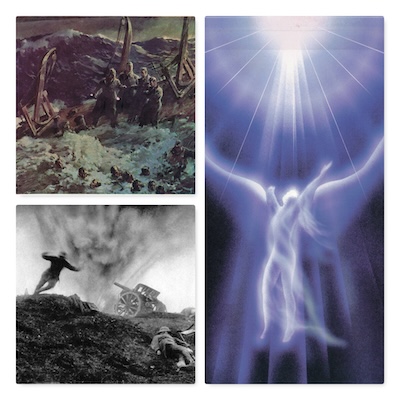
Although I often find myself shaking my head in disgust at what seems like utter insanity in the world today, I try to remind myself that the incompetence, foolishness, senselessness, stupidity, craziness, whatever it is called, all add up to an adversity that offers learning experiences. I wonder what life would be like if it were one of total creature comforts and hedonistic pleasures, as depicted by Nero playing his fiddle while Rome burned. If not for failures and adversities, how would we learn? If we were to reach the point of pure pleasure and comfort, would it defeat the idea that this life is part of a larger life and that the objective of this life is to expedite learning from our mistakes and adversities? It seems to me that it would. Is life one big paradox?
In the 2024 book, An Urgent Message for Humanity, a group of scientists, including Drs. Melvin Morse and Raymond Moody, report on a controlled study they carried out with a number or credible mediums for the Bigelow Institute for Consciousness Studies. The primary questions put to the spirit world through the mediums had to do with the progress, or lack of it, being made since 1857, when French educator Allan Kardec’s book, The Spirit World, was published. I believe they could have gone back another seven years and started with the works of John Edmonds, George Dexter, Adin Ballou, and Robert Hare, but the exact starting point does not appear that critical. The answers would surely have been the same. The researchers asked if the Spirit World and Mankind have failed to achieve good progress in securing human spirituality. They asked if earthbound spirits have impeded, sabotaged, or distorted human spiritual progress and why the spirit world has not done better in helping humans progress spiritually.
“The consensus, especially among the core trance mediums, is that humanity has failed to make good progress in securing human spirituality since 1857,” the book reads. “All agree that humans are to blame, yet acknowledge that humanity’s failure is the spirit world’s failure, in the sense that when a child fails, the parent has also failed.” However, the spirits pointed to the paradox of it all – that failures, challenges, temptations, and adversity are required in order for us to learn and progress. “You have not failed,” the response came through one of the mediums. “There is no such thing. More and More of you are waking up, and we are so excited. Keep spreading the word and the love.”
Another spirit stated that “what may be perceived at ‘bad’ or negative experiences are crucial for spiritual growth and that challenges, difficulties, and even adversities are not merely obstacles but essential elements in the journey of spiritual growth. These challenges are seen not as hindrances but as catalysts for growth and opportunities for learning, and they are necessary for the evolution of the human spirit.”
When I encounter adversity, I keep reminding myself that it is a learning opportunity. There are many times when I’d prefer a little less learning and more peace of mind, but I then consider that my adversities are small compared with those of so many others. I could be homeless. I could be in a war-torn country. I could have significant physical limitations. A loved one could have died prematurely. Best appreciate what I have and not dwell on what I don’t have. From there, my thoughts often turn to our political leaders and I try to imagine how successful they would be if they told their constituents that adversity is good for them, that their suffering is required for their long-term welfare. In other words, “grin and bear it” for the greater good. It surely wouldn’t work, as materialism, grounded in epicureanism and hedonism, has too much of a grip on the mindset of the vast majority.
Paradoxes
When I consider the chaos and turmoil in the world today, I quickly look for the paradoxes and usually find some. Many years ago, while doing a lot of sports writing for publications, I came to see many paradoxes in sport and started collecting them with the idea of someday doing a book on sports paradoxes. One key sports paradox is “the harder you try, the more you fail.” In baseball, for example, speed and strength are important, but players learn that ‘swinging for the fences’ is not the way to hit homeruns. The way to do it is take a normal swing while making good contact with the ball. The same principle applies in pitching. Sandy Koufax, considered by some baseball authorities to be the best pitcher ever, was pretty average in ability when a teammate told him to slow down his pitches. His overthrowing was affecting his control. When Koufax learned how to throw a “slower fast ball,” he went from average to great.
As a competitive runner for many years, I learned to train harder and harder until at one point I realized that I was overtraining and going in reverse. I came to understand that resting, i.e., doing nothing, was a key part of making progress as a runner. But too much rest usually means regression. That’s a concern for the best baseball teams in this week’s playoffs, i.e., did they get too much rest for winning so early, thereby losing their rhythm?
Other paradoxes from dozens of clippings in my folder:
- Americans are healthier than ever but enjoying it less.
- The man considered by many as the greatest athlete ever, Babe Ruth, had the antithesis of an athletic build.
- History shows that the death rate always goes down when doctor’s strike (in foreign countries).
- Protests by Christians drove box-office receipts up during the movie, “The Last Temptation of Christ.”
- Air Force pilots are warned not to become too fit, as fitness usually means developing a slower heart rate and that leads to blacking out in high-speed flights.
- The celebrity who refuses to give autographs because he doesn’t believe he should be idolized is looked upon as arrogant.
- Movie actors who portray real people are usually much more financially prosperous than the people they portray.
- Rocky Marciano couldn’t make it as a baseball catcher because of a weak arm. That got him into boxing and being world champion, and he is now remembered for his ferocious knock-out punches in the boxing ring with the same right arm.
- The most noted people buried at Punchbowl Military Cemetery are non-combatants — Ernie Pyle (war correspondent) and Ellison Onizuka (astronaut).
- When in a sand-trap, golfers will often hit in the opposite direction rather than toward the tee in getting out.
- Two swimmers in trouble from a rough ocean swam for shore and died against the rocks; rescue officials said they should have headed out to sea.
- The most-gifted athletes are usually the worst managers, while the least-gifted athletes are often the best managers.
- Losing is better than winning for football teams who want a high draft pick the following year as the team with the most losses gets to pick first.
- Higher pay for military recruits resulted in more independent lifestyles for them and an undermining of unit cohesion.
- Studies suggest that advanced technology in communication methods has made people more lonely.
- In football, the closer you get to the goal line, the more difficult it becomes to score.
- The desire for fame leads to a desire for privacy.
- Speed bumps slow cars down for safety reason, but also slow down emergency response vehicles and therefore have the effect of delaying help.
- According to famed football coach John Madden, the better the player, the less he knows what he does.
- A tailwind is supposed to produce faster times for sprinters, but too much of a wind upsets their rhythm and results in slower times.
- Publishers realized that their average reader wanted a hero who was vulnerable, so they gave Superman some weaknesses.
- Athletes can be too good for their own good. If they break records by too much, they are suspected of using steroids.
- It takes 2-3 days for mail to reach me from the other side of the country, but takes twice as long for mail from my own city to be delivered to me.
- The more we are certain of something, the more we realize how uncertain everything is.
Under the category of religion/spiritual, I have the following paradoxes:
- Embalming is intended to give added life to the body, but indications are that it can hold the unadvanced spirit earthbound, unable to completely free itself from the earth body.
- The more advanced a soul in the spirit world, the more difficult it is for that soul to communicate with us. The less-advanced (in vibration), the easier it is to communicate.
- The “First Coming” was supposed to be a rich, noble person, but it turned out to be one born in a manger in impoverished conditions. (Under the paradox principle, the “Second Coming,” if there is such a thing, should be the opposite of what is expected.)
- The most important subject facing humankind, i.e., survival of the consciousness after death, is the most ignored subject.
- The more you come to know, the more you realize how little you know. That seems to especially apply to the study of consciousness and its survival.
Overall, indications are that adversity, even that extending to widespread chaos, cannot be banished and is in our best interest, whether we appreciate it or not.
Michael Tymn is the author of The Afterlife Revealed: What Happens After We Die, Resurrecting Leonora Piper: How Science Discovered the Afterlife, Dead Men Talking: Afterlife Communication from World War I. and No One Really Dies: 25 Reasons to Believe in an Afterlife. His latest book Consciousness Beyond Death: New and Old Light on Near-Death Experiences is published by White Crow books.
Next blog post: October 20

Michael,
I have been following directions of spreading the word and love. “You have not failed,” the response came through one of the mediums. “There is no such thing. More and More of you are waking up, and we are so excited. Keep spreading the word and the love.”
As the person in the middle, I get to see the frustration of the spirits in trying to spread the word. Progression is up to each of us. I am reminded of a speech in Mr. Smith Goes to Washington where James Stewart is talking about helping others. He describes a hill in his home town where some cars make it over the hill all by themselves. some cars stall going up the hill. The townsfolk race out to help push the car over the hill. Why would they care? People help strangers. Spirits help strangers.
Your articles serve as the car which represents the readers belief. Some readers stall and their are always helping hands.
I was recently told “Read your books but nurture your thoughts to ask the right questions?
Your articles ask the right questions and to help to spread the word. That’s a win.
Thanks
Bruce
Mike, saying 3 in the Gospel of Thomas reads, “The kingdom is within you and it is outside you.” The kingdom, understood as being in Christ is reportedly a state of being and a world. Does that count?
Jon, I am not sure if that is paradox, since it is both. A paradox as I understand it is the opposite of what is accepted being the truth. My “softer fast ball” of Sandy Koufax is an oxymoron, but oxymorons are considered one type of paradox.
Bruce, thanks for your input and encouragement.
enjoyed your sports stories Mike, but disagree with your feeling that the world is getting crazier and more chaotic. it is all too easy to get caught up in the headlines, scandals and outrages. long before the internet, newspapers and television trapped us in their daily diet of shocks. you could ignore the news then and you can ignore it now. knowing the damage caused by earthquakes and civil wars changes nothing, they just keep happening … like rain, snow and drought. combining stoicism with a small measure of epicureanism helps us smooth the rough edges of life until we transcend to paradise where we can rest, reflect and figure out our next move.
It’s a tough question that overlaps with another very thorny one, the problem of evil and suffering in the world. While I agree that adversity can produce character change/growth and that this could well be its purpose, it is also true that adversity produces massive suffering on a global scale, spanning billions of years affecting billions of species, and that much of this suffering does not appear to lead to growth or learning but instead just to misery, degradation, and death. I could give countless examples, but they would nauseate the audience.
I am not accusing you of doing this, but I’m suspicious of blithe explanations of the suffering/evil in the world as merely the price we pay for learning and growth as souls. I think the problem of suffering remains a very difficult one for anyone who thinks seriously about the subject.
Edward, it’s interesting that you and Gordon (prior comment) seem to be at polar opposites. I think I’m in the middle and will admit that the larger picture is apparently beyond my comprehension. However, I do wonder what other explanation there could be for the suffering/evil beyond “it is what it is.” Much to ponder on. Thanks for the comment.
Gordon, you may very well be right. It is difficult to measure and put things in perspective. I haven’t done any real traveling in 10 years and so I depend on the news reported by the media. Perhaps the extreme biases of the various media have created the mania that seems apparent to me, while social media has magnified it. Clearly, at least to me, Hollywood and Madison Ave. have promoted hedonism and epicureanism, and that has resulted in changing values and much of the mania. Whatever the perceived degree of the mania, It may very well be a good learning experience. Thanks for the comment.
Michael,
I wanted to thank you for the reference to the Bigelow study. I have downloaded the various reports mainly to look at the recruitment methods of the mediums. They analyzed if the medium had delivered higher level philosophy. Some already had done this.
The answers were interesting and were affected by the level in which the spirits operated. Brigitet Rix is quoted “In the background are a large team of higher-dimensional beings called the Protectors of the Earth who have never experienced life on Earth. The more ‘advanced’ or ‘evolved’ they are, the less likely they are to have individual names. Their Minds and thoughts blend and merge, and facts and knowledge are melded into one clear flow, which is then concentrated on to my receptive level.”
In my experience there is a mixed bags of spirits. The results are very interesting.
My questions would have been different. I would have asked which spirit/medium writings are to be listed in the top 10. This would have produced a useful outcome, a practical guide.
Thanks
Bruce
I’m reading a book by Senator John Kennedy of Louisiana, titled, “How to Test Negative for Stupid.” He offers a number of interesting paradoxes, including “the best way to kill a bill is to ‘love it death’.” As I understand it, if the senator introducing the bill shows too much interest in it, the other senators become skeptical about its effect and thus the bill is defeated.
A couple of more paradoxes came to mind when I came across an old column I wrote for a running magazine having to do with the “zen of running.” Big Rock was the name of a Japanese Buddhist monk that we hosted many years ago. Actually, his Japanese surname translated to “Stone,” but his dictionary also gave it as “big rock.” I was discussing the motivation and inspiration of the Japanese samurai with Big Rock.
“Perhaps you have confused what it is the samurai is attempting to master,” Big Rock replied. You assume that the samurai is practicing long hours to master his technique as a warrior. This is not true. He is attempting to become master over himself. He knows that he cannot completely be victorious, but at the same time he knows that he must never cease the struggle.
“The true samurai does not train long hours to become stronger,” Big Rock continued. “He strives to become weaker. We have a saying in our religion that a tree that is unbending is easily broken. It is the hard and the strong that will fall. The soft and weak will overcome.”
Was Big Rock saying that the old samurai warriors were weak men?
“That is so,” he answered. “They may have been strong of body, but the true samurai was weak internally. The word you might use is ‘humble.’ Yes, that is the word. To be weak is to be humble. To be strong is to be proud.”