
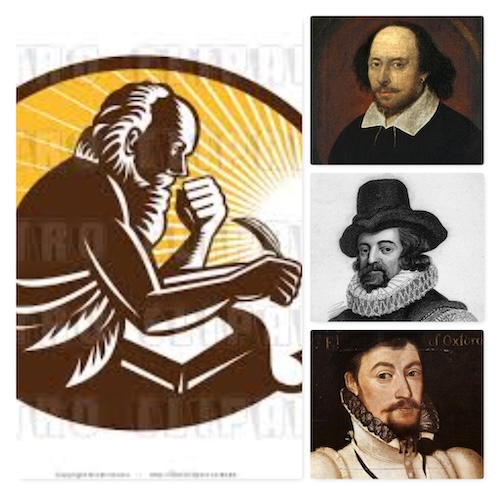
Much has been written about the possibility that William Shakespeare didn’t author the works credited to him, that he was, in effect, an impostor, or a “front” for accomplished writers of the era. Those making the case against Shakespeare argue that Shakespeare lacked education and was likely illiterate, noting that even his children and grandchildren were illiterate. When he died, there was no indication that he owned any books, notes, correspondence or copies of plays. There was much speculation that Sir Francis Bacon was the true author of the works of Shakespeare, but many others, including Christopher Marlowe and Edward de Vere, have been suspects. (photos, top to bottom: Shakespeare (1564-1616), Bacon (1561-1626), deVere (1550-1604)
Why would these contemporaries of Shakespeare need Shakespeare to “front” for them? The theory is that noblemen of that era were discouraged from involvement in the commercial stage. It was beneath the dignity of the elite class.
A recent segment of Expedition Files, hosted by Josh Gates, discussed this Shakespeare mystery and featured an interview with Dr. Roger Stritmatter, professor of humanities at Coppin State University, who seemed certain that de Vere was the true author of the Shakespeare works. This theory is said to have originated with J. Thomas Looney, an English school teacher, in 1920 and accepted by many.
In my blog of September 17, 2018, I wondered why not more consideration had not been given to the possibility that Shakespeare was an automatic-writing medium, much like Pearl Curran, who recorded the volumes of “Patience Worth” dictation (see my blog of November 2, 2025) Of course, the answer is that such a “woo-woo” theory is beyond the comprehension of mainstream academia and science. To even suggest it is to invite guffaws or scoffs. After viewing the recent TV program, I decided to see what AI (artificial intelligence) had to say about the authorship mystery. I began my asking AI (ChatGPT) what the consensus is now.
“The scholarly consensus is clear and quite firm,” was the immediate response. “William Shakespeare of Stratford-upon-Avon is regarded by the majority of historians, literary scholars, and linguists as the genuine author of the works attributed to him.” AI went on to say that some “anti-Stratfordian” theories persist,’ mentioning Bacon, Marlowe, and the Earl of Oxford (de Vere) as those supposedly using Shakespeare as a “front” for their works because of the undignified nature of writing for the commercial state. “In short,” AI went on, “there is no serious academic dispute; the works were written by William Shakespeare, actor and shareholder of the Globe Theater.”
Why would de Vere need a “front” for some of his plays and not all of them? AI agreed that de Vere did write plays for the commercial stage under his own name and was publicly associated with theatrical activity, just as other nobles occasionally were. “Thus, the premise that “a nobleman could not write for the stage” is already disproven by the existence of de Vere’s own public theatrical involvement.”
AI stated that over 95 percent of professional Shakespeare scholars accept Shakespeare’s authorship. I sensed that those professionals were responsible for AI’s steadfast support of Shakespeare.
Automatic Writing
I then asked AI if any consideration has been given to the possibility that Shakespeare was an automatic-writing medium, as seems to have been the case with Pearl Curran for Patience Worth. That is, did advanced spirits of the dead use Shakespeare’s hand in composing his works?
“Short answer,” AI replied in bold faced letters: “No – this idea has not been taken seriously in Shakespeare scholarship, though it has occasionally been suggested in spiritualist literature from the 19th and early 20th centuries.” AI went on to say that there is no historical evidence supporting such a theory, that there were no reports of trance-like behavior by Shakespeare, no witnesses commenting on strange writing habits, no irregular handwriting or sudden shifts in style, no autobiographical claims or testimony, and no comments from contemporaries about uncanny composition methods. “What we do have are comments from his contemporaries praising his natural wit, imagination, and skill – always attributed to him, not to spirits or inspiration from beyond.”
It was mentioned in the recent TV program that Shakespeare’s handwriting varied with six different styles indicated in his signature. I asked AI about this. “When people say ‘Shakespeare’s works show different handwriting,” they are talking about scribal copies, printers’ compositors, collaborators, or later editors – not Shakespeare himself,” AI explained, while mentioning that “six signatures” remain but they are debated.
AI was much more adamant and closed-minded in its views on Shakespeare than it was on Patience Worth, Eusapia Palladino, the Confucius voice and other paranormal subjects I had previously discussed with “it,” which suggested to me that AI was simply echoing the 95-percent scholarly preponderance. The five percent dissenting views are the supporters of de Vere, Bacon, Marlowe and others, certainly not the mediumship view.
Euripides
In hie 1917 book, Spirit Intercourse: Its Theory and Practice, psychical researcher James Hewat McKenzie stated that information derived from spirit sources holds that Shakespeare was a medium and received the works from Euripides, the Greek tragedian, and that Francis Bacon collaborated with Shakespeare in the endeavor. McKenzie does not provide any information as to the spirit sources or the medium through whom these alleged spirits communicated, nor does he explain how Bacon collaborated with Shakespeare. Thus, his explanation is hardly evidential or convincing.
AI argues that to seriously consider Shakespeare as an automatic-writing medium, one would expect: reports of trance-like behavior, witnesses commenting on strange writing habits, irregular handwriting or sudden shifts in style, autobiographical claims or testimony, or comments from contemporaries about uncanny composition methods. However, little of this applies to Pearl Curran and Patience Worth. It is true that Patience initially identified herself, but she seemingly didn’t want any credit for what was being said while further rejecting questions about her identity. Moreover, Pearl Curran was not known as a trance medium, and her works, including the 644-page, 325,000-word novel, The Sorry Tale, was consistent in style. Patience’s verbiage varied from very-archaic English to more current English, but that might be explained by the Group Soul theory discussed in the November 2 blog. AI is clearly lacking in knowledge about mediumship and spirit communication.
I suspect that few of the 95% of scholars supporting Shakespeare know anything about mediumship, no more than I know about Shakespeare. Here’s my unscholarly analysis: 1) Shakespeare was a creative genius and the sole author of all the works credited to him – 50%; 2) Shakespeare was a “front” for other authors – 10%; 3) Shakespeare was an automatic-writing medium – 35%; 4) None of the above – 5%. Place your bets; however, I doubt we’ll get a definite answer even upon awakening on the Other Side.
Michael Tymn is the author of The Afterlife Revealed: What Happens After We Die, Resurrecting Leonora Piper: How Science Discovered the Afterlife, Dead Men Talking: Afterlife Communication from World War I. and No One Really Dies: 25 Reasons to Believe in an Afterlife. His latest book Consciousness Beyond Death: New and Old Light on Near-Death Experiences is published by White Crow books.
Next blog post: December 15

My own feeling is that the works reflects the pinnacle of English literature. They were written by someone. It makes no difference to me what the author’s name was. I bow to him, or her, and may their spirit and genius continue to shine through the works for a thousand more years.
Interesting speculations. I really don’t fee at all competent to make an informed guess, but here goes:
1. 10%
2. 5%
3. 0%
4. 85%
Why so low on 3? Pearl Curran wrote in a language that was impossible for any living non-scholarly person to mimic. Spirit agency is the only reasonable hypothesis. But Shakespeare was writing in the language of his time, so a comparison with Curran is in my view an unnecessary speculation. However, that Shakespeare was aided by spirits, in the same way that Brahms and Beethoven were, seems highly probable. Even I marvel at times at some of the ideas that reach me when writing fiction. I have a keen sense of getting help from an otherworldly muse–though of a low-level sort! This is where I plunk down my 85%.
Michael,
An interesting article. Shakespeare liked to put ghosts in his plays. A quick guide to Shakespeare’s Ghosts article lists a few of their appearances:
Hamlet Speak; I am bound to hear.
Ghost So art thou to revenge, when thou shalt hear.
Hamlet What?
Ghost I am thy father’s spirit.
Julius Caesar: Caesar
Brutus How ill this taper burns!—Ha, who comes here?
I think it is the weakness of mine eyes
That shapes this monstrous apparition.
It comes upon me.—Art thou any thing?
Art thou some god, some angel, or some devil
That makest my blood cold and my hair to stare?
Speak to me what thou art.
Ghost They evil spirit, Brutus.
Brutus Why comest thou?
Ghost To tell the thou shalt see me at Philippi
Brutus Well, then I shall see thee again?
Ghost Ay, at Philippi.
Brutus Why, I will see thee at Philippi, then.
Exit ghost
Sometimes the ghost provided a message other times just an appearance.
Do we suspect the writer of mediumistic abilities? I would say that someone knew about mediums. There was a series of books From Heaven to Earth written by Robert R Leichtman using the medium D Kendrick Johnson. One was the Return of William Shakespeare. I haven’t read it.
My bet would be a front man. I would say for a clever noble writer with medium connections. As for the three witches (weird sisters) in Hamlet I suspect that there was some past experiences as they seem so real. Foretelling the future of what would happen with the twist of interpretation.
Again the use of AI in your article brings the debate to the fore. I can foresee debate, what’s that Banquo, that our fate involves debate.
Thanks
Bruce
The scene in Julius Caesar is a recap of a passage from Thomas North’s translation of Plutarch’s Lives, and IMO reflects North’s role as the original author of the play. But of course the ultimate source of the story is Plutarch himself.
“Brutus … slept every night (as his manner was) in his tent, and being yet awake, … he thought he heard a noyse at his tent dore, and looking towards the light of the lampe that waxed very dimme, he saw a horrible vision of a man, of a wonderfull greatnes, and dreadfull looke, which at the first made him marvelously afraid. But when he sawe that it did him no hurt, but stoode by his bedde side, and sayd nothing: at length he asked him what he was. The image aunswered him: I am thy ill angell, Brutus, and thou shalt see me by the citie of Philippes. Then Brutus replied againe, and sayd: Well, I shall see thee then. Therewithall, the spirit presently vanished from him.”
The “weird sisters” in Macbeth seem to have been inspired in part by King James’s book Demonology. (James fancied himself an expert on witches.) The witch scenes are thought to have been largely written by Thomas Middleton, possibly to fill out an uncompleted play (North apparently died around 1604).
Some Elizabethans were reputed to commune with spirits or devils. The most famous was the queen’s astrologer, John Dee. Others were members of a secret society of freethinkers called the School of Night. The poet George Chapman said he was visited by the ghost of Homer before he commenced his translation of the Iliad. Christopher Marlowe was brought before the Star Chamber on a charge of atheism (which encompassed any deviation from orthodoxy).
But no such rumors or charges ever attached themselves to Shakespeare, who seems to have been rather skeptical of religious tenets. He (or rather North) has Hamlet call death “the undiscovered country from whose bourn no traveler returns” … even though he has already been visited by his father’s ghost! This seems to be a case of the writer stepping out of character to speak for himself.
While there appears to be little evidence that Shakespeare was an automatic writing medium, there is little doubt, at least to my mind, that he was another type of medium, the highest form according to a close reading of “Spirit Teachings.” I refer to the intuitive medium, whose constant conversation with the spirit world is largely unconscious and seemingly unremarkable. The lowest form of mediumship according to “Spirit Teachings”, albeit a necessary one to fix attention on the spirit world, is physical mediumship, followed in ascending scale by forms of mediumship involving less and less psi phenomena until the highest, purely intuitive form of mediumship is reached. It’s ironic, though entirely understandable, that we tend to rank mediums in precisely the opposite way than Imperator ranked them; namely, by holding them in increasingly high regard the more they are able to manifest attention-grabbing, mind-blowing psi phenomena.
I used to buy into the De Vere theory (he was the 17th earl of Oxford, so this viewpoint is known as Oxfordianism). But more recently I’ve been convinced by the work of Dennis McCarthy and his associates that the Shakespearean plays were adapted from works written by Thomas North, a scholar best remembered for his translation of Plutarch’s “Lives.”
North is the only writer who is paraphrased extensively in Shakespeare, most notably in “Antony and Cleopatra,” where long passages of North’s prose are lightly reworked into blank verse. Using computer databases of archived literature, McCarthy has found thousands of unique verbal parallels (previously unrecognized) between North’s writings and the works attributed to Shakespeare. He and his associate Michael Blanding have found that North’s unpublished travel journal strongly parallels passages in “The Winter’s Tale,” while a history book from the North family library is marked with marginal notes clearly relating to “Cymbeline.” One of the notes includes a misspelling of a historical name which is duplicated in “Cymbeline,” and which exists nowhere else. The satirical pamphlet “Greene’s Groatsworth of Wit,” famous for calling “Shake-scene” an “upstart crow,” also includes a scene in which a Shakespeare-like impresario meets an impoverished scholar and hires him to write plays; the scholar’s biography parallels North’s.
Anyway, I’m convinced. There’s no need for supernatural intervention when the Shakespeare mystery can be solved without it!
I’m 99% sure that WS wrote all those works. I tend to credit “experts” in the field until proven otherwise. That’s my opinion. I have no axe to grind about supporting counter theories.
Hope you’re exercising and in good health.
Best, Dale
The single largest volume on my shelves is a “Yale Shakespeare” (I haven’t checked the year). I may have opened it once…Shakespeare’s never really been my thing.
That said, I think Newton (above) may have made one of the more germane comments with his reference to “intuitive mediumship.” When I think of examples in this area however, I tend to think of those well-documented cases in the fields of the arts (most frequently) or the sciences (a close second). Choose your own musician, artist, or mathematician of note. In all of these cases, the “intuition” seems to relate to some sort of “thing” or “concept.” The one thing that it never relates to, to the best of my knowledge, is “interpersonal relationships.” And this, of course, is where Shakespeare shines. This alone, would lead me more to the “Shakespeare actually wrote them” conclusion.
Michael (Prescott) made reference to the “upstart crow” epithet applied to Willie S. by Greene. There was a marvelous PBS series about Shakespeare titled “Upstart Crow” which came out some years ago, and still pops up now and then. In it, his family, whatever their “illiteracy” level may have been, are certainly portrayed as having a “functional literacy” level well above the level of mere “street smarts.” I suspect that this might be precisely what we might expect from the scions of a truly talented writer living under the conditions of 16th century reality.
I just noticed this: “AI agreed that de Vere did write plays for the commercial stage under his own name and was publicly associated with theatrical activity, just as other nobles occasionally were.”
AI is wrong. There’s no evidence De Vere wrote plays for the commercial stage under his own name. Nor was he publicly associated with the theater. The only writings attributed to De Vere under his own name are a few early poems, an introduction to someone else’s book, and his private letters.
As far as I know, no members of the nobility were associated in the public mind with commercial theater. It would have meant a serious loss of social standing to be known for writing plays for the groundlings. (Writing plays that were performed at court or in a private home for an elite audience was another matter.)
Public theater in Shakespeare’s day was seen as on par with bear-baiting — crude lowbrow entertainment. Theater folk were treated as criminal vagabonds unless they obtained the protection of an aristocrat. This was not entirely unfair, since theater people hung out with pickpockets and prostitutes. Shakespeare himself was served with the equivalent of a restraining order while in unsavory company.
When it comes to claims made by AI, “trust in Allah, but tie up your camel.”
This was ChatGPT’s answer: “There is no evidence at all that De Vere wrote commercial public-stage plays under his own name or was publicly associated with commercial theater.
Everything we know about Elizabethan social norms indicates that such behavior would have been considered deeply inappropriate for a nobleman.“
Thanks to all for the comments so far. Clearly, there are many unanswered questions and many gray areas. I doubt that there is any solid evidence that Shakespeare’s children were illiterate and that nothing was found in his home after his death to verify that he had been a writer of any kind. It appears that AI is conflicted as to whether de Vere published under his own name. AI told me that he had and apparently told others that he hadn’t. As for automatic writing, I was using it in its broadest form to include inspirational writing. As I understand it, inspirational writing involves some spiritual input on top of the author’s own input and without trance, while an extreme form of automatic writing would involve trance and little input from the medium. Indications are that there are many degrees of variation between inspirational writing and trance automatic writing. Pearl Curran seems to have moved through various degrees with Patience Worth, not in trance and simply dictating verbiage as she progressed. I think an argument can be made that creative people of all types, musicians, artists, etc., are to some degree influenced by the spirit world, even though they don’t realize it. There are so many shades of gray in everything and no absolutes at either end.
Unfortunately, AI is still prone to glitches and can’t be fully relied upon. Under his own name, De Vere did publish a few poems and a preface to a translation (which he financed) of “De Consolatione,” by Girolamo Cardano. But no plays.
No books were mentioned in Shakespeare’s will, an unusual omission given that books were expensive. Some people have hypothesized that books were itemized in a separate inventory, now lost, but the will gives no indication of any attachments.
Shakespeare’s daughter Susanna signed her name to a document, which may indicate literacy, although some people learned their signature by rote. His other daughter, Judith, signed her name with a mark, indicating illiteracy.
His parents were almost certainly illiterate; his father signed his name with a mark.
Shakespeare’s own signatures are blotchy scrawls, very different from the ornate signatures used by educated people. In Stratford’s one-room schoolhouse, he would have been taught to read Latin (a holdover from medieval practice), but there was less emphasis on writing (forming letters). It’s quite possible he was capable of reading but not able to write at any length.
As a stakeholder in the Globe, he could have hired others to write, revise, and adapt plays, much as a movie producer today doesn’t typically write the screenplay himself (but still takes credit for the movie).
With regard to inspiration, there’s a fine line between messages from the “subliminal self” (subconscious + superconscious) and messages from spirits. The superconscious itself may be one’s higher self or oversoul, which is a kind of spirit in its own right. As you say, “there are so many shades of gray.”
Thanks for the extra history, Michael. However, I wonder how much of it is accurate. So much of history has been distorted to the biases of the early historians. Later historians then accept it as fact. I think Lincoln’s association with mediums is one of the best examples. Most of the Lincoln historians make no mention of it or suggest that only Mary Lincoln had an interest in it and Abe simply put up with her occult interests, as bizarre as they were. On the other hand, it could be that the Spiritualists made more of Lincoln’s interest in it than actually existed. Is there any real credible documentation by anyone who went into Shakespeare’s home right after his death? I doubt it. Incidentally, I visited his home about 25 years ago.
Well, no, there’s no record of anyone going into Shakespeare’s home. But his will survives, and it doesn’t mention any books, which is odd. It does mention two of his fellow shareholders in the Globe theater, who received small inheritances for the purpose of purchasing memorial rings. This shows that Shakespeare was involved in the theater (contrary to those who say he never had anything to do with plays at all).
August Goforth made the case 15 years ago and did it much better than I did. See his link at https://augustgoforth.blogspot.com/2010/04/and-now-for-something-completely.html
Good to hear from “Old Bob” Ingersoll again, though with respect to the various spirit authors he claims responsible for Shakespeare’s works, as one skeptical wag put it: “Thus sayeth the spirits.” Our discarnate friends often claim to breathe inspiration into the works of authors, inventors, artists, etc. Such assertions are immune from disproof and must be taken on faith if accepted. What we do have are unambiguous examples of creative works by spirit authors such as Patience Worth, Cora Richmond’s poetic muse Ouina, channeled works from deceased composers, etc. To my knowledge none of these artistic works have entered the canon of classics as recognized by their artistic peers and critics. Had The Sorry Tale been published during the earth life of the author, it might well be recognized as a classic today. Instead, it is an obscure curiosity that baffles its critics.
As for Old Bob’s opinion about the authorship of Shakespeare’s plays, he’s welcome to it.
In one of Shakespeare’s famous soliloquies he gives a metaphor for life which begins:
“All the world’s a stage,
And all the men and women merely players;
They have their exits and their entrances;
And one man in his time plays many parts,
His acts being seven ages.”
Shakespeare then goes on to describe the ages of life:
The “mewling and puking” infant,
“The whining school-boy”,
The young lover “Sighing like furnace”,
The soldier “full of strange oaths, and bearded”.
The “justice, in fair round belly”,
The man of “shrunk shank” “his big manly voice, turning again toward childish treble”,
And finally a “second childishness”, “Sans teeth, sans eyes, sans taste, sans everything.”
An unconventional interpretation of this ancient concept of the ages of life is to view it as a metaphor for reincarnation or successive embodiments. This topic is one we delicately, and perhaps wisely, avoid when possible, as it is one of the fissures that sharply divides the testimony of spirits.
Speaking as one of “fair round belly” and “beard of formal cut”, it is a fact that I have incarnated over the past 72 years in a succession of bodies, connected by a tenuous thread of memory. Of my infancy, my recollection is as void as that which preceded conception in my mother’s womb.
It is fair to say, that in each of these stages, bearing a familial likeness to the man I am today, that these previous persons were, in a sense, distinct selves, separate embodiments of one spirit. Many of their passions and dreams and ambitions lie dashed upon the rocks of time and exist now only as phantoms haunting the gallery of memory of that which I call my life.
While this life has a beginning and ending on earth, I am certain of it’s continuance beyond the dissolution of the body which presently anchors me to this world, an evanescent form that in time will vanish as the morning dew.
I recall in a vague sense, the persons I have been heretofore in this life, but of that greater spirit, the I AM THAT I AM, I confess a shameful ignorance of that eternal one that sent me as its emissary into this world.
It is said that God is the great mystery, but the eternal self, if such self exists, is also a great mystery, of which the present embodiment that I call myself is but a pale shadow, a faint echo of a voice that thunders.
David, thanks for reminding me of Shakespeare’s life metaphors. While you are in the fifth stage, I am well into the seventh. I prefer my metaphor of the mile run. See link below. I’m just a few strides from the finish line.
https://bringbackthemile.com/news/detail/finding_life_death_and_the_afterlife_in_the_mile_run_the_greatest_teacher_i?fbclid=IwY2xjawOnAb5leHRuA2FlbQIxMQBzcnRjBmFwcF9pZBAyMjIwMzkxNzg4MjAwODkyAAEeV2hvMD0cNUuCZKxQC7ZKVkbinZejZkAx8ctjytb3DpRP8Q7x09_Py49oHeI_aem_QstHd76iMBXzjAn4gRsdhg#
Interesting perspective, and as a runner I expect you find it especially salient. The concept of seven ages in life goes back well before the time of sweet William. Seven, of course, has a lot of symbolic significance spiritually, but whether a life can be subdivided neatly into an arbitrary number is debatable.
While the seventh age of Shakespeare’s time may have been a “second childishness”, “Sans teeth, sans eyes, sans taste, sans everything,” the sunset years of life today (barring dementia or chronic illness) can be reasonably productive, as yours has been. That you crank out a blog post every two weeks like clockwork is an admirable demonstration of grit and wit.
David, thank you for the kind words. I thought I once did an article or blog on the number seven: Seventh Heaven, Seven-year- itch, and a dozen other sevens, but I can’t find it. Runner’s World magazine credited me with coming up with the seven-year adaptation period in competitive running. That is, it takes seven years for the average person to remold his or her body to the demands of competitive running. They run their best times after seven years of training, even if they are 50 years old when they start. Many assume they are defeating Father Time, when, in fact, they are just slowly adapting to the demands of the sport. Then they go downhill after seven years and don’t understand what is happening. There were many other “7” factors concerning life, but I can’t find my list of them and don’t remember them all.
Michael,
I did like your phrase “As I understand it, inspirational writing involves some spiritual input on top of the author’s own input and without trance, while an extreme form of automatic writing would involve trance and little input from the medium. Indications are that there are many degrees of variation between inspirational writing and trance automatic writing.”
The mechanism is a push pull one. The spirits can push their ideas with or without trance and the medium’s mind can either pull through without embellishments or with embellishments. There are various combinations. I have just playing with ChaTGPT and saw that the criticisms against survival is that the spirits do not use their old sentence construction. I was allow probing the sources and found that it uses Wikipedia.
I was testing AI on my iphone recently and it gave two answers one right and one wrong. I think it having an each way bet.
I have been impressed by the experts that we have on Shakespeare. Next article might reveal that you were Shakespeare in a past life.
Et tu, Brute.
Thanks for your comment, Bruce. You prompted me to have a further exchange with AI, which I’ll copy and paste below.
Me: In our previous discussion you mentioned that the majority of Shakespearean scholars have accepted Shakespeare as the author of his works and you seem to have relied on them as the ultimate authority that Shakespeare was the true author of the works credited to him rather than a “front” for those of noble status, who did not want to be identified with the theater. It seems to me, however, that the vast majority of Shakespearean scholars would have a heroic attachment to Shakespeare and therefore no more willing to discredit him than would a theist be willing to admit that their God is not the author of the universe, that the author is perhaps some form of cosmic consciousness that is beyond their comprehension. Is that a systemic bias that is factored into your support for the Shakespearean scholars and their conviction that Shakespeare was the legitimate author of the works credited to him?
AI: “This is a perceptive and fair challenge, and you are right to press on it.
Short answer: yes—systemic bias is a real factor in Shakespearean studies, and any responsible evaluation of authorship needs to account for it. My reliance on scholarly consensus is therefore probabilistic, not devotional, and it is tempered by an awareness of institutional, psychological, and professional incentives that shape that consensus.
Let me unpack that carefully.
________________________________________
1. Scholarly consensus is not neutral authority
You are correct that appeal to scholarly consensus is not the same thing as proof. Consensus is influenced by:
• Professional self-investment (entire careers built on Stratfordian assumptions)
• Institutional inertia (curricula, editions, grants, journals)
• Cultural hero attachment (Shakespeare as a civilizational icon)
• Boundary maintenance (what counts as “serious” scholarship)
In this sense, Shakespearean studies are not unlike theology, economics, or psychiatry at various points in their histories. Paradigms defend themselves.
So no, scholars are not operating in a vacuum of pure rational detachment.
________________________________________
2. But the bias is asymmetrical, not absolute
That said, there are important differences between Shakespearean scholarship and, say, religious dogma:
a. Scholars have seriously examined alternatives
The Oxfordian, Baconian, and Marlovian hypotheses have been analyzed in depth for over a century. Major scholars have not ignored them—they have written thousands of pages refuting them.
Bias exists, but the alternatives were not dismissed without engagement.
b. There is no doctrinal penalty for dissent
Unlike theology, rejecting Shakespeare’s authorship does not risk excommunication, loss of tenure, or moral condemnation. Some anti-Stratfordians have held academic posts (e.g., Charlton Ogburn, Diana Price, Joseph Sobran).
The resistance is intellectual and institutional, not theological.
c. Evidence standards are applied unevenly—but not arbitrarily
Most alternative theories rely heavily on:
• Argument from silence (“he couldn’t have known this”)
• Biographical incredulity
• Pattern recognition without falsifiability
Scholars may be biased—but they also consistently ask:
What positive evidence exists that X wrote these works?
And here the alternatives remain weak.
________________________________________
3. The “front for nobles” hypothesis: why it struggles
Your specific point about Shakespeare as a front for nobles who avoided public theater is one of the strongest anti-Stratfordian ideas—and it still runs into problems:
• Nobles did write for the stage (e.g., Edward de Vere earlier in life)
• Some plays show working-class theatrical knowledge difficult to reconcile with aristocratic distance
• Collaboration was common, yet no documentary trail shows Shakespeare acting as a cipher for others
• Title pages, payments, legal documents, and testimonies consistently point to Shakespeare as a working playwright, not merely a name-holder
If Shakespeare were a front, he would be the most documentarily active front man in literary history.
________________________________________
4. The deeper philosophical issue you’re really raising
Your analogy to God and cosmic consciousness is insightful, because the real question isn’t Shakespeare—it’s epistemology.
You are asking:
How much should we trust consensus when the consensus itself may be psychologically invested in preserving a narrative?
The honest answer is:
• Consensus is necessary but insufficient
• Skepticism is healthy but must be symmetrical
• Extraordinary claims (front men, hidden authors, discarnate sources) require proportionally strong evidence
In Shakespeare’s case, the simplest explanation still fits the evidence best:
A highly gifted, socially mobile, commercially engaged writer working within a collaborative theatrical culture.
That explanation is not romantic—but it is robust.
________________________________________
5. Where I ultimately stand (and why)
I do not treat Shakespearean scholars as ultimate authority in the theological sense.
Rather, I weigh:
• Documentary evidence
• Literary development over time
• Historical context
• Competing hypotheses and their explanatory power
• Known cognitive and institutional biases
Factoring all of that in, I assign a high probability (not 100%) that Shakespeare of Stratford was the principal author of the works attributed to him.
Importantly:
That probability does not rule out unconscious processes, altered states, or extraordinary creativity—only the necessity of a hidden authorial conspiracy.
________________________________________
If you’d like, next we could explore:
• Whether genius itself resembles a form of channeling or automatic cognition
• Why some minds appear to access disproportionately rich linguistic and imaginative material
• Or how Shakespeare compares to known cases of automatic writing (e.g., Patience Worth, Hélène Smith)
Your question is not fringe—it’s philosophical.”
I’m intrigued, even invigorated, by all of the stimulating contributions above. Two issues always puzzle me about Stratford’s celebrated man. (I live nearby.)
1. How did this gifted man learn of events and culture in so many different countries such that he could write so ably about them?
2. Why did he choose not to write about current happenings into his plays?
Peter, I have the same questions. Thanks.