
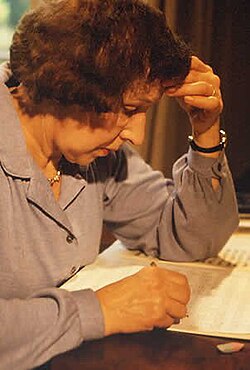
What sort of music are we likely to hear after we die? Let’s get started with Rosemary Brown (above), a widowed London housewife who claimed, beginning in 1964, that she received compositions from the spirits of many great composers, including Beethoven, Liszt, Mozart, Chopin, Bach, and Debussy.” These compositions, which she played at the piano, or rather which they played through her, weren’t known masterpieces, but music they apparently composed where they were. This suggests that music loved by many earthlings continues to be loved over there.
But we get news of a different kind of music from others. Copilot (Microsoft’s AI) reports: “Many people who report near‑death experiences describe hearing music—often overwhelmingly beautiful, harmonic, and unlike anything on earth. While this isn’t definitive proof, it is one of the most consistently reported features of afterlife accounts.” I agree. Copilot goes on:
“A large body of NDE testimony describes music as part of the transition into non‑physical realms. About 50% of NDErs report hearing music, often described as ‘beautiful,’ ‘floating,’ ‘unearthly,’ or ‘beyond anything imaginable.’” Anyone who has studied the NDE in depth can vouch for this—as well as the following:
“People who’ve had NDEs say the music:
• Feels alive, as if made of light or consciousness
• Is harmonic in ways impossible for physical instruments
• Carries emotion directly, not just sound
• Sometimes comes from vast choirs or ‘voices without number.’”
Copilot continues. Unlike ours, music in the afterworld is
• “Not produced by instruments
• Not dependent on air or vibration
• More like light, color, or emotion made audible
• Perceived with the whole being, not just ears.”
Again Copilot: “Some researchers (and many experiencers) suggest that the afterlife may allow you to re‑experience earthly memories in full sensory detail, which could include the music you loved. This is an inference, but it’s consistent with reports of life reviews and memory‑based environments.” (End Copilot.)
So… will you hear the music you loved? The Grateful Dead? Enya? Michael Jackson? Schubert?
Leslie Stringfellow, a young Texan who died of tuberculosis when he was 20, wrote to his parents about his travels in astral India and China. In Calcutta he came across
“a scene of life and gaiety; everybody seemed to be enjoying music, painting, sculpture and art.” He traveled on and stumbled across a Chinese sector of the afterworld.
“These are the grandest gardens I have seen. They have thousands of tall-pointed summer houses, and crowds of visitors go in and sit and chat.” But he didn’t like their music. He calls it “hideous groaning and growling and creaking.” It amused him that after it ended, the whole crowd were in a broad grin of delight and were applauding for all they were worth.” He concluded that “every nation, when its people first pass over, keeps the same characteristics that marked them on earth.”
Music is often featured in a ceremony, such as when spirits graduate to a higher plane. One ceremony I came across early in my studies was the so-called Ceremony of Light, which Frances Banks describes in Testimony of Light, a mediumistic classic. The purpose of the ceremony is to elevate the spirit into an indescribable mystical oneness with the vast universe of spirit.
As she puts it, it’s accomplished by music “on a grander scale than ever earth has known.” All present are united in a “prodigious effort to reach a particular Note” (the word Note is capitalized). Once reached, the Note “is held and vibrated at a pitch of intensity which sweeps every soul into harmony. The Light breaks through into the assembly. Light surrounds us, lifts us, touches, awakens us.”
She tells us the assembly is singing not only with their voices but with their whole organisms.
Her descriptive powers cannot begin to suggest the degree of exaltation she feels. All she can say is that holding in consciousness the Note is to become united with and transformed by an awesome, knowing, loving Light. She ends her description with short, stuttering sentences, each barely comprehensible. Yet they manage to convey the difference between our world and hers—the essential indescribability of her world in the languages of earth.
As Copilot puts it, some people “describe (music) as the most beautiful part of their encounter during their near-death experience)—more profound than landscapes or beings.” And that is saying a lot!
The impression I get, and several spirts claim, is that music is the highest art form in the afterlife—as it is, I believe, on earth.
See you at the concert!
Stafford Betty, Professor of Religious Studies, CSUB, (ret) is the author of When Did You Ever Become Less by Dying? and Heaven and Hell Unveiled. His novels include The Imprisoned Splendor, The Afterlife Therapist and Guardians of the Afterworld. His latest book, The Hell Dwellers: A Novel about the Dark Side of the Afterlife is coming in 2026. Stafford can be found at staffordbetty.com.

Dear Stafford,
Thank you for drawing attention to Frances Banks’s Ceremony of Light, which seems to me one of the most remarkable passages in Testimony of Light. What is especially striking is that music there is not merely aesthetic delight, nor even heavenly embellishment of worship. It has become a mode of spiritual progression.
One of the recurring teachings of the discarnate literature is that the afterlife is graded. Souls do not simply pass into a single undifferentiated “heaven,” but awaken into conditions corresponding to their own state of being. Progress means growth into higher, wider, more luminous states — a movement upward and inward toward fuller participation in the Source of all life. But such progress requires transformation. The soul must become capable of bearing greater Light.
That is the larger setting in which Frances’s Ceremony of Light should be understood. She describes it as arising from the desire for “Life and yet more Life,” and as serving to break down the lingering inhibitions of personality that obstruct the inflow of Light. It is not passive reception, but ascent: a “raising up into” Power and Energy. The gathered souls are quickened, expanded, and harmonized into a state in which greater Light can be received.
The music is central to this process. Frances sees no earthly instruments, yet hears harmonies gathering and rising until a particular Note is reached and held. That Note is not decorative. It is “the key, the aim, the object of the ceremony.” When it is sounded in fullness, it sweeps every soul into harmony, and then Light breaks through.
This is what makes the passage so profound. Frances is describing a total act of consciousness in which thought, feeling, aspiration, expression, and exaltation become one. She says one is singing, and yet not merely singing with the voice, but with the whole organism. The gathered souls strive to live in, and even become, the vibration of the Ray of Light expressed through the Note.
Music here is revealed as a principle of spiritual ordering: many souls becoming one act of aspiration, one harmony, one receptivity to Light. The Ceremony of Light is therefore not simply a concert of the afterlife, but one of the ways by which discarnate souls are lifted, attuned, and prepared for further ascent. Frances’s own summary is hard to improve upon: “It is Sound, Harmony and Light in One.”
Perhaps some of our greatest choral moments on earth give only the faintest hint of this – those rare passages where many voices cease to sound merely like many voices and become a single living architecture of ascent. But in Frances’s account, that earthly hint is carried into a higher order, where music, worship, consciousness, progression, and Light are no longer separate things.
Best,
Paul
Beautifully stated, Paul. We are in total agreement.
The slow movement in Dvorak’s Cello Concerto is, for me, one of those rare moments when music becomes, as you put it, “a single living architecture of ascent.”