
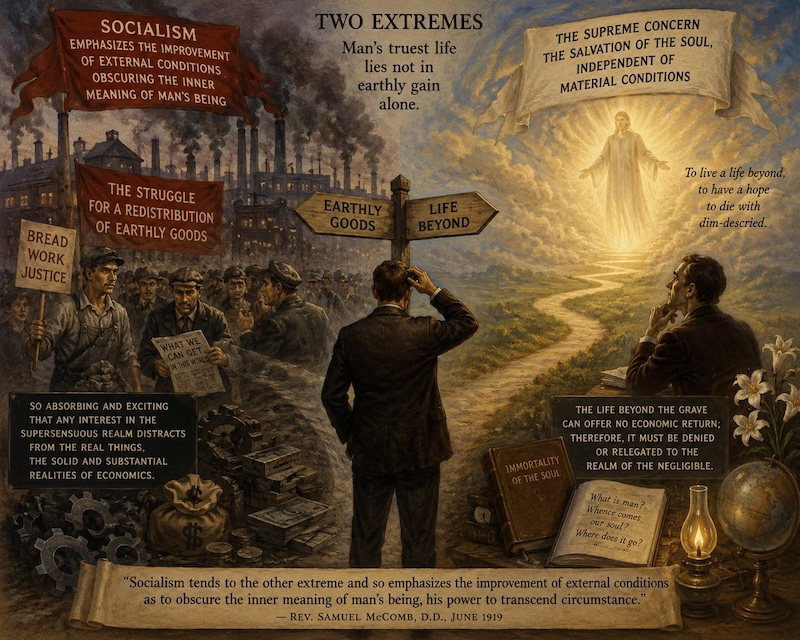
There is much talk these days about the spread of Socialism in the United States, especially in New York. There are so many shades of gray in all political and economic systems that it is difficult to know the extent of the movement, whether its advances are minor, moderate, significant, or extreme, whether they are to be welcomed or resisted. The dividing line between Capitalism and Socialism as well as between Socialism and Communism is very obscure. In sorting through old books and journals recently, I came upon the June 1919 issue of the Journal of the American Society for Psychical Research, which features an article titled “Hindrances to Belief in Immortality,” by the Rev. Samuel McComb, D.D. (1864-1938). As McComb saw it then, Socialism was a hindrance to a belief in immortality of the soul.
Born in Londonderry, Ireland, McComb received his master’s degree at Oxford and his doctorate from the University of Glasgow before becoming a professor of church history at Queen’s University in Ontario and then serving as a Presbyterian minister in London and New York City. In the ASPR Journal, McComb begins his essay by pointing out that the Great War, which had just ended, had reawakened humans, after some 50-60 years of doubt and denial, to the question of whether there is anything beyond death. Although not mentioning Darwinism, per se, he gives three reasons for the doubt and denial; 1) the breakdown of religious authority; 2) the rise of modern materialism combined with the triumphs of natural science, which certainly included Darwinism; 3) the rise and spread of Socialism among the wage-earning classes, especially the doctrine of Karl Marx and his followers, with its materialistic conception of history and its resultant denial of spirit in man.
However, even before Darwinism, which had its beginnings in 1859, McComb sees the Jewish tradition, as set forth in the Old Testament, along with “intellectually untenable” pictures of heaven and hell as repellants to a belief in immortality. He quotes a letter from an American soldier: “Living as we do, with death as a constant companion, has but deepened my conviction of something after this life. But it has destroyed my belief (what belief I may have had) in the conventional heaven of theology. With all reverence I can think of nothing more deadly than an eternity devoted to singing, playing, and adoration….I believe that death is followed by life as sunset is followed by sunrise, but by a life much more closely related to this one than theological dogma would have us believe.”
Psychic Research
McComb offers a then-recent survey of American scientists, psychologists, and philosophers taken by Professor J. H. Leuba, in which two-thirds of the responders rejected a belief in immortality. While McComb concluded that materialism as a theory of knowledge had been vanquished by idealism, it was alive as ever as a psycho-physiological solution of the problem of mind and brain. “The idealist’s reasoning seems an airy nothing when confronted with the world of objective facts,” he opines, “[but] no physical facts, it is maintained, can explain moral values and ideals.” The materialist remains convinced, he continues, that the path of wisdom is that of observed fact and inductive method. Psychic research, McComb concludes, appears to be the only serious effort to counter the “rock-ribbed dogmatism of modern materialism.” He notes that many defenders of materialism are beginning to admit the reality of the phenomena of psychical research but they often view them as telepathic communication between living persons, which McComb sees as explaining the obscure by the more obscure.
But back to Socialism, McComb states that to the strict Marxian Socialism in not merely an economic doctrine; it is a philosophy of life, one which rejects belief in immortality. (He does not distinguish between immortality and survival, the latter not necessarily extending to immortality.) “In opposition to the teaching of many religious bodies that the supreme concern is the salvation of the soul which is quite independent of material conditions, Socialism tends to the other extreme and so emphasizes the improvement of external conditions as to obscure the inner meaning of man’s being, his power to transcend circumstance, ‘to live a life beyond, to have a hope to die with dim-descried .’ The life beyond the grave can offer no economic return; therefore, it must be denied or relegated to the realm of the negligible. Moreover, the struggle for a redistribution of earthly goods and for a larger opportunity to get out of the present world what is in it is so absorbing and exciting that any interest in the supersensuous realm distracts the attention from the real things, the solid and substantial realities of economics.” (McComb no doubt borrowed from poet Robert Browning in his use of the term “dim-descried,” meaning “vague made real.”)
McComb goes on to say that Socialism holds up the ideal of a socialistic state as an object worthy of reverence, commanding the utter devotion of our lives and suppression of all other desires and ambitions. He offers ideas I had not considered and which I struggle somewhat with. I more or less assumed that Capitalism is more embracing of materialism than Socialism and therefore would be more a detriment to a belief in survival. That is, in the pursuit of greater wealth and creature comforts, there is little or no thought given to survival or immortality. But I have found so much of life to be paradoxical.
Work Ethic vs Welfare State
McComb doesn’t use the word “Capitalism” nor a tamer word from his era, such as mercantilism, or even free-enterprise. The reader is left to infer that a proper work ethic is lacking in Socialism and that it is somewhat synonymous with the “welfare state.” Exactly what the desired state of socio-economics is, McComb does not say, perhaps economic liberalism.
“…the socialist must be led to see that the implications of his creed are deeper than he suspects,” McComb concludes. “No programme of economic reform, no acceleration of materialistic dreams, can satisfy the spiritual ambitions of human spirits that once realized the import of liberty, equality, brotherhood, and caught a glimpse of the new world wherein dwelleth righteousness. Such a belief is really mystical in character. For man is now seen to belong to a grander order than that of earth; he is, as it were, the focus of eternal values; he escapes our economic categories and stands forth in his true being as a citizen of a transcendent world who now is passing through a preparatory discipline and after each task is done, is haunted by a divine unrest that urges him to find his goal beyond the limitations of his terrestrial lot. It is paradoxical but true that the super-earthly man appears to be, the more sacred become all his temporal interests and strivings.”
I struggle somewhat with comprehending all that, not so much with the unenlightened mindset of the Socialist as with the more enlightened mind of the free-enterpriser. However, it’s something to ponder on. Any thoughts or ideas by readers are appreciated.
Next blog post: July 27
Michael Tymn is the author of The Afterlife Revealed: What Happens After We Die, Resurrecting Leonora Piper: How Science Discovered the Afterlife, Dead Men Talking: Afterlife Communication from World War I. and No One Really Dies: 25 Reasons to Believe in an Afterlife. His latest book Consciousness Beyond Death: New and Old Light on Near-Death Experiences is published by White Crow books.

A friend sent me an email commenting that Marxism created the mindset described above and it is a thing of the past. He mentioned a couple of current American politicians he admires and said they are not materialists. However, one of them is a declared atheist and I assume he is also a nihilist. My point to him was that being a non-materialist does not necessarily mean the person accepts the idea of consciousness surviving death. Also, Marx was communist, not a mere socialist. It is confusing.
Mike,
Coincidentally, yesterday I was listening to Leslie Flint: / William Ralph Inge. In the sitting he says: “Christ himself was a great seer, a great prophet, a great teacher, and above all of this, he was a great humanitarian. He was more perhaps of a Socialist, than any Socialist could ever hope to be.”
https://www.leslieflint.com/dean-william-inge
Spiritualism is not the only important social movement that current history has forgotten (despite Michael’s heroic efforts to keep it alive). Another forgotten movement of consequence is the democratic (and theistic) form of socialist thought that swept across America during the First Gilded Age, setting the stage for the New Deal several decades later. In a much smaller, more intermittent way than Michael, I, too, have tried to rekindle a memory of that era and of its once-famous champion, Edward Bellamy. His ideas would again catch fire, I suspect, if only more people were to rediscover books in this Second Gilded Age. For those interested in learning more about another repressed social movement, similar in key respects to spiritualism, here’s my (inadequate) attempt at summarizing Bellamy’s extraordinary vision and its ripple effects still being felt today.
https://www.counterpunch.org/2018/11/19/on-earth-as-in-heaven-the-utopianism-of-edward-bellamy/
PS: If the link doesn’t work, just search for “counterpunch bellamy.”
Newton, many thanks for sharing the refresher on Edward Bellamy. Although I vaguely recalled the name, I confess to being ignorant of Bellamy’s wisdom and contributions. I think he would agree that, given the advances in health and longevity, the age threshold for full-time community service, etc., should now be raised from 45 to perhaps 60 or 65, but all else appeals to reason.
Greetings to Michael and all. Here are my thoughts:
1) When Rev. McComb writes “No programme of economic reform, no acceleration of materialistic dreams, can satisfy the spiritual ambitions of human spirits that once realized the import of liberty, equality, brotherhood, and caught a glimpse of the new world wherein dwelleth righteousness. Such a belief is really mystical in character….” – I find his conclusion heartwarming…. while remaining to identify my sentiments as rather socialist. It’s about sentiments: to try to present them as outcomes of rational thinking would yield little good, I’m afraid.
2) The very topic discussed by Rev. McComb brought to my mind the following lines, written a couple of decades later after McComb’s, and first published, alas, after his passing:
“The major problem of our time is the decay of the belief in personal immortality. And it cannot be dealt with while the average human being is either drudging like an ox or shivering in fear of the secret police. How right the working classes are in their ‘materialism’! How right they are to realize that the belly comes before the soul, not in the scale of values but in point of time! Understand that, and the long horror that we are enduring becomes at least intelligible. All the considerations are likely to make one falter — the siren voices of a Gandhi, the inescapable fact that in order to fight one has to degrade oneself, the equivocal moral position of Britain, with its democratic phrases and its coolie empire, the sinister development of Soviet Russia, the squalid farce of left-wing politics — all this fades away and one sees only the struggle of the gradually awakening common people against the lords of property and their hired liars and bumsuckers. The question is very simple. Shall people like that Italian soldier be allowed to live the decent, fully human life which is now technically achievable, or shan’t they? Shall the common man be pushed back into the mud, or shall he not?” ( — George Orwell, Looking back on the Spanish War)
My sense is that Orwell, while respectable in his reasoning, fails to get to the bottom of the issue. My sense is that the spiritual and the material are simply inetrtwined into one, and that it’s a false dichotomy to accept the question which came first. If the purpose of our lives in this world are to perfect our souls, whether it will require satisfying the belly first or the soul will depend a) on “the individual,” because we come to this world with a variety of souls, b) our needs will change over the course of our lifetime.
3) Michael, I share your sense of confusion regarding political ideologies, so much so that for a number of years I have practically abandoned caring for all “-isms.” Then, amid all that haze that enveloped me, a beam of light appeared. It’s a theory by the French anthropologist Emmanuel Todd, published in English translation in 1985 as “The Explanation Of Ideology: Family Structures And Social Systems.” Itsreception from the academia has been lukewarm. But, it’s record of predictions is *good*: https://policytensor.substack.com/p/the-churchs-crusade-against-cousin . Of course, a theory being a theory, it’s just a matter of (historical) time before it becomes obsolete. But, for the purposes of _my_ current figuring things out, it’s useful and highly stimulating. Recommended.
Thanks, Dorian for the quote and the link. Both are very meaningful and worth pondering on. So much of life seems to fall in various shades of gray and to be paradoxical. I’ve experienced numerous paradoxes within the past few weeks, i.e., the end result being the opposite of what I had expected. However, I am pessimistic by nature and the paradoxical result means things turned out much better than I had anticipated. In my competitive running days, I found that when I expected to win or do well, I did poorly. When I didn’t expect to do well, I won. That shaped my attitude on almost everything and that mindset continues to this day.
Socialism is entirely possible and survival of death is a fact because Consciousness is Fundamental. We are all essentially Conscious Energy which can never be destroyed.
I am a Marxist Socialist, but now believe Communism will only be achieved in the Summerland. It is impossible on Earth except perhaps in small communities, because Earth is a melting pot of Spirits at different levels of evolution. The best we can hope for on Earth is a multi-party Socialist system with free elections so if a government is corrupt or inefficient it can be voted out and replaced. This could happen under even a Socialist Constitution as there are many brands of Socialism as different as Soviet-style State ownership of almost everything to Yugoslavia’s more liberal system based on cooperatives and freedom of movement in and out of the country.
Creating a democratic form of Socialism should be our objective on Earth, learning from past mistakes and not repeating them.
Tony
Tony, I suspect Socialism hasn’t worked because of ignorant, greedy, or otherwise improper government leadership. The question is whether such leadership is even possible. It seems oxymoronic.
Mike,
Well, it seems there are some Democratic Socialists who believe in God and are spiritual.
Bernie Sanders says he is.
There are also Christian Socialists. Check this site:
https://religioussocialism.org/about/
AI search supplied the below:
Some of the most famous religious socialists include:
Helen Keller: The celebrated author, disability rights advocate, and radical socialist who integrated her activism with her deep Christian faith. [1]
Eugene V. Debs: The iconic American labor leader and founding member of the Socialist Party of America, who famously stated, “Socialism is merely Christianity in action”. [1, 2]
Martin Luther King Jr.: A pivotal civil rights leader who advocated for democratic socialism, explicitly rooting his fight for economic and racial equality in his religious convictions. [1, 2, 3]
Ernesto Cardenal: A Nicaraguan poet, Catholic priest, and liberation theology proponent who famously described himself as a “Marxist who believes in God”. [1, 2, 3, 4, 5]
Dorothy Day: An American journalist, social activist, and devout Catholic who founded the Catholic Worker Movement, which combines radical socialist economic theory with traditional Catholic piety. [1, 2, 3, 4]
Christian socialism in America blends the ethical teachings of Jesus with socialist economics, viewing capitalism as rooted in greed. This tradition has historically fueled major movements like the Social Gospel, Civil Rights, and modern labor advocacy through organizations like the Institute for Christian Socialism. [1, 2, 3]
Key facets of this movement include:
Theological Roots: Prominent thinkers like Walter Rauschenbusch and Martin Luther King Jr. argued that the Gospel demands the dismantling of competitive capitalism in favor of cooperative, egalitarian communities. [1, 2, 3]
Historical Impact: Christian socialists actively shaped the early American labor movement, working alongside figures like Eugene V. Debs and influencing organizations such as the Democratic Socialists of America. [1]
Modern Organizing: Contemporary groups like the Institute for Christian Socialism aim to help US churches confront the dominance of capitalism and promote the radical, life-sustaining elements of Christian faith. [1]
The movement is distinct from mainstream Christianity and secular socialism, often creating ideological tensions with both. To explore modern American leftist Christian theology, you can visit the Institute for Christian Socialism, or review historical discussions of the movement across platforms like Reddit. [1, 2, 3]
Based on my Google search, it appears that socialists can be religious and/or spiritual, which leads me to believe that they believe in some type of afterlife, although they may have different names for it , different concepts of it.
Take care!
Sincerely,
Yvonne Limoges
Thanks, Yvonne. Last I heard, Bernie Sanders was a hard-core atheist and his philosophy was “traditional Jewish.” Of course, one can be an atheist and still believe that consciousness survives death, but very few are of that mindset. Perhaps his philosophy has changed. An interesting summary on the others.
Michael,
The conversion of the socialist Robert Owen should not be forgotten.
“At what period in Mr. Owen’s career he became a spiritualist is not clear. No intimation is given in his autobiography of the time or means of his conversion. It is incidentally introduced in connection with a reference to the Duke of Kent’s ” departure into the sphere of spirits.” He anticipates a possible objection to such a phrase, which he meets by asserting that he has the evidence of his senses “that spirits occupy space and communicate with their friends on earth in their natural character as when in full life, except that they are not visible.” It was in 1849, thirty years after the duke’s death, that his “good and kind and enlightened spirit took the first opportunity that a medium for such communications offered to commune with him.” “His whole spirit-proceeding with me,” (says Mr. Owen) “has been most beautiful, — making his own appointments, meeting me on the day, hour and minute he named; and never in one instance (and these appointments were numerous as long as I had mediums near me on whom I could depend) has this spirit not been punctual to the minute he had named.” from p232 Life of Robert Owen by Packard, Frederick.
It was remarked that if nothing good came of Spiritualism, the conversion of Robert Owen was one of the most important things to have occurred for any religion.
Thanks
Bruce
Thanks, Bruce. Robert Owen was definitely one of the pioneers of psychical research. I have his 1860s book, although it is now in shreds.
I believe that Bruce was referring to the socialist philosopher Robert Owen, the father of psychic researcher Robert Dale Owen.
Michael,
I was reared in the 1940s and 1950s by kind, working class, socially concerned, ‘left’ thinking, parents in the English East Midlands. Father and Mother held a mix of religious and spiritual ideas developed from their schooldays. Dad would reach for the works of Swedenborg as a comfort when stressed. Mum enjoyed dipping into The Psalms and the Book of Common Prayer, but neither attended church. She had premonitions and was strongly intuitive. A shame she never had the opportunity to develop psychic abilities. Dad chose to train as an electrician. In 1925 it was still a new area of work. The first domestic consumers were ‘the wealthy’ having their oil lamps and acetylene chandeliers exchanged. He was apprenticed and qualified during the harsh economic years of the 1920s. Those days were his formation. A lifelong freethinker and active trade unionist, sometime shop steward and negotiator. He had no time for communism which he disliked for its anti-religious dogma. For my family, friends and associates socialism was Jesus’s teaching in daily practice.
Thanks, Peter. I also was reared during the 1940s and the situation with my parents was much the same. But it was more a matter of whatever my father’s union recommended. Of course, it was always Democratic, but the Democratic Party of today is definitely not the same one that FDR and HST headed up during the 1940s.
Thanks Michael. I should have included the important point that my socialist parents were sure that they – and all of us – go on to a new place at the point of death. It was this certainty that influenced and supported my Father’s politics in action. Your comment about FDR etc reminded me that over here in the 1930s there was a yearning for progressive social measures. Clement Attlee’s 1945 government began in earnest to bring that about, being well supported by Methodists, Salvationists and Catholics. It is said by the likes of Silver Birch that when people are ready, great influences from spirit guides work well for us here on earth. Many a socialist can vouch for that power in a home circle.
Thanks, Peter, for the additional point. I can’t say the same. The afterlife was either humdrum or horrific for us Catholics. It was pretty clear that everyone was going to purgatory before going to heaven and that purgatory was just as bad as hell, except that it wasn’t permanent. We didn’t really discuss it outside of church. You were fortunate. However, I believe the “miracles” taught by the Catholic Church had a later influence on me and contributed to my interest in psychical research.