
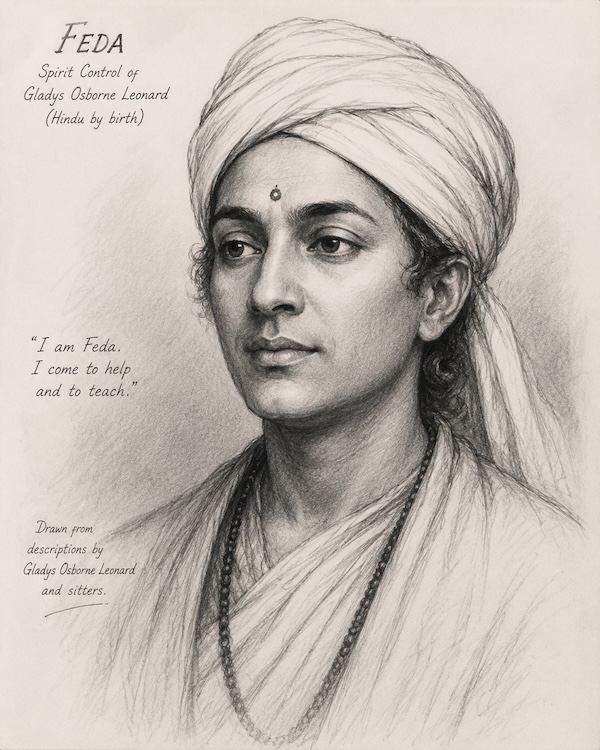
There are some stories that are simply too mind boggling for historians and researchers to grasp and write about. They conflict with either science or religion and therefore are filed away in dust-covered cabinets, never to be heard about again (except at this blog). One such story is that of Feda, a mysterious being for sure. Except for a few mavericks, even psychical researchers of a century ago struggled to understand Feda. It was easier for them to conclude that she was a “secondary personality” buried in the subconscious mind of an English medium, Gladys Osborne Leonard, rather than being the spirit of a dead ancestor. To believe in “ghosts” invited and still invites pompous rebukes and reprimands, chortles and guffaws. Television newscasters are sure to label it a “woo-woo” story and talk about it in a jesting manner to provide some humor to go with the serious news. It’s a paradox: the serious and most meaningful stuff becomes the most humorous and most ridiculous.
It was in December 1910 that Leonard and two friends began experimenting with various forms of mediumship. After numerous failures, they received messages from several people, including Leonard’s mother. These messages came by the table-tilting method, so many tilts for each letter of the alphabet. During this first successful sitting, a long name was spelled out, beginning with “F.” As they could not pronounce it, they asked if they could abbreviate it by drawing several letters from it. The communicating entity consented and the three women selected “F-E-D-A” as the name for what they took to be a spirit entity.
In fact, Feda told them that she was Leonard’s great-great grandmother, a Hindu by birth, and that she was raised by a Scottish family. She married William Hamilton, Leonard’s great-great grandfather, at the age of 13 and died soon thereafter, about 1800, while giving birth to a son. Leonard recalled hearing a story about an Indian ancestress from her mother, but did not remember any details. Feda told Leonard that she was going to control her as she had work to do through her because of a great happening (apparently World War I) that would soon take place. Feda further said that she had been with her as a spirit guide since her birth and that she was fulfilling work required of her to make spiritual progress of her own soul.
Initially, Leonard refused, telling Feda that the idea of being controlled while in the trance state did not appeal to her. While Feda was disappointed, she continued to come regularly in the table sittings conducted by the three young women. Trance was not necessary for the table phenomenon. As Leonard explained it in her autobiography, it took the psychic power of all three women for the table phenomenon, which began with a small bamboo table but later involved a dining room table said to 7-feet long, 4-5 feet wide and with four solid, heavy legs. Feda required singing and complete harmony before she could tilt the table. “My friends were amazed at this weighty table rising up and down so gracefully and lightly, as indeed we were ourselves,” Leonard wrote, pointing out that Feda tilted the table so rapidly that they had a difficult time calling out the letters fast enough to keep up with her.
During one table sitting, about 18 months after Feda first introduced herself to them, Leonard went into a trance and Feda spoke through her, bringing many messages from friends on her side. As her health was not affected by the trance state, Leonard permitted Feda to control her in future sittings, but it took another 18 months before Feda was proficient in taking over Leonard’s body and relaying messages from other spirits. Feda then told Leonard to become a professional medium and promised her that she would look after her. Leonard began by holding circles in Western London, but after the war broke out Feda asked her to give up her public sittings and begin private sittings for those who had lost loved ones in battle. While nearly all the messages were by the trance-voice method, a few came by means of the direct-voice.
SPR Investigation
Sir Oliver Lodge, a world-renowned physicist and pioneer in electricity, thermos-dynamics, and radio, as well as past-president of the Society for Psychical Research (SPR) and the British Association for the Advancement of Science, had numerous sittings with Mrs. Leonard, receiving many communication from his son, Raymond, who had been killed on the battlefield in 1915. Feda referred to Lodge as “Solomon.” While Lodge recognized that Leonard’s subconscious often interfered with the communication from Raymond and other spirits, he was able to filter out numerous veridical messages coming from his son and was certain that the information was beyond Leonard’s knowledge or research.
Charles Drayton Thomas, a researcher for the Society for Psychical Research,(SPR) who carried out more than 500 experiments with Leonard beginning in April 1917 (See PSI Encyclopedia link for both Thomas and Leonard), described a typical sitting: Leonard would take a seat several feet from him and after two or three minutes of silence she would go into a trance. Suddenly, in a clear and distinct voice, Feda would take over Leonard’s body and begin using her speech mechanism. There was no similarity between Leonard’s voice and that of Feda, who spoke like a young girl. Moreover, Feda spoke with an accent and had frequent lapses of grammar.
Occasionally, just after Leonard went into the trance state, Thomas would hear whispering of which he could catch fragments, such as, “Yes, Mr. John, Feda will tell him…Yes, all right…” Feda often referred to herself in the third person, e.g., “Feda says she is having trouble understanding Mr. John.” Mr. John in that case was John Thomas, Charles Drayton Thomas’s deceased father, who communicated frequently with his son, as did his deceased sister, Etta.
“Controls” like Feda were common with trance-voice mediums and were said to be like mediums on the other side of the veil. That is, most spirits are not able to communicate directly with the earth realm and require the assistance of the control to relay messages to the sitter in the earth realm. “Feda’s work therefore is twofold; first to understand the messages which are transmitted to her telepathically, and secondly, to effect their accurate expression in words,” Thomas explained. Most of these “controls” did not appear to be advanced souls, but, like mediums on this side, had a special ability to act as a go-between. At some point during Thomas’s eleven years of research with Leonard, both his father and sister learned how to communicate directly, i.e., without Feda’s assistance.
Thomas observed that Feda could not always grasp the idea which was being conveyed to her by the spirit communicator, primarily by means of thought-transference, or find the words to express them. “Even when the conditions are so good that she seems to herself to hear the message in spoken words, some important part of a sentence may be missed, and the resulting impression which she transmits is inaccurate,” he explained. “More difficult still is it when Feda cannot receive the thought in the form of words, but catches only its general import. Omissions easily reduce a communication to chaos. Feda is perfectly aware of all this and has discussed her difficulties with me.”
Many skeptical scientists concluded that the controls were “secondary personalities” buried in the subconscious of the medium and somehow able to read the minds of the sitters, feeding back factual information to them, but Thomas disagreed. “While studying the literature of psychical research, during the period before my personal investigations commenced, I was inclined to think that mediumistic controls were dream aspects of a medium’s own mind, or even instances of secondary personality,” he reported. “Experience showed me that these hypotheses fail to meet the facts. The controls studied by me not only claimed to be distinct individuals, but were proved to be so by every test I could apply; never did slip or slightest indication warrant the supposition that they were other than the intelligent and self-possessed individuals they claimed to be.”
Not Earthbound Spirits
Some religious fundamentalists concluded that they were all earthbound or evil spirits impersonating deceased loved one. Thomas rejected this idea as well. “If throughout these years, I have been speaking with those who wish to amuse themselves by deceiving me, or to do me hurt by impersonating my loved ones, then the only possible conclusion would be that they are taking considerable pains for no intelligent end. Such amusement must have pulled on them long ago.”
Much of what Thomas received from his father, sister, and others had to do with the nature of the afterlife, as difficult as it was for them to explain, but there were many evidential messages concerning people, places, and things which Thomas concluded the medium had no knowledge of and which were outside his own consciousness. The book and newspaper tests were designed to overcome the skeptical argument that the medium was reading Thomas’s mind. (To be discussed in the next blog here).
Feda frequently had difficulty with names, occasionally getting the full name but often just giving the first letter or first syllable. At one sitting, Etta said she could not get Feda to say her husband’s name, Whitfield. “I can feel it, but cannot say it,” Etta told him. “That is, I cannot get it spoken. I get it on the surface, so to speak, but cannot get it into the medium’s mind.” Etta added that it was much easier for her to send ideas through Feda than to send words. Also, it was much easier to get names through table-tipping than through the voice, but the table was much slower and cumbersome.
One spirit who was able to communicate through Leonard without Feda’s assistance was Sir William Barrett, the physicist who encouraged the formation of the SPR. Shortly after his death in 1925, Barrett began communicating with his widow, Florence Barrett, through Leonard and several other mediums. Lady Barrett was a physician and dean of the London School of Medicine for Women. Initially very skeptical, she was soon convinced that her late husband was actually communicating with her, especially after he made reference to some torn wallpaper in his room and noted that Lady Barrett had recently had it repaired. There is no way, Lady Barrett concluded, that the medium could have known about the torn wall paper and the repairs.
Sir William explained to his widow that when he communicated with her through Mrs. Leonard he had to leave part of himself behind. “In the earth body we have the separation of subconscious and conscious,” he explained. “Consciousness only holds a certain number of memories at a time. When we pass over they join, make a complete mind that knows and remembers everything; but when one comes here to a sitting the limitation of the physical sphere affects one’s mind, and only a portion of one’s mind can function for the time being…I cannot come with and as my whole self, I cannot.” As a result, Sir William further explained, he was very much limited in what he could communicate. Apparently, spirits controls, such as Feda, learned to overcome some of these difficulties, but not all of them.
Next blog post: August 10
Michael Tymn is the author of The Afterlife Revealed: What Happens After We Die, Resurrecting Leonora Piper: How Science Discovered the Afterlife, Dead Men Talking: Afterlife Communication from World War I. and No One Really Dies: 25 Reasons to Believe in an Afterlife. His latest book Consciousness Beyond Death: New and Old Light on Near-Death Experiences is published by White Crow books.

Michael,
A very interesting subject. There is good coverage of the quality of Feda’s messages in Immortality The Scientific Evidence by Alson J. Smith. An obscure book but well written.
“Miss Radclyffe -Hall then asked AVB, a friend of Daisy (through Feda ) if she “remembered an old friend of mine called Daisy.” AVB replied that she did remember Daisy. She then indicated that there were two men present (in the spirit world) who wanted to communicate with Daisy, and that she (AVB) had known one of these men herself during her lifetime , but not the other .
There were many other references to past events and people which were later verified either by Daisy or her sister . Then at one sitting , Daisy’s father said: “There were two of us who stood in the same relation to Daisy , with a slight difference . . Do you follow me?” Feda had referred just before this to a man “writing in jerks,” and had described at length a machine in this man’s room: “It’s nearly all made of some dark -colored metal a big thing on a stand… like a rolly thing or a rod running through the middle, two narrower rods as well, and above the rods something seems to rise up, something that looks curved.”
All of this Daisy Armstrong in the Near East, recognized as applying perfectly to
her adopted father, the Reverend Bertrand Wilson, whom she believed to be alive in England. But it was subsequently learned that he had died three days before this sitting had taken place. The adopted father was a composer and was in the habit of sitting all day at his table, composing music.
In the next room he had a printing press. The investigators (Miss Radclyffe-
Hall and Lady Troubridge ) wrote:”An inspection of the Excelsior Model Hand
-Printing Machines has revealed that Feda’s description of the machine was very near the mark indeed.” Neither of the investigators knew that Daisy had an adopted father-Miss Radclyffe-Hall had not seen her for many years and Lady Troubridge had never met her, nor did they know that such a person as the Reverend Mr. Wilson existed. A perfect stranger to the entire group had to be contacted in order to find out the exact date of the adopted father’s death. Here , then, would seem to be a case which very nearly rules out the telepathic hypothesis. The facts that came out were facts, and they were unknown to the medium, the sitter, or to any other one person, including Miss Daisy Armstrong”.
Controls work with mediums. They select the medium not the other way.
It is the quality of the communication that should be judged,
Thanks
Bruce
Thanks for your comments, support and encouragement, Bruce. They are much appreciated. I think I have the Smith book somewhere in my library. I may have to go to my knees to find it. The problem is that once I go to my knees, it is difficult to get back up. Will attempt it tomorrow when my energy level is higher. 🙂
Michael,
When I quote an obscure book I think to myself “Surely Michael would not have heard or even have this book” yet it seems that you have. My wife asks what should she do with my collection of books. I suspect your wife does the same.
Yes, Bruce, what to do with my books — now or after — is a dilemma that my wife has asked about. I did find my copy of the Smith book, but I read it 25 or so years ago and will have to reread it. Thanks for reminding me of the book.
I can’t begin to imagine the effort it must have taken to conduct these sessions. Then there are all the investigations that went on to try to prove or disprove them. And it’s not just human endeavour, but according to this report and many others, it requires an enormous effort from the other side of the veil too. Then we have dedicated reporters like Michael Tymn and this blog. It seems that the message of the survival of consciousness is vitally important. I often wonder how different the world would be if everyone knew there is no death. I think back to my own atheist period and shudder at how impoverished my outlook on life was compared to now. My views changed with an appearance by my husband 2½ years after his death, and though it shook my worldview and turned my life upside down for a while as I did my own investigations, the freedom from the fear of death is beyond priceless.
Thank you, Gloria, for the meaningful comment and kind words. Yes, a conviction that consciousness survives death can make a big difference in a person’s outlook, but, as discussed in a prior blog or two here, it appears that a little doubt is necessary for the Divine Plan to function properly. To put it another way, “absolute certainty” is not in the best interest of humankind.
I understand your point Michael. The only thing I can be certain of is that I can’t be certain of anything ultimately! I study Advaita Vedanta and in that worldview, consciousness is the only reality, all else is an appearance, and yet the appearance is also the same consciousness. It makes the most sense to me of everything else I have studied. I have no idea what will become of ‘me’ when the body drops but I don’t have the anxiety about it, that I’ve had in the past. I still enjoy exploring the possibilities though.
What I find endearing about Feda is her humility. It also makes me more inclined to believe that she is indeed from a higher realm rather than being a mere alter-ego in this one. All of the great religious traditions teach that the ego must yield to spiritual impulses of empathy and compassion toward others, and also toward oneself, if genuine progress is to be made in this world to equip one for the next.
Here is where I have begun to break with a long habit of absorbing NDE accounts and putting substantial stock in them. Far too many come back from the briefest glimpse, at best, of the afterlife not filled with humility but rather filled with intellectual and spiritual pride, with crucial revelations they feel impelled to share with the world, with detailed knowledge about the next world or the future of this one.
Am I alone in noticing that the torrent of NDE accounts on today’s internet often conflict with each other, even flatly contradict each other, once they move beyond the basic elements of the experience? Some accounts say yes to reincarnation, others no. Some predict a dark future ahead for humanity, others a bright one. Some indicate that there is no hell, others relate being there. Etc.
It would be one thing if these NDErs were a bit reserved and tentative about their revelations, and some indeed are. My favorite line was from a guy talking about his life review, who said with simple candor, “I wasn’t as good as I thought I was.” But for me, in this final chapter of my life, I’ve been turned off on the whole NDE thing by far too many experiencers who, like modern Gnostics, think they know THE truth that they must share, promote, and publicize in every way possible.
No, give me good old fashioned spiritualism at this point, the kind of thing Michael’s been talking about and trying to keep alive for so many years. I’ll take Feda any day over another guy or gal who flat-lined for a few moments and now KNOWS all about what awaits us in the next world and this one as well.
Indeed, I’ve become so jaded with NDEs (I who used to love them so) that it wouldn’t surprise me in the least if science, before long, was able to explain away the entire phenomenon. The “tell” for genuine spirituality is humility, of that I’m certain, as certain as I am that so many current NDE accounts, though thankfully not all, are lacking in that revealing virtue.
Newton: Skeptics have vigorously sought to “explain away” NDEs from the beginning and have failed miserably thus far. Bruce Greyson gave an interesting talk a while back entitled
Are Near-Death Experiences Real? He provides clear evidence that distinguishes NDEs from dreams, hallucinations, and false memories.
I sympathize with your discomfort over the “revelations” from some people who have had an NDE. I find, however, the same contradictions and doctrinal disputes abundant in Spiritualist literature. We each have a viewpoint on reality that, of necessity, is incomplete. As you say, humility is a virtue, particularly when one’s cage is being rattled by an unaccustomed point of view.
Newton, I pretty much agree. As I have mentioned a few times, I see NDEs as “icing on the cake” — the cake baked by the pre-1935 researchers. Indications are that many of the NDErs are not even aware of Feda, George Pellew, and other spirit controls, including group souls like Imperator, Silver Birch, etc. As Sir Oliver said, it is the cumulative evidence that convinced him. Many thanks for your comments and participation.
Hi Michael! Great. I wrote an article about trance-channelers for end of August (Victor Zammit had the topic lately), so this one (my version of your article) is perfect for the day after. Looked up Wikipedia for Gladys Osborne Leonard, and at the end a man is mentioned who took her for “a fraud”. And Gladys was one of the best! But we know that. Thanks, your blog is always a revelation, many greetings, Manfred (manipogo.de).
Thanks, Manfred. I assume Wikipedia was your reference. It has a fraud theory for every psychic phenomenon and almost always ends with it and gives it the most weight. It is a matter of semantics, but I wouldn’t call Leonard a “channeler.” That seems to be a “new age” term reserved mostly for clairvoyants, but the definition is not clear-cut.
Hi Michael! Only as a justification: I know a lot of psychic research, I use Wikipedia only for the dates, and I’m always angry how they act. I wrote an article about trance-channelers which will be published first; but it has nothing to do with zthe one about Feda and Gladys Osborne Leonard. I try to publish related issues, small series, to teach my readers. Greetings Manfred.
Charles Drayton Thomas, In communicating with his Father via Gladys Osborne Leonard, was told: “For convenience in passing from one sphere to another, there are channels or clearings, call them ‘tunnels,’ which have been bored mentally, just as you have tunnels excavated physically on Earth. Constant use of these tunnels keeps them clear.”¹ Passage through a tunnel occurs in about a quarter of NDEs, but is seldom mentioned in accounts of death via mediums. If NDEs are not mere happenstance, but rather part of a coordinated effort to shine more light on our true condition, then perhaps the tunnel experience is a sort of express elevator giving us a peek beyond the more familiar environment of spheres closer to our own.
While NDEs confirm much of what is conveyed by discarnate persons via mediums, thus icing the cake as Michael put it, they have their own distinctive characteristics. Besides transiting via a tunnel, there is the encounter with a being of light who often bears witness to the life review. Life reviews in NDEs are varied; from just the highlights and lowlights to the entirety of a lifetime. The life review is a common feature of discarnate accounts, but rather than a “one and done” affair it is often conveyed as a gradual process of purification. Timelessness exists for both NDEs and accounts via mediums, but the everything, everywhere, all at once episodes in some NDEs are, I believe, unique.
As for icing the cake, NDEs confirm encounters with deceased persons as a greeting committee, viewing the lifeless body and its surround, communication via telepathy, movement via the speed of thought, etc. As evidence directly experienced rather than the knowledge of a third party mediated by another, NDEs play a unique part in thinning the veil between this world and the next.
¹ Life Beyond Death With Evidence, Charles Drayton Thomas.
David, I don’t recall the quote from your first paragraph. Interesting. Thanks for adding it.