
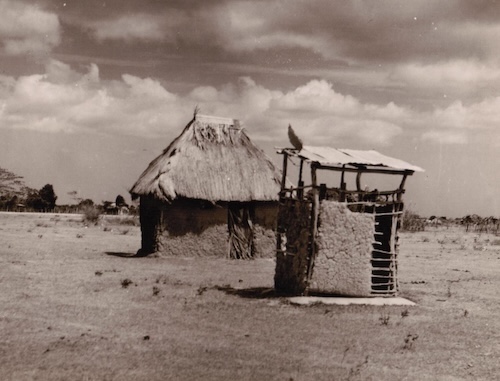
It’s hurricane season here in Hawaii and we seem to have them coming at us from all angles, just missing us. Had Hurricane Lowell decided to pass over our island, its magnitude was such that it is highly unlikely that I’d even have a home. Fortunately, both the house and outhouse are still standing, as shown in the accompanying photo. In fact, I might have been shark food, the ocean being only a mile from my home and within easy blowing distance with hurricane-force winds. Living in “paradise” does have its downside. Actually, the biggest upside, the beaches, lost their appeal 50 or more years ago. When I first moved here 55 years ago, I went to the beach several times a week, usually for a refreshing swim after a run, but my last visit to the beach was about four years ago for a scattering of a friend’s ashes.
Having survived well beyond the average life expectancy and having accepted the overwhelming evidence that consciousness survives death, I don’t have the extreme fear of death that so many others seem to have. However, I do fear surviving such a stormy catastrophe with no home and a very limited food supply, not to mention all the comforts that come with electricity and various luxuries. I think about living in our backyard in a pup tent and wondering how long six jars of peanut butter and three boxes of high-protein bars will last us, whether we will have water, and how many months or years it will take to restore some of life’s comforts. The welfare and mental states of my wife and relatives and friends add significantly to the fear factor. I wonder if there will be a need to share our peanut butter and high-protein bars with neighbors who have exhausted their supply of food. It is not a pleasant scenario. There’s not much to hunt for here and there are limits to fishing.
It’s unclear to me whether the hurricanes have increased in recent years because of climate change, whether it is all part of normal cyclical changes that have been occurring throughout earth’s history, or whether advanced meteorological forecasting has simply made us more aware of what is coming toward us. Could the hurricanes have been out there 30 or 40 years ago and we just didn’t hear about them?
Meteorology is clearly an inexact science, about as inexact as thanatology, the name given to the study of dying and death. Hurricanes don’t always follow the paths predicted by the meteorologists. For the most part, the meteorologists seem to do a very good job in charting out the path of the hurricanes, as well as in predicting wind velocity and the increasing or diminishing strength of the winds, but the hurricanes have a mind of their own and sometimes deviate from the predicted paths. In spite of their inexactness, meteorologists are referred to as “scientists” or at least I think they consider themselves such.
According to the dictionary, thanatology is the study of the phenomena of death and of the psychological mechanisms for coping with them, but I have never heard anyone call him- or herself a thanatologist. It would no doubt be met with raised eyebrows if someone identified himself as such and claimed to be a scientist. They probably call themselves therapists or psychologists and their discipline does not extend beyond death itself. At least, it is my understanding that thanatology does not go beyond death into the survival of consciousness. As I further understand it, psychical researchers have all died off and parapsychologists are concerned with psychic phenomena while avoiding any mention of consciousness surviving death. Such mention would mean they are not scientists. To my knowledge, those who dare venture into the survival issue don’t have a name by which to identify themselves. If they support the survival hypothesis, they are sometimes called spiritualists, but many take that word to mean the same as “weird cultists” rather than the opposite of materialists. I’ve been called a “spiritualist” now and then, but I qualify that by saying I’m a spiritualist with a lower-case “s” and not a capital “S”. But I sometimes further qualify that and say that I’m 80 percent spiritualist and 20 percent materialist. I wouldn’t be driving a 21-year-old Honda or wearing a $9.95 watch if I were a materialist. I’d opt for Mercedes or a Porsche and a Rolex. However, I do enjoy certain comforts and have such luxuries as a computer and a television, which account for me being partly a materialist.
Before Electricity
My materialist side also shows when we have long power outages due to strong winds created by hurricanes which come close to our island. With no air conditioning in our humid climate, no baseball games to watch, no computer to play on, and only a battery-operated light to read from, I always ponder on how people lived before electricity. I think about Mary Todd Lincoln, the widow of our great president, Abraham Lincoln, and how she lived as a widow in a downtown Chicago apartment before electricity. What did a person do in a small apartment with no electrical lighting, no radio, no television, no phone, no computer, no AC, no fans, no fireplace, just candlelight and maybe a few books? The men could escape to a pub and get drunk, but that wasn’t an option for women. Their only option was knitting. Men who didn’t drink could whittle or go fishing.
Mrs. Lincoln apparently found a little escape in browsing around some shops near her apartment and chatting with the shopkeepers. She probably felt obligated to make some purchases from those shopkeepers and bought more than she needed. When her only surviving son saw all the excessive purchases still in boxes stacked around her apartment, he was alarmed enough to question her sanity and her ability to live independently and frugally. The fact that she was interested in Spiritualism added to his concerns and resulted in her being committed to a lunatic asylum. Fortunately, two of her lawyer friends, husband and wife Spiritualists, managed to get her released from the asylum after a few months.
Back to the hurricanes, I’ve noticed that our television news people are making every effort to report on the threats in a very cheerful manner. A few years ago, they were scaring people with their dire forecasts, and apparently many stopped watching the new reports and/or they complained about the scare tactics. To regain viewership, they had to report on the approaching hurricanes with a smile and some optimism. It seems to be working, but it’s often difficult to know if the truth is being disguised by their smiles.
I think the churches took the same approach with the afterlife. They were scaring people with hell fire and damnation, while strumming harps in heaven for eternity didn’t come close to offsetting that horrific picture. For Catholics, purgatory was as bad as hell, just not permanent. Thus, they just stopped talking about it. It’s now all about praise and worship of God with no mention of what comes after death.
It’s all very unsettling, but it all provides adversity from which we can learn.
Next blog post: November 2
Michael Tymn is the author of The Afterlife Revealed: What Happens After We Die, Resurrecting Leonora Piper: How Science Discovered the Afterlife, Dead Men Talking: Afterlife Communication from World War I. and No One Really Dies: 25 Reasons to Believe in an Afterlife. His latest book Consciousness Beyond Death: New and Old Light on Near-Death Experiences is published by White Crow books.

You’re bringing back memories, Mike…
During my one year in the islands over 6o years ago, as far as I recall, we didn’t have any hurricane alerts of note–but we did have a major tsunami alert. When the sirens started up around two in the morning, it was the sign for all of us to pile in the car along with a couple of six-packs and make a trek up the mountain, from the Kailua side, to about halfway up the Pali. I’ve had worse times.
We don’t have any tsunami alerts in our present location–but being in a mobile home on the very top of the Blue Ridge Mountains presents its own occasional insecurities. Fortunately, as a “small-s spiritualist” like yourself, my long-term concerns are essentially non-existent. My wife has also read enough of the material to buy in intellectually–but it’s apparent that I’ve still got some work to do to get that full buy-in emotionally…
Thanks, Don. I also recall a tsunami alert and going half way up the Pali, but that was only about 50 years ago. I also recall an air-raid alert just a few years ago that was a false alarm. The big problem was that the governor couldn’t remember his password in order to get it turned off. Many people panicked during the 30 minutes or so that we thought nuclear missiles were headed our way.
My take on the afterlife envisioned by the deepest forms of Christian faith is far from the dichotomy of either roasting in hellfire or strumming harps in heaven. Perhaps the prophet Isaiah lays it out in the clearest manner. ALL of creation will be redeemed and transfigured, reaching a resplendent consummation structured into things, hidden within things, from the beginning. Predatory nature will be gloriously transformed, with the lion lying down peacefully, lovingly, with the calf. All tears will be forever wiped from human eyes, and we will know suffering and death no more. For me, it is thinking far too small about ultimate things to focus primarily on individual survival or our own personal reunion with loved ones, as crucially important as those things are. If there is indeed a God who is Love and Life, then we can’t really even begin to understand the peace and joy of the ecstatic union that awaits us–not only human beings but also, as I see it, all living things.
Thanks, Newton, I agree. If I occasionally stray into personal things, it is for lack of verbiage in discussing the bigger picture or in not wanting to be redundant. When I started writing a weekly column about running for the morning paper here, my wife asked me how much I could possibly write about putting one foot in front of the other. I surprised her by continuing with the column for 24 years. Of course, there is much more to say about the bigger picture, but after some 400 blogs, I sometimes run out of ideas.
The amazing fact, Michael, that you continue, after so many years, to come up with new posts that elicit lively and productive conversation is evidence far beyond a reasonable doubt that you are a champion-level marathon runner in the realm of spirit. Without exaggeration, you literally changed my life, my worldview, by introducing me in book after book, post after post, to the psychical research and researchers of the late 19th/early 20th centuries. And I know that in this regard I’m far from alone.
Your kind words are appreciated, Newton. What amazes me is that so few people seem interested in the subject. I sense that, as Kierkegaard suggested, they are in despair, but they don’t really know they are in despair or, if they realize it, they think it is the result of social or economic conditions.
Michael,
By a strange twist of fate, tonight, a few hours before I read your post, I was looking at a book on Kierkegaard in a free library. It looked interesting but I thought not to invest any time in a book that seemed to be too highbrow for me. Lo and behold, it is mentioned a few hours later. A nudge from the universe, a strange coincidence, or a reminder to invest time in Danish philosophers. Could be Kierkegaard dropping a hint that he should not be forgotten. The book was not there two days ago.
Thanks,
Bruce
Bruce, Kierkegaard is a somewhat difficult read, but it has some real gems that make it worth the price, at least to me.
Dear Michael,
Your distinction between fear of death as annihilation and fear of the many things that can happen to us before death is an important one, and capable, I think, of being carried somewhat further. A conviction of posthumous survival can radically alter one’s understanding of death without making embodied existence any less vulnerable. One may cease to fear that death means extinction and still fear cancer, dementia, incapacity, financial insecurity, violence, the suffering of those one loves, or any of the innumerable contingencies to which embodied life exposes us. One can make the walls thicker, so to speak, but one cannot make embodiment invulnerable.
There may be a deeper point here, however. Conditions do not merely occasion fear; over time, conditions lead to conditioning. We spend an entire lifetime inhabiting a biological organism that can be injured, deprived, diseased and finally destroyed. Around that organism we construct widening circles of self-concern – spouse, children, livelihood, home, community, possessions, projects, even nation or humanity more broadly – and each valued thing becomes another possible point of vulnerability. The diameter of this circle differs enormously from one person to another, as does the weight assigned to what lies within it.
This does not mean that attachment or concern is therefore something simply to be minimized. A person without children need not fear for his children, but that hardly means that having children is a mistake because they create additional occasions for fear. The same can be said of marriage, friendship, community, or necessary possessions. The issue is not whether we care, but how we carry what we care about – whether primarily through anxious possession and control, or through care tempered by gratitude and surrender. One may fear ill health, for example, while also experiencing gratitude for good health while it is present. The fact that something can be lost does not make valuing it illegitimate.
Fear itself is not simply an evil. Like pain, it can perform an indispensable epistemic function. It tells us that something may be wrong and that attention is required. The problem begins when fear ceases to be a signal and becomes a sovereign – when it takes control of perception, interpretation and response. The mature objective is therefore not necessarily fearlessness in any crude sense, but the capacity to receive fear’s information without surrendering one’s center to it.
Fear may also help explain another curious feature of this subject: the widespread lack of interest in the question of survival itself. One might expect fear of death to impel people toward investigation, yet in practice the opposite very often seems to occur. Your own observation is hardly unique. The history of psychical and survival research, from Frederic Myers onward, repeatedly confronts not merely skepticism but indifference, dismissal and sometimes outright hostility toward a question which, if answered in the affirmative, would surely rank among the most consequential imaginable. David Fontana, among more recent researchers, explicitly reflected upon this opposition and upon the peculiar resistance encountered by serious survival research.
Some part of this reaction may itself be psychological. Precisely because the possibility of annihilation is so disturbing, avoidance of the subject can function as a psychological defense against the fear it evokes. One need not consciously think, “I am afraid of extinction and therefore will not investigate it.” The defense works more effectively when the disturbing question is kept outside the field of serious attention altogether. Death may be treated as morbid, unknowable, speculative or simply not worth thinking about, while the underlying anxiety remains largely untouched. The defense that protects a person from confronting the fear may therefore also prevent access to the evidence capable of diminishing it. This need not explain every case of indifference or rejection; intellectual commitments, institutional pressures and genuine evidential disagreement obviously play their parts. But it may help explain the otherwise curious fact that a question of universal and unavoidable personal relevance can remain so remote from serious inquiry for so many people.
The matter becomes still more interesting if the broad picture given in the survival literature is substantially correct. Death would then remove many of the conditions that continuously generate fear in an incarnate context. One no longer remains within the terrestrial web of circumstances in which bodily disease and decline, unemployment, financial insecurity, physical injury and death itself can occur. Yet it does not follow that a consciousness conditioned by decades of vulnerability instantaneously becomes free of fear.
A suitable analogy may be borrowed from Ramana Maharshi. When an electric fan is unplugged, its blades do not stop at once. The motive power has been cut off, but the accumulated momentum continues until it is spent. Something similar may happen with fear after death. During incarnation the motor remains plugged in: bodily vulnerability, uncertainty and the possibility of loss continuously replenish the fear response. Death may disconnect much of that motive power while leaving the acquired psychological momentum temporarily intact.
Such a model would help explain why many individuals may enter discarnate existence relatively free of fear, while others may arrive with fear still strongly active, or encounter new conditions that evoke it. Newly deceased persons may be frightened, confused, exhausted or traumatized by their incarnate experiences, yet they are not necessarily depicted as being left to externalize those states ideoplastically into their surroundings. Rather, they are often received, reassured, rested and gradually reoriented. Frances Banks, in Testimony of Light, describes the Rest Home in precisely this kind of role: part hospital, part place of rest, part teaching center. The newly arrived may require reassurance, explanation and time before they can assimilate what has happened to them.
Entry into discarnate existence fundamentally recontextualizes the conditions that shaped the person incarnately. The circumstances that generated a fear may have ceased, while the conditioning they produced remains. The danger may be gone while consciousness still responds as though it were present. Where that adjustment occurs readily, the fan simply winds down.
The discarnate literature also describes harder cases. Jurgen Ziewe’s Elysium Illuminated contains a particularly striking discussion of what he calls trauma fields. In these lower conditions, unresolved fear, guilt, anger, obsession or despair do not merely remain private emotions; because the discarnate environment is described as highly thought-responsive or ideoplastic, inner states can acquire outward environmental expression. Ziewe consequently describes fear as a powerful “world-builder.”
A disturbing feedback process can then develop. Fear contributes to the production of a frightening environment; the environment appears to confirm the fear; and the confirmed fear further strengthens the environment. The original incarnate power source may have been disconnected, but the psychological residue has found a secondary source of reinforcement. What began as conditioning acquired under earthly circumstances can, in certain discordant discarnate conditions, become partly self-sustaining.
This is why I think it is important not to interpret the thought-responsive character of these environments too simply. The alternative after death is not merely between a pleasant heaven and a private nightmare of one’s own creation. These accounts repeatedly describe shared or consensual environments populated by other consciousnesses. Some may reinforce pathology; others may counteract it or help the individual emerge from it. Moreover, lower conditions are not necessarily harmless simply because thought and emotion help shape them. Testimony of Light, for example, indicates that those undertaking rescue work in the Shadow Lands do so with experienced guides, and other accounts similarly describe real dangers arising from other discarnate beings or collective conditions.
One of the recurrent patterns in rescue accounts is that, once an individual has even provisionally accepted help, the first practical step is frequently to get him out of the conditions in which he presently finds himself. At the beginning of Jane Sherwood’s Post-Mortem Journal, “Scott” (T. E. Lawrence) awakens in a miserable region and encounters a helper who tells him that they must first get him into a happier condition before much more can be done for him. He is then led through an increasingly brighter environment. The logic is almost medical: one does not begin rehabilitation while the patient is still inside the burning building.
Stephen Turoff’s Seven Steps to Eternity gives a similar picture in the setting of battlefield deaths. The protagonist, newly dead at the Somme, is quickly led away by discarnate rescuers from the battlefield, and later the book makes explicit that rescue workers are tasked with getting newly dead soldiers away from such scenes because the fighting and the lower influences associated with it continue to present dangers. The sequence seems repeatedly to be one of contact, tentative acceptance of help, extraction from the damaging environment, stabilization, reorientation and finally deeper healing. The environment itself is part of the treatment.
This also bears on psychological defenses. One persistent theme of the discarnate literature is that concealment becomes increasingly difficult after death. Earthly life permits extraordinary scope for impression management, rationalization, hypocrisy and self-deception. One may lie to others, construct an acceptable persona, seek social confirmation for it, and sometimes succeed in hiding inconvenient truths even from oneself. The discarnate accounts suggest that this becomes progressively harder because what one is becomes increasingly transparent to others and expressive in one’s surroundings. But transparency to others is not the same thing as self-knowledge.
A person may still cling to a constructed self-image after everyone else can see through it. Ziewe describes precisely this among perpetrators who continue to justify themselves, deny what is before them or retreat into deeper contraction even when their environment is exposing what they have become. Perhaps the right way to put it is that defenses may lose their opacity before they lose their persistence. Death may not abolish self-deception, but discarnate conditions may progressively deprive it of the external supports that previously allowed it to remain convincing.
That also helps explain the role of compassionate assistance. A psychological defense is often maintained not merely because a person loves falsehood, but because the truth it conceals is psychologically unbearable. If abandoning the belief “I was justified” means confronting “I caused terrible suffering,” then denial may protect against collapse into shame, horror or guilt. A helper who can communicate, in effect, “Yes, this is true, but you are not beyond help,” may make recognition possible without annihilating the person’s remaining sense of self.
There is, however, a prior question: can anything be done before death to alter what consciousness carries with it? Here I think the answer supplied by both psychology and spiritual traditions is clearly yes. There is an interesting paper by Kenneth Ring, “The Impact of Near-Death Experiences on Persons Who Have Not Had Them” (1995). People who had not themselves undergone NDEs but had immersed themselves substantially in NDE material nevertheless showed some of the same kinds of psychological changes commonly associated with experiencers, including reduced fear of death and increased spirituality.
That seems very pertinent to individuals such as yourself and to serious readers who have immersed themselves for years in survival evidence. Sustained study can do more than add propositions to the intellect. Study can give way to conviction, and conviction can gradually become formation. There is a considerable psychological difference between saying, “Some people claim there is life after death,” and reaching the point at which survival has become part of the ordinary background against which one understands reality. Death may still be feared as a process, and one may still fear what may happen prior to it, but the prospect of annihilation no longer occupies the same unquestioned place in the imagination. Sustained inquiry can therefore itself become a form of preparation.
But knowledge is not the whole of preparation. Allan Botkin’s work with traumatized veterans offers an interesting terrestrial analogue. Botkin, a psychologist who spent many years treating combat trauma, developed what he called Induced After-Death Communication after observing that some patients undergoing a modified form of EMDR reported encounters with deceased persons connected with their grief or trauma. Whatever interpretation one places upon those experiences, Botkin reported cases in which emotional structures that had persisted for decades – grief, guilt, anger and traumatic fixation – underwent striking and apparently durable reorganization. The point here is not that such experiences establish survival, but that consciousness can sometimes be released from deeply entrenched conditioning much more rapidly than one might suppose. Preparation for death may therefore consist partly in healing what would otherwise survive death.
The discarnate literature repeatedly insists that what matters is not merely what one knows but what one has become. This is where contemplative and devotional traditions become highly relevant. If incarnate conditions lead to conditioning, spiritual practice is the deliberate formation of the consciousness that must eventually pass beyond those conditions. Persistent contemplative practice may cultivate the ability to find stillness under pressure; prayer may habituate the mind to turn toward the Divine rather than reflexively toward fear; ethical discipline may restrain the formation of habits that would otherwise become deeply entrenched; and therapy may heal trauma, guilt or grief that might otherwise remain active.
There may therefore be a continuum here: first, the deliberate formation of consciousness through the manner in which one lives and practices; second, terrestrial repair where trauma, grief, guilt or other injuries can be healed during embodied life; third, postmortem convalescence where surviving disturbances require reassurance, rest, instruction and healing; and, in the harder cases, discarnate rescue from conditions that have become sufficiently self-reinforcing that the individual cannot readily escape them unaided.
The principle resembles preventive medicine. The existence of hospitals is hardly an argument for neglecting one’s health. Likewise, if reports of postmortem hospitals and rest homes are trustworthy, their existence would hardly be an argument for postponing psychological or spiritual development, healing or maturation until after death. Heal now what can be healed, because whatever is genuinely healed need not require healing later. This does not imply that trauma sufferers are somehow blameworthy for what has happened to them, nor that spiritual practice guarantees immunity from fear or suffering. It means only that consciousness can acquire capacities, and that some of those capacities may matter greatly when familiar earthly supports fall away.
If the survival literature is right, death does not simply transport a finished personality into another location. It removes some conditions, exposes others, and initiates further processes of adjustment and development. Some fears may fall away quickly because the conditions sustaining them have vanished. Others may persist for a time through psychological momentum. In still other cases, especially within discordant discarnate conditions that reinforce them, fears may have become so deeply embedded in trauma, character or self-enclosing patterns of consciousness that substantial healing or rescue is required.
So survival does not mean that death solves everything. And where fear does persist, its continued presence does not imply that death has left the person’s situation fundamentally unchanged; the conditions that once generated it may already have fallen away even while their psychological effects remain. A well-grounded conviction of posthumous survival gives us, rather, a different horizon within which the vulnerabilities of embodied life can be understood. It suggests that those vulnerabilities are not the whole story, that what has happened to consciousness is not necessarily irreversible, and that development continues.
And that places a certain responsibility back upon us while we are here. If consciousness survives, then the most consequential preparation for death may not be acquiring ever more information about the next world, useful though such knowledge may be. It may be attending, as best we can, to the consciousness that will enter it.
Best,
Paul
Thank you, Paul, for sharing all that. You offer much to ponder on and so many paradoxes. Life seems to be one big paradox. As researcher Gary Schwartz put it: “It’s remarkable how [survival] research has been for the most part ignored by religion, but frankly, I’m relieved.” Perhaps, along the same line of thinking, it is best that the general public takes so little interest in it.
Wow. And thank you. I’ll have to read your comment a few more times, Paul, and chew on it awhile, before it fully sinks in and sheds even more light than I was able to glean in a single reading. Might I ask about any books or articles you may have penned, any internet content you may have created, other than the illuminating comments you continue to grace us with on Michael’s blog?
Dear Newton,
Thank you for your very kind comments. If you and Michael would humor a little blog cross-seeding, you will likely also find of interest my recent comment posted to Stafford Betty’s current blog post “No Limit to the Soul’s Progress”.
All best regards,
Paul
Newton, please read the equally revelatory comments Paul has made on my most recent blog.
Dear Paul and Stafford: Your suggestions that I read Stafford’s most recent blog post and Paul’s subsequent comments have brought me even more edifying material to ponder. Now I have an additional blog, another path of spiritual exploration, of which to keep abreast. This prompting and urging, in the form of invitation, is deeply appreciated.
The work of spiritualists and mediums of various stripes, and those who study them, has certainly done much to illuminate the contours of what apparently lies ahead for human beings when they pass from this world to the next. And a glorious vision it is. But what about, for example, our animal friends? Would a loving God not love them all, indeed all lifeforms, at least as much as we love our pets?
This is where I believe that spiritualism (defined broadly to include NDEs, which sometimes feature reunions with pets and beautiful natural landscapes) would benefit from supplementation by something akin to Isaiah’s peaceable kingdom passages. These passages seem to point to an eventual consummation and transfiguration of all creation, at least all that lives, not merely human beings and their pets but everything into which was breathed the Ruach, the animating divine breath.
Long have I believed that the “eternal” in “eternal life” does not refer to a special kind of life that follows earthly life but rather to life itself, the life of the amoeba as much as the man.