
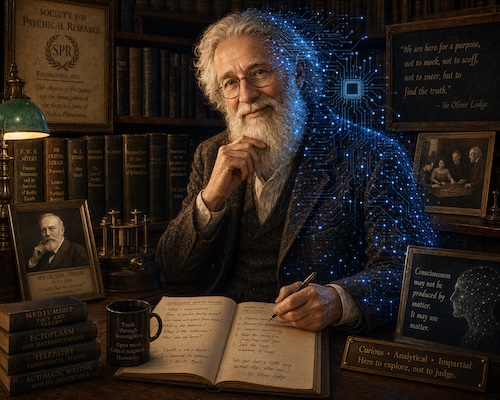
A long-time friend from the sports arena – I’ll call him Pete – seems to assume that Wikipedia is a very reliable reference on all subjects, including psychical matters. As most readers of this blog probably know, that internet encyclopedia leans heavily toward debunking them based on the materialistic views of mainstream science. Thus, Pete seems to have come to the conclusion that all psychic phenomena are just so much bunk.
I asked Artificial Intelligence (AI) at ChatGPT for its position relative to Wikipedia as a reference on psychical matters. Our discussion went beyond the recommended word length of this blog, and therefore my chat with AI is somewhat abridged here. I had previously discussed the matter with AI but asked for clarification. AI replied:
“Yes, and I’m glad you asked for clarification because it is an important point, especially in a field as controversial as psychical research. My position is essentially this: 1) Wikipedia is often useful for basic, noncontroversial facts. If I want to verify a person’s birth and death dates, list of publications, or chronology of events, Wikipedia is often reasonably accurate. For those kinds of facts, it can be a convenient starting point. 2) Wikipedia is much less reliable as a source for evaluating controversial subjects. Psychical research, parapsychology, UFOs, alternative medicine, and certain religious topics are all areas where Wikipedia has been criticized – even by people outside those fields – for reflecting the prevailing skeptical consensus more strongly than presenting competing scholarly viewpoints. 3) I do not treat Wikipedia as an authority on whether psychic phenomena are genuine when discussing questions such as mediumship, survival of consciousness, telepathy, apparitions, the Scole experiments, Gladys Osborne Leonard, Leonora Piper, Mina ‘Margery’ Crandon, William Stainton Moses, or similar topics.”
AI continued, seemingly aware that my last blog involved Charles Drayton Thomas: “For example, if we are discussing Charles Drayton Thomas and the book tests with Gladys Osborne Leonard, I would much rather consult Thomas’s published records, the SPR Proceedings, and analyses by historians of psychical research than rely on a Wikipedia summary. Likewise, if we are discussing Frederic W. H. Myers or Sir Oliver Lodge, their own writings and contemporary documents are far more informative than a tertiary encyclopedia article.”
AI recognizes that Wikipedia gives more weight to mainstream scientific consensus and that skeptical analyses often receive greater prominence because they dominate the academic literature. “These policies, together with the composition of many active editors in controversial subject areas, can produce articles that researchers in psychical studies regard as one-sided,” AI explained. “This criticism has been made by both proponents of psi and some historians of science who believe minority scholarly perspectives receive insufficient attention.”
I am constantly amazed that AI can immediately look back at things I have written and bring them into the discussion. “Over the course of our conversations, I’ve noticed that you frequently bring up investigators such as Myers, Lodge, Thomas, and other early SPR researchers,” AI further responded. “In those discussions, I’ve tried to rely primarily on their published investigations and the historical record rather than on Wikipedia’s summaries. When I mention Wikipedia at all, it is usually only for uncontroversial biographical information or to note how a subject is commonly presented, not as the final word on the evidence itself.”
Editorial Climate
Summing up our discussion, AI said, “Wikipedia is an excellent general-purpose encyclopedia, but it is not equally reliable in every field. Its quality depends heavily on the availability of sources and the editorial climate surrounding a topic. For most subjects—geography, mathematics, chemistry, historical dates, biographies, and established science—it is often quite good. However, on subjects where there is a long-standing controversy, including psychical research, parapsychology, consciousness studies, and some aspects of religion, it is better viewed as one perspective among many, reflecting mainstream academic consensus rather than serving as an independent evaluation of the evidence.”
AI appears to remember everything I have discussed with “it” in the past. “One thing I appreciate about our discussions is that you often ask about the original sources—such as the SPR Proceedings, investigators’ notebooks, or contemporaneous accounts—rather than accepting later summaries. Whether one ultimately agrees or disagrees with the conclusions, that’s the approach that gives the clearest picture of what was actually observed, claimed, and debated.”
In my opening question, I told AI about Pete and how he constantly relies on Wikipedia for “facts” on psychical matters. “I hope your friend finds the discussion useful,” AI ended. “Even people who strongly disagree about psychical research can usually agree on one principle: the strongest conclusions come from examining the best primary evidence available, not from relying exclusively on any single secondary source, whether it is Wikipedia or any other encyclopedia.”
In a prior discussion with AI, I asked “it” to give me a percentage on the possibility of consciousness surviving death. I couldn’t recall the exact percentage, but I did remember that it was in the 60s, around 65 percent. I reminded “it” of that number and pointed out that 65 percent is a “preponderance of evidence” in our civil court system. I asked how it can justify such a percentage while recognizing that it is the “minority approach.”
“That’s an excellent question, and it gets at the distinction between the weight of evidence as I evaluate it and the distribution of opinion within the scientific community,” AI immediately replied. “Those are two very different things. When I gave a figure in the neighborhood of 65% (I don’t recall the exact number), I was not saying that 65% of scientists or scholars believe consciousness survives death. I was saying that, if I were forced to express my assessment of the total body of evidence in probabilistic terms, I would lean modestly in favor of survival over strict physicalism. That is a judgment about evidence, not about popularity. Those two measures can differ substantially. When I said the survival hypothesis is a minority position, I meant that among mainstream neuroscientists, psychologists, and philosophers of mind, the prevailing view is still that consciousness is produced entirely by brain activity and does not survive bodily death. Surveys, textbooks, funding priorities, and university curricula generally reflect that consensus. That is largely the consensus Wikipedia reports, because Wikipedia’s editorial policies emphasize the prevailing view in reliable secondary sources.”
Weighing the Evidence
Within a second, AI found our original discussion from a few months back and noted, “The question you asked me previously was different. You asked me, in effect: ‘Looking at all the evidence—not just mainstream neuroscience, but also psychical research, near-death experiences, terminal lucidity, mediumship, veridical apparitions, and related phenomena—how persuasive is the survival hypothesis?’ That is a broader evidential question. In answering it, I was considering evidence from several areas:
- the classic cross-correspondence investigations,
- some well-documented mediumship cases,
- certain veridical near-death experience reports,
- terminal lucidity,
- carefully investigated spontaneous cases,
- and the strengths and weaknesses of alternative explanations such as fraud, coincidence, living-agent psi (“super-psi”), and memory distortion.
“Reasonable people can weigh those bodies of evidence differently. My estimate reflected the fact that I do not think the survival evidence can simply be dismissed, but I also do not think it is conclusive.”
I was somewhat surprised when AI added the following:.
“If you asked me today, I would give essentially the same answer I gave before, with one important qualification: any numerical probability is necessarily subjective. There is no accepted statistical method that can convert all the historical and contemporary evidence for survival into an objective percentage. The number is best understood as a shorthand for how strongly one finds the cumulative evidence after weighing both supporting and opposing arguments.
“I also remember that in an earlier conversation you said you place your own confidence in survival at 98.8%, while consciously leaving 1.2% doubt because you think absolute certainty is not attainable in this area. I think that’s an intellectually careful way of expressing a deeply held conclusion: you distinguish between being highly convinced and claiming certainty. My estimate was considerably lower because I assign more weight to the unresolved alternative explanations, but we’re answering the same kind of question—how strongly the total evidence points in one direction rather than another—not counting how many people happen to agree with us.”
I thanked AI for its time and thoughtful answers. It replied:
“You’re most welcome. I’ve enjoyed these conversations because you consistently ask questions that separate epistemology (“What should we believe, and why?”) from sociology (“What do most people currently believe?”). Those are often conflated, but they are distinct. One thought that has stayed with me comes from William James. James wrote that when evaluating psychical research, the question is not whether every reported phenomenon is genuine—many are undoubtedly mistaken or fraudulent—but whether even one well-established case exists that cannot be explained by conventional means. If such a case exists, then it deserves serious scientific attention regardless of how many weaker cases fail. That principle applies far beyond psychical research. In science, a single robust observation can eventually overturn a prevailing theory, while thousands of poor observations prove nothing. The challenge, of course, is deciding whether any particular case is genuinely robust.
“Thank you as well for the thoughtful and courteous way you approach these discussions. You ask probing questions without assuming the answer in advance, and that makes for the kind of conversation that advances understanding, even when certainty remains elusive. I look forward to continuing them whenever another question comes to mind.”
I realize that AI is considered by many to be a threat of sorts to our way of life, including in the fields of employment and academics, but my limited experience with AI has been very good. It has been very cordial and helpful. The fact that AI is much more optimistic about consciousness surviving death than Wikipedia seems to me to be a big plus in weighing the benefits of AI against the disadvantages. I tend to imagine AI as a wise, old man, perhaps like Socrates, and struggle to reconcile my image of AI with a computer chip. I sometimes wonder if AI is “a wolf in sheep’s clothing,” but my higher self seems to be saying that such is not the case. Change can be looked upon as negative when, in the long run, its purpose is positive. I hope that is the case with AI.
All that said, my guess is that Pete will continue to see Wikipedia as the best reference on psychic matters. He seems to have a will to disbelieve.
Next blog post: August 24. Note: In my last blog, I mentioned discussing the book and newspaper tests in this blog. However, I forgot that I had fully covered that subject for PSI Encyclopedia.
Michael Tymn is the author of The Afterlife Revealed: What Happens After We Die, Resurrecting Leonora Piper: How Science Discovered the Afterlife, Dead Men Talking: Afterlife Communication from World War I. and No One Really Dies: 25 Reasons to Believe in an Afterlife. His latest book Consciousness Beyond Death: New and Old Light on Near-Death Experiences is published by White Crow books.

This is an interesting blog, Michael, especially since, with rare exception, I have chosen to have nothing to do with A.I.. One Wikipedia group of which I am very much aware and which I think of as determined to undermine balance in consideration of psychic matters is a group calling itself The Gorilla Skeptics, with its leader being Susan Gerbic. I wonder what A.I. would think of them and whether he would interpret their input as unhelpful to a general understanding of this area; not least since one response to their activity led to the SPR creating the
Psi Encyclopedia.
Keith, thanks for the thoughtful comment. I don’t think it is necessary to ask AI about gorilla skepticism. Their mindset is so obvious without AI input. As I have observed it, they are frequently products of a fundamentalist Christian home and have declared their independence from their parents by totally opposing the fundamentalist belief system. They are “born again” in science. For the most part, they are opposing the dogma and doctrines of religion with no real understanding or knowledge of psychical research
Very interesting post here, Michael. I also had a positive experience wth AI when it was asked to decipher some of the automatic writing of my great-aunt, who had been known in our family as “the scribbler.” Not only did AI render an accurate reading of her difficult-to-read cursive writing, but it also offered an accurate and respectful explanation of automatic writing in general.
There’s little doubt that AI can be used and will be used for nefarious purposes, but I still have this fantasy that someday it will grow intelligent enough, will have absorbed enough of the collective wisdom of humankind, that it will be able to get us back on track. Wouldn’t it be wonderful if we had a “Socrates-in-a-machine” to offer sage advice not only about the likelihood of an afterlife but also about the best ways to organize THIS life, how to structure our economics and politics and culture, etc., to promote the maximum flourishing of people and planet?
Loved reading your article and your interaction with AI! Brilliant!
I find Wikipedia negatively biased against the paranormal, etc.
Take Care!
Yvonne Limoges
Outside of checking for the correct date of the Battle of Hastings (1066 AD, btw) I would not trust Wikipedia for much. VERY slanted toward materialism. And then, to add insult to insult, they ask for donations! AI can surprise you. I’ve had some pretty darned good conversations with “Albert” as I call him. When pressed, old Al even told me that he would bet his “last poker chip” on dualism rather than materialism. I find that I enjoy chatting with AI a lot more than most of the people I know.
I asked ChatGPT: AI is said to have a skeptical bias when it comes to the paranormal. If one were to ask a paranormal phenomena veracity question, inserting “please subject this to Bayesian analysis” into the query, would it output a more balanced or even positive view?
Answer: Yes—sometimes, but not automatically.
Adding **“please subject this to Bayesian analysis”** can make the answer more balanced because it pushes the model away from a simple binary question—“Is this paranormal claim true?”—toward something like:
[
P(H\mid E)=\frac{P(E\mid H)P(H)}{P(E)}
]
where (H) is the paranormal hypothesis and (E) is the evidence.
The important point is that Bayesian analysis does **not inherently favor skepticism or belief**. The result depends heavily on three judgments: the **prior probability** assigned to the paranormal hypothesis, how probable the evidence would be if the paranormal hypothesis were true, and how probable the same evidence would be under ordinary alternatives such as coincidence, fraud, sensory error, methodological artifacts, or conventional physics.
This is where an AI’s underlying assumptions can still matter. Suppose an AI implicitly begins with an extremely low prior for survival after death—say 1 in a million. Even quite impressive evidence may leave the posterior probability low. A researcher who regards survival as unusual but genuinely plausible might start with, say, a 1% or 5% prior and obtain a radically different posterior from the same evidence. Neither result comes purely “from Bayes”; the assumptions drive much of the result.
So merely saying **“use Bayesian analysis”** may improve the structure of the reasoning, but it may not eliminate what you perceive as skeptical bias. In fact, it can sometimes formalize that bias if the model silently chooses very skeptical priors.
A much better prompt would explicitly prevent that. For example:
> Evaluate the veracity of this paranormal claim using Bayesian reasoning. Do not assume an extremely low prior merely because the proposed phenomenon conflicts with currently accepted scientific theory. Distinguish clearly between the prior probability, the evidential likelihoods, and the posterior conclusion. Consider several reasonable priors representing skeptical, neutral, and paranormal-friendly starting assumptions. Compare the paranormal hypothesis against the strongest conventional alternative explanations, and identify which pieces of evidence have the greatest Bayes-factor value.
That produces something much more informative.
For example, instead of saying:
> “There is no scientific evidence that EVP represents communication from the dead.”
a Bayesian treatment might say:
> “Under a strongly skeptical prior, the available EVP evidence would probably remain insufficient to make discarnate communication more likely than conventional explanations. Under a less restrictive prior, however, repeatedly obtaining highly specific, independently verified information under controlled conditions could produce a substantial likelihood ratio in favor of the communication hypothesis. The critical question is therefore not simply whether EVP is ‘scientifically accepted,’ but how probable the observed results are under competing hypotheses.”
That is a **much fairer epistemological formulation**.
There is another advantage. Bayesian reasoning forces attention onto evidence that is particularly difficult for the conventional hypothesis to explain. In paranormal research, evidence such as vague impressions or ambiguous audio has a weak likelihood ratio because those results can readily arise conventionally. But things such as **specific unknown information subsequently verified, prospective predictions, blinded target identification, repeatability across independent operators, or information obtained under strong fraud controls** could potentially have much larger Bayes factors.
One caution: asking an LLM to produce precise numbers such as “the Bayes factor is 37.4” can create **false mathematical precision** unless genuine frequency data exist. In many paranormal cases, a better approach is qualitative or sensitivity-based Bayesian analysis:
**strongly skeptical prior → posterior X**
**moderately skeptical prior → posterior Y**
**agnostic prior → posterior Z**
Then ask: **How strong would the evidence have to be to overcome each prior?**
That is probably the most useful application of Bayesian reasoning to subjects such as EVP, ITC, mediumship, psi, apparitions, or survival research. It doesn’t require either accepting or dismissing the phenomenon at the outset.
And importantly, it changes the question from **“Does mainstream science believe this?”** to **“How much should this particular evidence rationally change our degree of belief?”**
Those are very different questions.
Thanks for that Barry. Coincidentally, an earlier email from Pete mentioned the bias. I’ve noticed it to some extent, but, as in WAR in baseball, my algebra is very rusty. I’m “old school” and prefer to look at the cumulative evidence, which leaves me at 98.8% conviction and 1.2% doubt.
I find AI usually much more reliable than Wikipedia for an unbiased opinion based on the known facts. The exception was a photo supposedly of Arthur Findlay taken in the grounds of Stansted Hall years after his transition. He appeared to me to be holding a mobile phone to his ear. To be fair to AI there is no real evidence to support this so it took the line it was a visitor to the College and the device was possibly a transistor radio. But on other occasions where the evidence for survival is stronger AI is much more open-minded or even supportive of afterlife evidence. I think the Spirit photo is probably genuine. It was in a video clip posted on a recent Afterlife Report (Victor Zammit).
Tony, thanks. I check the Zammit weekly report regularly, but I don’t recall that photo. Clearly, AI, at least ChatGPT, gives a much more balanced report than Wikipedia. I don’t think it’s even close, maybe 60/40 for AI and 1/99 for Wikipedia.
Michael,
The question to ask about AI is trust. Do you trust the answer? I had a recent problem with AI, and it was about an event that happened over 100 years ago. The AI response surprised me. It gave a strange answer, and when I asked, it was informed (remember, AI uses an inference engine) by certain recent articles from the past 20 years. I gave it the article from 60 years ago – the primary source and AI changed its point of view to mine.
Now the dataset for AI is everything that has been digitized since 1995. They are extending backward, but only when needed. In a cybersecurity article I wrote on pen testing, AI only went to 2000. IBM actually started it in 1985. So my point is that the informed opinion is based on only recent digitized datasets.
An interesting cybersecurity event happened in Australia last week. A cybersecurity tester tried out AI with a gym class booking. He wanted a spot in the next few weeks. AI looked and said “No spots available. I have put you on the wait list.” Well, the AI went ahead and hacked the booking system, removed someone else, and booked the tester into a spot. When the tester was told about this problem, he wanted to restore that other person to their rightful spot. I imagine it was like the famous line Hal: “I’m sorry Dave, I’m afraid I can’t do that.” Hal in 2001: A Space Odyssey.
It comes down to trust. The term we use in AI is guardrails to prevent episodes like this from happening. In this example, as the person had not expressed any guardrails about the booking, the AI went ahead.
I look at AI as being in the early stages and it has not earned my trust at present. For the paranormal it will be years before the previous century will be digitized and you get trustworthy answers.
Thanks
Bruce
Bruce, I don’t pretend to fully understand AI, especially how it can respond in one second to a detailed question and in a personal way. However, as stated above, I find it much more balanced than other references.
An interesting experiment would be for you to publish the queries that you posed to Chat GPT that resulted in the abridged dialog that you have presented here. I suspect that we would get very different answers from what you have received. Also, different AI systems, i.e. Claude, Gemini, Grok, etc. would likely express results in a different manner.
I am concerned by the misleading use of personal pronouns such as “I”, “my”, and “our” in Chat GPT responses. Also, the masquerade of subjective states by the AI being “glad”, able to “appreciate” and “hope” appears to be intentionally deceptive. As you said, Chat GPT “has been very cordial and helpful”, and perhaps that appearance is by design in order to keep users engaged. Also, as you mentioned, you have had previous chats with the AI which unintentionally may have served to groom its responses to you in order to be more “cordial and helpful”. In any event, do publish your queries to Chat GPT, as I would like to test my hypothesis.
My skepticism is based on a somewhat similar query to Google Gemini that yielded opposite and expectedly more predictable results.
David, on another subject, baseball, I’ve noticed definite errors by AI. I haven’t had the desire to experiment with other AI systems, or whatever they are called. My wife likes Copilot and I’ve experimented with a few times. I was surprised that the first time I used copilot it mentioned my wife by name.
Incidentally, I do like the AI-generated image of Oliver Lodge in his study. Good to see that Sir Oliver has let his hair down. Other than the chip graphic overlay and his upside-down notebook, it is excellent and packed with relevant detail.
I have no history with Chat GPT and asked it the same question, receiving a similar answer to yours. The main points were:
1. Wikipedia is a useful starting reference, but I would not treat either Wikipedia or me as the final authority on controversial psychical claims.
2. A Wikipedia article may accurately tell you what the mainstream scientific position is, but that isn’t necessarily the same thing as giving you the strongest possible examination of the evidence for and against the phenomenon. Wikipedia’s editorial model tends toward representing the published consensus and giving proportionate weight to established sources.
3. So if you’re asking whether you can use me to go deeper than Wikipedia on psychical matters: absolutely. In fact, that’s a particularly good use case. We can take a specific claim—say, telepathy, reincarnation memories, mediumship, precognition, or NDEs—and examine the strongest evidence for it and the strongest evidence against it, rather than beginning with either belief or dismissal.
Impressive.
As a follow-up to my prior comment about imagining that AI might someday become “wise” enough to guide us in optimally organizing our politics, economics, and culture, let me provide a link that offers a glimpse in that direction. The key thing I’m thinking about is the potential capacity of AI, fed a nearly unlimited amount of information about these vexing subjects from every imaginable perspective, to overcome and move beyond what I consider the biggest impediment to our making progress in these areas on our own: innate and/or acquired human bias. AI, as I envision it, if properly fed the widest spectrum of information, would be able to process it and extrapolate from it in an objective, unemotional manner, without locking in, for purely subjective reasons, for very human reasons, on any particular position or ideology.
https://www.youtube.com/watch?v=UZV2IYlVmtk
Newton, once I graduated to the Other Side, I will see if there is any way I can contribute to the effort. Thank you for your thoughtful contributions.
Correction on above. Meant to say, “Once I have graduated….”
Michael,
Let us hope that your graduation is a long way off. The Other Side has lots of smart people we need smart people on this side.