
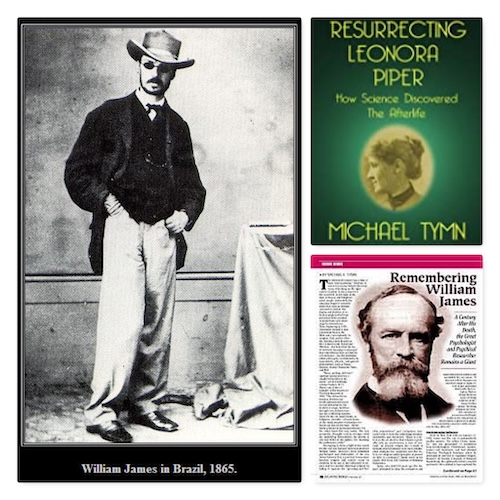
The book, The Varieties of Religious Experience, authored by William James, a Harvard professor of both philosophy and psychology, first published in 1902, and republished many times since, is considered a classic in the field. According to the back cover of my1961 copy, the book is a culmination of Professor James’s interest in the psychology of religion and approaches the study of religious phenomena in a new way – through pragmatism and experimental psychology. To substantiate his own observations and beliefs, James calls upon many great thinkers from the past, including Voltaire, Whitman, Emerson, Luther, Tolstoy, John Bunyan, and Jonathan Edwards. The publishers refer to it as one of the great intellectual achievements of our century.
Strangely and curiously, the book makes no mention of the survival (of consciousness) concern, the very crux of religion. Moreover, there is no mention of Leonora Piper, the Boston medium James discovered in 1885 – the medium he called his “white crow,” the one who proved that all crows are not black. He did his own investigation of her and then arranged for Richard Hodgson, who had been teaching law and philosophy in England, to move to the United States and continue studying her. Hodgson had gained a reputation as a debunker of fake mediums. Hodgson began studying Piper in 1887 and continued studying her, on the average of three times a week, until his death from a heart attack in December 1905.
“During the first few years I absolutely disbelieved in her power,” Hodgson, who earned his doctorate in law at the University of Melbourne, wrote some 12 years into his 18-year investigation of Piper. “I had but one object, to discover fraud and trickery…of unmasking her. Today, I am prepared to say that I believe in the possibility of receiving messages from what is called the world of spirits. I entered the house profoundly materialistic, not believing in the continuance of life after death; today I say I believe. The truth has been given to me in such a way as to remove from me the possibility of a doubt.”
It wasn’t Piper’s integrity or character he questioned during the first few years. It was whether the communications coming through her were from spirits of the dead, as they claimed to be, or from a secondary personality in her subconscious that had the ability to read the minds of others and even tap into a theoretical cosmic reservoir or universal mind for the information coming through her, first by trans-speaking and later by trans-writing. Hodgson and other researchers leaned toward James’s theories. The telepathy theory extended to reading the minds of people not even in Piper’s presence as well as people not known to her. It seemed that any explanation other than “spirits of the dead” was preferred and more appealing to science, which had seemingly impeached religious ideas about a spirit world in the preceding decades.
It was the communication coming from George Pellew (GP), who had died at age 32, that convinced Hodgson, as well as other dedicated researchers, including Frederic Myers, Sir Oliver Lodge and Professor James Hyslop that spirits of the dead were involved. The “GP” personality brought a more complete fullness of personality than other communicators. It was one thing for a medium to tap into another mind or cosmic reservoir for information, quite another for that other mind or reservoir to dialogue with the fullness of a personality rather than just fragmentary bits of information as was the case with most “spirits.”
Over the period of time during which GP communicated, Hodgson brought 150 sitters, 30 of whom were known to GP when he was alive. GP immediately recognized 29 of those 30, the only one not recognized being a woman who was a young girl when he met her. GP greeted each of the 29 by name. The non-recognition of the other 120 was contrary to the telepathic and cosmic soul theories. That is, if GP, or Mrs. Piper’s secondary personality, had been reading minds or searching in some cosmic reservoir, he (she) would have known the names of all of them.
Much Give & Take
“The continual manifestation of this personality – so different from Phinuit or other communicators – with its own reservoir of memories, with its swift appreciation of any references to friends of G.P., with its ‘give and take’ in little incidental conversations with myself, has helped largely in producing a conviction of the actual presence of the G.P. personality, which it would be quite impossible to impart by any enumeration of verifiable statements,” Hodgson explained. “It will hardly, however, be regarded as surprising that the most impressive manifestations are at the same time the most subtle and the least communicable.”
Nevertheless, Professor James continued straddling the fence, mentioning none of it in his 1902 book – absolutely no mention of the Piper phenomena. As the story goes, James asked Hodgson to read the rough draft of his book, and when Hodgson did so he was perplexed that James did not once mention Mrs. Piper or even address the survival issue, and he let James know of his concern. Whether to appease Hodgson or to correct his oversight, James then added a postscript to the book in which he said he felt facts were still lacking for “spirit return,” though he was impressed by the research of Hodgson and other strongly pointing in that direction. “I am baffled as to spirit return,” he wrote. He also admitted that he was willfully taking the point of view of the so-called “rigorously scientific” disbeliever, and making an ad hominem plea, stating that tactically, it is better to believe too little than too much. He further stated that he had said nothing in his book about immortality because “for me it seems a secondary concern.”
Hodgson died on December 20, 1905, at age 50, while playing handball. Although he apparently did not anticipate a premature death, he jokingly told friends that if he were to die early enough he would communicate through Mrs. Piper much more effectively than others had because of his familiarity with the modus operandi. However, it wasn’t as easy as he had anticipated. On January 8, 1906, he communicated with a friend through Mrs. Piper but explained that he was still in the awakening process and it was much more difficult to communicate than he had realized. He needed more time to figure it all out before he could communicate effectively. He was still struggling on June 27 and July 3, 1906 when he communicated through Mrs. Piper with Professor William Newbold, a professor of psychology and philosophy at the University of Pennsylvania. Hodgson greeted Newbold as “Billy,” just as he called him when alive. “I find now difficulties such as a blind man would experience in trying to find his hat,” Hodgson told Newbold. “And I am not wholly conscious of my own utterances because they come out automatically, impressed upon [Mrs. Piper’s brain].” He explained further difficulties that he had not anticipated when he was studying Mrs. Piper.
Hodgson told Newbold that he was present (in spirit) behind him when he was carrying on a conversation with William James a week earlier. He heard James tell Newbold that he (Hodgson) was very secretive and careful. Newbold responded that he did have a talk with Professor James a week or so earlier, but that he didn’t recall James making such a comment. Newbold later asked James about it and James recalled so describing Hodgson in that conversation. As James saw it, there was no way Mrs. Piper could have known about that conversation and therefore the only plausible explanation was supernormal.
Guess Who?
James also sat with Mrs. Piper and heard directly from Hodgson. In an attempt to prove his identity, Hodgson mentioned an incident that took place when he and James were at the Putnam Camp in the Adirondacks. Hodgson was sitting in a chair before the fireplace when little Martha Putnam crept up behind him and put her hands over his eyes, asking him to guess who was there. Hodgson replied, “It sounds like Martha but it feels like Henry Bowditch (a much heavier person).” James remembered the incident. Hodgson asked James if he remembered how he used to play leap-frog and bear with the boys and James definitely remembered those games.
Although Hyslop, a professor of logic at Columbia before becoming a full-time psychologist and psychical researcher, was introduced to psychical research by James and remained friends with him over the years, he wrote, in the November 1919 issue of the ASPR Journal, that “James seem to have confused means and ends in the method of determining ethical truth, and also have wholly missed the basis of scientific truth which may be wider than ethical truth.” He pointed out that James leaned toward polytheism and seemed to have preferred the doctrine of Spiritualism but “he could not openly avow such a doctrine.”
Hyslop does not explain why James couldn’t “avow such a doctrine,” but it is not difficult to infer that it would have invited much disdain from the majority of his colleagues who had already subscribed to the materialistic mindset.
Hyslop continued: “The fact is that he never clearly understood the problem of psychic research. This is clearly proved by his anomalous and paradoxical position in the Ingersoll lecture on the immortality of the Soul, delivered at Harvard University. He had very little to do with the Society’s work, tho (sic) the public thought he had much more to do with it, and after he had rejected the spiritual body doctrine of Swedenborg it was hard to make him see just what the tendencies of psychic research were. He returned to what he ought to have regarded as wallowing in the mire of Hegelianism when he felt a leaning toward the cosmic reservoir theory. But this aside, the main point is that he could never boldly decide between the respectable philosophy of pantheism or monism and the logical tendencies of pluralism which should have taken him with less reverence into spiritism than would be required to convert the materialist.”
William James is one of my favorite people from history, but it seems to me that he continually straddled the fence because he lacked the boldness that Hodgson, Lodge, Myers, and Hyslop displayed.
Michael Tymn is the author of The Afterlife Revealed: What Happens After We Die, Resurrecting Leonora Piper: How Science Discovered the Afterlife, Dead Men Talking: Afterlife Communication from World War I. and No One Really Dies: 25 Reasons to Believe in an Afterlife. His latest book Consciousness Beyond Death: New and Old Light on Near-Death Experiences is published by White Crow books.
Next blog post: November 9

I agree, Michael, that the great William James never got solidly behind the validity of contact between genuine mediums and the departed. I also agree that the GP communications through Leonora Piper rank among the most persuasive evidence that such contact occurs. But his work with Mrs. Piper did indeed affect William James deeply and radically altered his worldview, causing him to break decisively with scientific/materialist reductionism.
Perhaps James’ clearest expression of this altered worldview came in an essay called “What Psychical Research Has Accomplished,” which can be found in his Collected Works. After summarizing in positive fashion the work of the SPR and complimenting by name its key researchers (Myers, Barret, Balfour, Crookes, Stewart, the Sidgwicks, Gurney, Hodgson, etc.), after acknowledging the marvels of the mediumship of Stainton Moses and Leonora Piper, James calls out the knee-jerk refusal of his scientific colleagues to closely examine and seriously consider such evidence of supernormal phenomena. It is in the midst of all of this that James makes his own “confession” of what this examination and consideration have done to his prior reductionist thinking.
“For me, the thunderbolt has fallen, and the orthodox belief has not merely had its presumption weakened, but the truth itself of the belief is decisively overthrown. …My own white crow is Mrs. Piper. In the trances of this medium, I cannot resist the conviction that knowledge appears which she has never gained by the ordinary waking use of her eyes and ears and wits. …As a matter of fact, the trances I speak of have broken down for my own mind the limits of the admitted order of nature. Science, so far as science denies such exceptional occurrences, lies prostrate in the dust for me; and the most urgent intellectual need which I feel at present is that science be built up again in a form in which such things may have a positive place.”
Thanks, Newton, for the additional positive comments. He was probably a 90% believer, but the 10% skepticism kept him only one leg off the fence. Another curious aspect not mentioned above is that James found it strange that spirits had nothing better to talk about than Uncle George’s watch or some other trivial matter. That suggests the James had never read the works of John Edmonds, Robert Hare, Allan Kardec, or Stainton Moses and that he never considered that the trivial was more evidential than the profound. Any thoughts on that? He did mention that Phinuit often talked about more profound subjects, but he said nothing more about what Phinuit had to say.
Michael,
Excellent analysis. I remember (not sure of the article) but Hodgson died on the way to racketball/squash. When he came through he was asked about his missing ring. He said that he had moved it to his small pocket for safe keeping. It was found where he said it would be. Any story which mentions a fellow Australian is a good story and when you mention that he chides James that is when it becomes a great story.
I am rather partial to stories of returning SPR investigators.
Thanks
Bruce
Bruce, as I recall, Hodgson died of a heart attack while playing handball. However, I don’t recall the missing ring matter. As you probably know, there were a number of other veridical messages with William James. The most evidential one involved what would today be a racist word, so I was reluctant to include it.
Michael,
My mind remembered the part -page 13 Proceedings of the Society for Psychical Research Vol XXIII (1909)
“The Ring Incident.
On Hodgson’s 50th birthday, a lady whom I will call Mrs.
Lyman, an old friend of his, much interested in the Piper work,
had given him a rather massive ring to wear. The source of
this ring H. had kept to himself, and after his death Mrs.
L. asked the administrator of his estate to return it to her.
The ring could not be found.
“On January 24th, Mrs. Lyman herself had her first sitting.
As soon as Hodgson appeared he wrote :
The ring. You gave it me on my fiftieth birthday. When
they asked I didn’t want to say you gave it me, I didn’t
want to say that. . . . Two palm-leaves joining each
other—Greek. [Here followed an illegible word. The palms truly described the ring, which Mrs. Piper probably had seen; but it bore no Greek inscription, nor was the symbol on it a Greek cross.] You gave it to me—
Mrs. L. Yes, Dick, where is it now?
They have got it. They took it off my finger after I was gone.
Mrs. L. No, they didn’t find it on your finger.
Pocket, it was in my pocket, I’ll find it you shall have it.
On January 29th, Mrs. L. had another sitting. The Hodgson control
wrote I have been trying to make clear about that ring. It is on my mind all the time. I thought if I could get Margaret B. to get it for me, I would get it to you through her, then no one would understand. I could not tell Miss Pope about you.”
I know the word that is racist starting with n so best left out.
Thanks,
Bruce
William James gives a clue as to the reason for his ambivalence on personal survival at the outset of his classic Ingersoll lecture on Human Immortality:
I suspect that most readers of this blog have a “pungent craving” for the hereafter, a keen interest, nay even an “obsession” as James put it. Many spiritual people have an understandable indifference to the subject of personal survival. They have achieved a level of selflessness whereby the disposition of their personal ego after death is a matter of little or no concern. I, at one time dreaded the thought of being shackled for an eternity within the cramped confines of my own personal quirks and limitations. I was not an easy convert to a belief in the survival of the human personality but, as more than one intrepid explorer in the field put it, “the facts beat me.”
As the philosopher David Hume famously said: “Reason is, and ought only to be the slave of the passions”. Clearly, the primary thrust of James’ passion was directed elsewhere than the final disposition of the human identity.
David, thanks for that. I don’t recall when his Ingersoll lectures began, but it is my understanding that his 1902 book was a collection of them. While he says in the postscript prompted by Hodgson that he had always considered immortality as a secondary objective, he doesn’t quite define the primary objective. I’m guessing morality and a more humanistic worldview, but I don’t see the foundation of religion or the humanistic view without survival……As I mentioned in response to another comment, James also said he didn’t understand why all the messages were so trivial, such as with Uncle Jerry’s watch, seemingly disregarding the fact that the trivial are more evidential than the profound and overlooking all the profound messages coming from Judge Edmonds, Allan Kardec, and William Stainton Moses. He also mentioned that Phinuit sometimes gave long lectures going beyond the trivial, but doesn’t say what he talked about.
Michael, I attended a 3-day workshop in NYC with experts on William James.
Many said that his father who educated his children by sending them on
trips to Europe not in schools always said when you make a decision about
something make certain that you know for certain why you have made this
decision. They also felt that James had a fear of displeasing his father and so
he was ambivalent most of his life about many things.
FYI Blessings Karen
Special thanks to Newton for completing the picture. It’s clear to me that James decisively rejected materialism.
I share your analysis. I have great admiration for your work. I have studied the story of Mrs. Piper. I wrote a book about her. https://www.amazon.com/dp/B0BP44TD92
Thanks, Jean. I wasn’t aware of your book(s). I just ordered Kindle copies of the Piper book and the more recent survival book. Look forward to reading them.
Thank you. That’s very kind. Good reading.
Michael et alia,
I like “Another curious aspect not mentioned above is that James found it strange that spirits had nothing better to talk about than Uncle George’s watch or some other trivial matter.” I had an aunt-in-law appear for years. Each time, I asked her for evidence to convince the family. Trivial matters unknown to me but evidential. Credibility to convince that it was not my message.
I saw the various spiritual teachings as meaningful only when they produced sufficient evidence to prove who they were. When Hodgson returned and provided evidence to Hyslop, a comment resonated with me. It might resonate with others.
Rector explained to Hyslop that Hodgson had spent too much on the technical side of providing evidence for survival and had not balanced it with spiritual thinking.
Your blog has a great balance of the congregation who provide this balance of thinking. I would imagine that, should the virtual (note I didn’t say virtuous) members ever meet together, they would gather into small groups with common thinking, evidence, and spirituality.
Each of your articles illuminates different aspects of the afterlife.
Thanks
Bruce
Nice comment, Bruce. Imperator’s credibility as a spiritual teacher is, for me, greatly enhanced by his repeated admonition that we judge the words of the departed, communicated through mediums, in precisely the same way we would judge the words of living human beings. It would be a great mistake, Imperator cautions, to put more stock in a spiritual teaching simply because it came from someone, who knows who, on the other side. Thus while Imperator gave the supernormal phenomena of mediumship their due as necessary to attract attention and uproot mindless materialism, he regretted that these phenomena often overshadowed the substantive teachings to which they served only as preludes.
Newton,
I have been following Imperator for years. I have an extensive analysis and have the following opinion. I would like to know if it matches yours.
Imperator is the head of operations, directing the training of mediums such as Moses Piper, etc. (termed lighthouses as opposed to regular mediums termed lights),
Rector conveys the message with Prudens keeping the telephone line open (as Hyslop described) free from Frustrators. So the team, as Piper’s controls described it, was “Prudens as guide, Rector, and Imperator called on for help.” The team called themselves the Messengers.
I have always told people to assess messages on the same level, whether it comes from a spirit or a person. Some spirits are closer to God than others, but they should not be blindly believed.
Thanks
Bruce ( a congregation is those who congregate and my pew is firmly Imperator)
Yes, Bruce, I see things much the same way. The angels, as I prefer to call them, are departed human spirits who apparently interact with our world in teams. On this side, we choose, in one way or another, the angelic voices we listen to and are influenced by. I think your light vs. lighthouse distinction is useful shorthand for distinguishing those mediums who open our minds from those who bring spiritual ideas into them.
Newton,
The distinction is not mine but Imperator. When he was describing the mediums that they used they were describing the ones where training separated out lights from lighthouses. The training in Moses case was theology; Mrs. Piper was placed under the control of the team, with restrictions placed on Hodgson for any medium work. My research was looking at their selection process of mediums. It is very interesting.
Thanks,
Bruce
Newton,
A correction to where the term lighthouse came from. My mistake was thinking it was direct from Imperator, but it’s about the Imperator method. It came from Myers.
“The discarnate spirit seeking to talk to earth sees a “light”—a glimmer of translucency in the confused darkness of our material world. This “light” indicates a sensitive. . . . Even in such fashion, through Mrs. Piper’s trances the thronging multitude of the departed press to the glimpse of light. Eager, but untrained, they interject their uncomprehended cries; vainly they call the names that no man answers; like birds that have beaten against a lighthouse, they pass in disappointment away.
It is our duty to search for and train such other favored individuals as already show this form of capacity for mediumship. . . .
Myers, National Review, 1898, p. 240
Myers wrote this in 1898, a year after the Imperator band took charge of Mrs. Piper. He takes over their word “light” and builds the lighthouse out of it.
Thanks
Bruce
While looking for the essay that Newton mentioned in the works of William James, I came across his essay “On a Certain Blindness in Human Beings” which relates to my earlier comment with respect to James’ ambivalence with respect to the hereafter. Here are a few snippets:
We need a world where there are people one-pointedly focused on so-called practical matters, while others write songs and tell stories and ponder the great mysteries of life. The heart leads and the mind follows.
David, thanks for those additional quotes. However, I struggled to interpret them and apply them to the “boldness” concern. How James could say that the survival aspect is “secondary” to the other concern is mind-boggling to me. No doubt the humanists of the world would agree with him and it may well be that those who don’t agree with him on that matter simply aren’t advanced enough. That includes me. On to another subject.
Michael – While to you and me survival is a high level of concern and interest for us, James made it clear that he did not share “a pungent craving” as motivated Myers and some others in the SPR to put their reputations on the line for a field on the margins of scientific research. Even in this day and age, with all of the legacy research on mediums, NDEs, deathbed visions, etc., there are very few scientists (and especially psychologists) willing to challenge the dogma around “mind is what the brain does” and advocate survival as a proven fact.
According to his own testimony, James didn’t so much lack boldness with respect to advocating survival as he lacked interest in investing the enormous energy required to confront the indifference and resistance of his colleagues. That takes passion, a real fire in the belly, and evangelical fervor that a man of James’ melancholy disposition would find difficult to summon.
“The Varieties of Religious Experience” fails to acknowledge Spiritualism as one of the varieties, and that is a much more egregious omission than the singularly uninspiring (though evidential) communications transmitted via Piper.